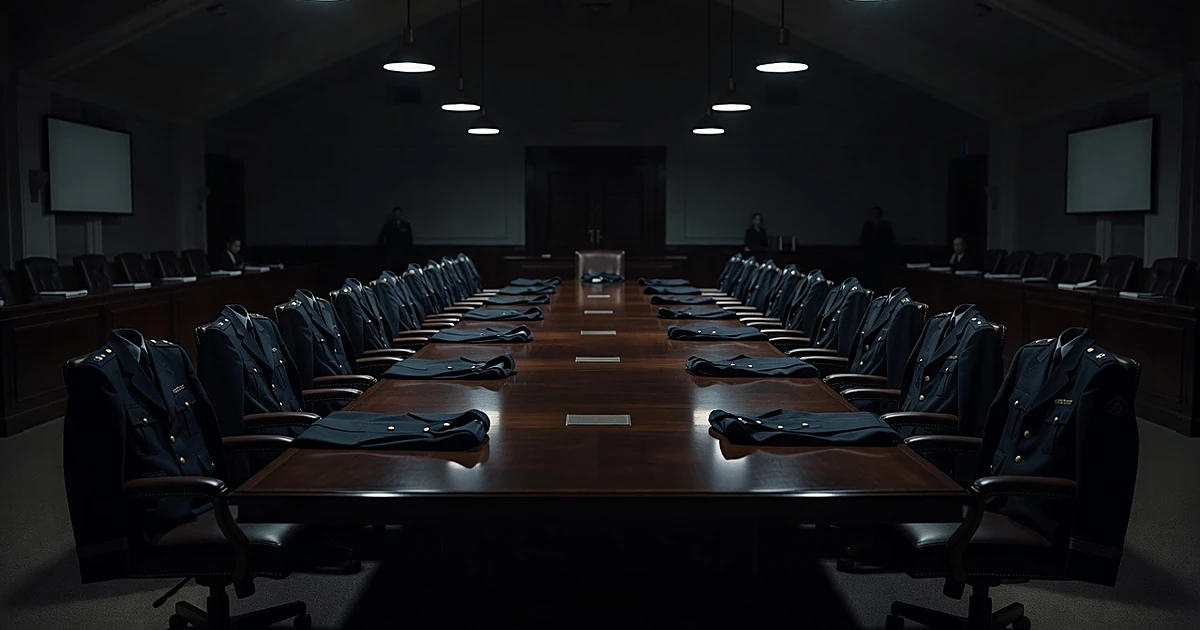




Defense Secretary Pete Hegseth’s plan to slash 20 percent of admirals and generals is drawing a cool response from senators who say they still lack his detailed rationale.
Hegseth publicly confirmed the cuts Wednesday in a 52-minute address to active-duty officers at Marine Corps Base Quantico in Virginia, framing the move as overdue accountability rather than the “purge” label he said the media prefers. Service branches have been asked to carry out the reductions by Jan. 1 next year, with some positions downgraded instead of eliminated.
The Hill reported that defense-focused lawmakers from both parties reacted with caution or open criticism, and several Republicans said they had not yet seen a full framework for the 20 percent figure.
The plan lands a year after Hegseth oversaw a prior 10 percent reduction of general officers. Since taking over at the Pentagon, he has also fired or pushed out more than two dozen senior military officers and blocked dozens of promotions across the Army, Navy, and Air Force.
Hegseth rejected the purge framing outright and cast the shake-up as a culture fight.
In the Quantico speech he told officers:
"Now the media calls that a purge. I call it accountability and long overdue, and frankly, the bare minimum. As usual, what the media levels as an accusation, I wear as an accomplishment."
He added that personnel decisions drive policy at every level.
"You see, you can’t change a culture with the same people who enabled it. Personnel is policy at every single level."
Hegseth also said last year’s Quantico remarks were aimed at the force’s backbone, not the top brass then in the room. His office did not respond to a request for comment. Allies maintain he does not weigh skin color or gender in these decisions, a point that sits against Democratic claims that women and people of color now feel stalled.
The address itself has drawn related attention, including earlier guidance that only fit, sharp-looking troops should attend Hegseth’s high-profile Pentagon speech.
Even some GOP senators who back a leaner military said they are waiting on details.
Sen. Ted Budd (R-N.C.) put it plainly:
"No, I certainly want to see his rationale in detail, and I don’t have that yet."
Sen. Deb Fischer (R-Neb.) kept the focus narrow when asked about the cuts.
"We are focused [on] what we are doing today."
Sen. Mike Rounds (R-S.D.) said late Tuesday he had only heard about the forthcoming cuts in news coverage and had not received a Pentagon briefing.
"I don’t know what his plan is."
Senate Armed Services Committee Chairman Roger Wicker (R-Miss.), approached Wednesday, answered by singing lines from Alfred Tennyson’s “Ulysses” about a port, a vessel, and mariners who had toiled with him, then offered no policy comment on the record.
Sen. Rick Scott (R-Fla.), a former Navy radarman and Trump ally, said he had not seen the plan either. Still, he backed the broader efficiency case.
"but as a general rule, I think most organizations have become top-heavy, and so I think as part of what he’s doing to look and make sure we have the most efficient military, we don’t waste our money."
That mix of caution and conditional support tracks other recent Republican hesitation around the defense secretary, including moments when Sen. John Kennedy stopped short of backing Hegseth.
Senate Armed Services ranking member Jack Reed (D-R.I.) spoke to reporters late Tuesday, before the plan was formally announced, and called the approach arbitrary.
Reed said the cuts will “add further disruption and confusion to the military forces, and he offered no framework for his decision. It seemed to be arbitrary, and it’s going to cause harm rather than help” the military.
Sen. Elissa Slotkin (D-Mich.), a former CIA analyst, used the word “purge” and described what she said she was hearing from inside the department about morale, especially among promising officers who are people of color or women and who fear being treated as DEI cases no matter how strong their records.
"And what I’ve been hearing from people inside the department is just how bad morale is. How many folks in uniform, extremely promising people, who are people of color or women just feel like there’s no way they’ll ever get ahead; that they’ll always be perceived as a DEI case, no matter how fantastic a job they do."
Slotkin also drew a line between private GOP frustration and public courage.
"I mean, I think there’s a lot of frustration under the surface, but there’s a big difference between private frustration and public courage."
Sen. Richard Blumenthal (D-Conn.) called the method “very draconian” and said Hegseth had not come to Congress “which he is obligated to do.” He went further on motives.
"Second, he is putting political loyalty above merit in reducing the number of officers."
Blumenthal added there may be a need to reduce officer ranks, “but there’s no evidence that he’s conducted any kind of systematic or intelligent or strategic oversight, either in the number or the specific individuals, beyond just personal discrimination.” He said Congress would push back harder if Democrats take the majority.
Rep. Chrissy Houlahan (D-Pa.), an Air Force veteran on the House Armed Services Committee, argued that cutting general officer posts gives the secretary more sway over who rises. She posted on X:
"These service members have dedicated their lives to protecting our nation and we owe it to them to have a SecDef that respects their careers, honors their service and applies their expertise to the challenges facing us today."
The 20 percent proposal is not Hegseth’s first personnel fight. The earlier 10 percent cut, the more than two dozen senior officers already removed, and the blocked promotions form the backdrop senators are reacting to now.
Those earlier steps include specific promotion freezes, such as when Hegseth halted promotions of four Army officers tied to recently ousted generals.
A Senate Republican source, speaking Monday, raised a separate Hill concern: that the secretary “is not being upfront with the president, and we all feel very much that the secretary has put the president in a very bad place with Iran.” Military leaders serve at the pleasure of the president, and allies of Hegseth stress that the final call rests there.
Iran and command-structure friction have already shown up in coverage of how the White House handles briefings, including reports that Trump shifted focus to Treasury Secretary Bessent in Iran briefings.
Political pressure on Hegseth has also come from inside the GOP conference itself, most sharply when Massie blindsided Republicans with an impeachment push against the defense secretary.
Senators still do not have a written framework explaining why 20 percent is the right number, which billets will vanish versus which will be downgraded, or how the January deadline will be met without the disruption Reed warned about. Blumenthal’s claim of a legal duty to consult Congress was stated without a cited statute in the reporting. Internal morale accounts Slotkin relayed remain attributed to unnamed people inside the department.
Hegseth’s public case is simpler: the force is top-heavy, culture does not change if the same enablers stay in place, and accountability is the point. Scott’s efficiency argument tracks that view. Budd, Rounds, and Fischer are not rejecting the goal; they are withholding a blank check until the rationale lands on their desks.
Taxpayers fund a military that must win wars, not protect an inflated flag-officer layer. If the plan is real accountability, Congress can demand the matrix and then judge the results, not freeze the brass in place because Democrats prefer the old roster.