
Dean Tavoularis, the production designer whose work defined the visual language of some of the greatest American films ever made, from The Godfather to Apocalypse Now, died Wednesday of natural causes in Paris. He was 93.
His death was reported by Jordan Mintzer, a writer and film critic for The Hollywood Reporter who co-authored the 2022 book Conversations with Dean Tavoularis. Deadline confirmed the news, detailing a career that stretched across four decades and left an unmistakable mark on American cinema.
Tavoularis won the Academy Award for art direction and set decoration for 1974's The Godfather: Part II and earned four additional Oscar nominations, for Apocalypse Now (1979), The Brink's Job (1978), Tucker: The Man and His Dream (1988), and The Godfather Part III (1990). His collaboration with director Francis Ford Coppola was one of the longest and most productive partnerships in Hollywood history.
Coppola released a statement after learning of Tavoularis' passing.
"My dear friend and collaborator Dean Tavoularis has passed, a profound loss. I would be unable to list the many ways he benefited my work and my personal life. He was a great artist, a great friend, a great Production Designer and a great man."
Those words carry weight from a man not given to empty praise. Coppola and Tavoularis worked together on more than a dozen films spanning nearly three decades, a run that included some of the most visually ambitious productions in the history of the medium.
Tavoularis was born May 18, 1932, in Lowell, Massachusetts, to a Greek immigrant family. He grew up in Los Angeles and studied at art schools there before landing his first professional work in the animation department at Disney Studios, where he served as a storyboard artist.
His break into live-action filmmaking came in 1967, when director Arthur Penn hired him to oversee the artistic direction of Bonnie and Clyde, starring Warren Beatty and Faye Dunaway. That film reshaped American cinema, and Tavoularis was the man who built its world.
Penn brought him back in 1970 for Little Big Man, starring Dustin Hoffman. That same year, Tavoularis worked on Michelangelo Antonioni's Zabriskie Point. He was already establishing himself as a designer who could move between vastly different visual registers, from Depression-era Texas to the American West to the surreal landscapes of European art cinema.
The leap came in 1972. Tavoularis' work on The Godfather, alongside cinematographer Gordon Willis, established the film's iconic look, the dark interiors, the amber light, the heavy wood and old-world textures that made the Corleone family feel both mythic and real.
It was the beginning of a creative partnership with Coppola that would define both men's careers. Tavoularis followed The Godfather with The Conversation in 1974, then took home the Oscar that same year for The Godfather: Part II.
Then came Apocalypse Now in 1979, a production legendary for its chaos, its ambition, and its visual grandeur. Tavoularis earned another Oscar nomination for that film, designing sets in the Philippine jungle that remain among the most striking images in cinema.
Tavoularis kept working with Coppola through the 1980s and into the 1990s. The list reads like a film-school syllabus: One from the Heart (1981), The Outsiders (1983), Rumble Fish (1983), Peggy Sue Got Married (1986), Gardens of Stone (1987), the "Life Without Zoe" segment of New York Stories (1989), and Jack (1996).
He also worked beyond the Coppola orbit. Wim Wenders hired him for Hammett in 1982. Warren Beatty brought him aboard Bulworth in 1998. Roman Polanski tapped him for The Ninth Gate in 1999. Nancy Meyers enlisted him for The Parent Trap that same year. And he later designed Roman Coppola's CQ.
The range of that filmography tells you something. Tavoularis wasn't a specialist locked into one genre or one director's vision. He could build a Mafia compound in Sicily, a war zone on the Mekong Delta, or a summer camp for a Disney family comedy, and make each one feel completely lived-in.
Tavoularis met his wife, French actress Aurore Clément, on the set of Apocalypse Now. She survives him, along with their daughters, Alison and Gina.
He spent his later years in Paris, far from the Hollywood machine. That choice seems fitting for a man whose work was always about the physical world, about rooms, streets, light, and texture, rather than about the industry's relentless self-promotion.
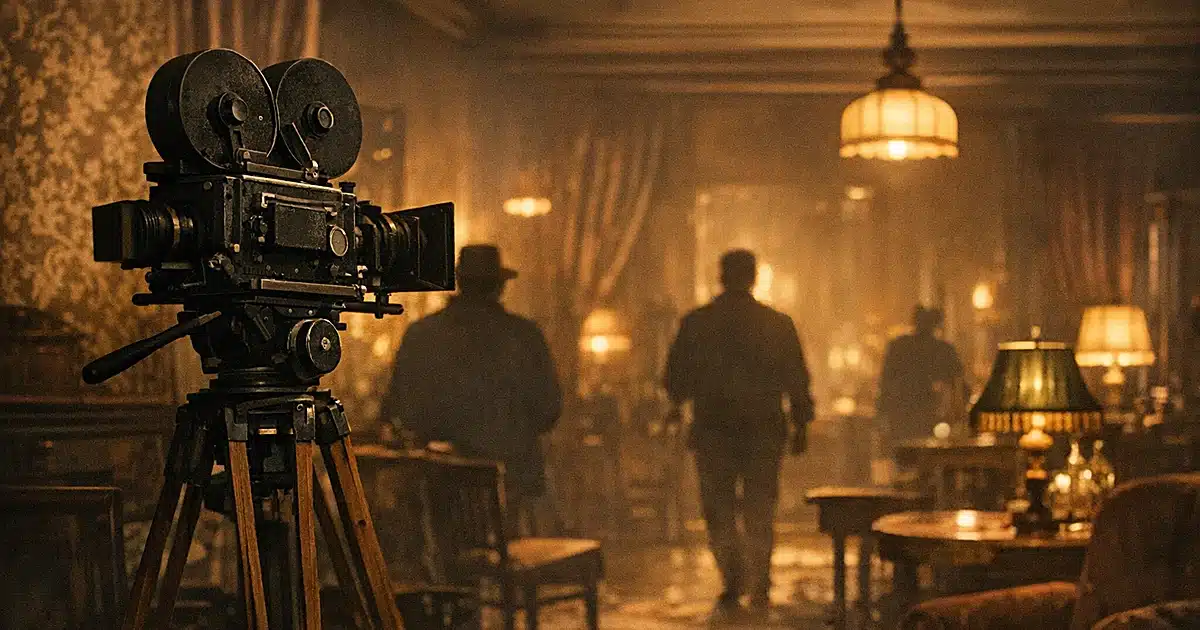
In an era when production design increasingly means green screens and digital rendering, Tavoularis belonged to a generation that built things with their hands. The sets he created for The Godfather weren't generated in a computer. They were constructed, dressed, and lit by craftsmen who understood that the physical environment tells the audience what kind of story they're watching before a single word of dialogue is spoken.
Five Oscar nominations. One win. A body of work that includes at least half a dozen films routinely placed among the greatest ever made. And a partnership with Coppola that produced a visual vocabulary Americans have absorbed so deeply they don't even realize it came from somewhere.
Hollywood doesn't make men like Dean Tavoularis anymore. That's not nostalgia, it's an observation about what happens when an industry trades craft for spectacle.