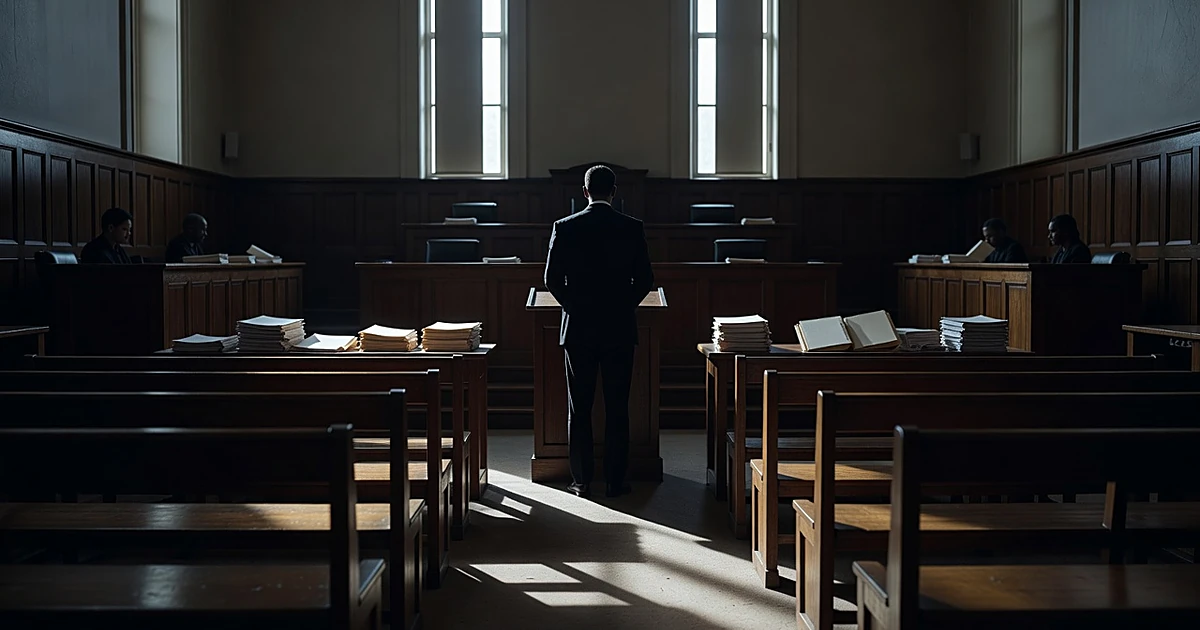
A gunman opened fire at the Washington Hilton on April 25, 2026, turning the White House Correspondents' Dinner into a crime scene, and turning a harsh spotlight on how a man armed with a shotgun, a handgun, and multiple knives got close enough to threaten the president of the United States and hundreds of guests inside a ballroom with no magnetometers at its doors.
In the days since suspect Cole Allen allegedly charged toward the security perimeter, attendees, lawmakers, and security professionals have offered accounts that paint a troubling picture: a prestigious annual event where a paper ticket was the primary credential, the hotel lobby had no screening checkpoint, and the building remained open to the public even as the commander-in-chief sat inside.
The Secret Service and D.C. police say their plan worked. The people who were in the room say the plan had holes big enough to walk a shotgun through.
Misha Komadovsky, a journalist for Germany's DW, shared a photo on X of the paper ticket attendees used to enter the event. She called it "the only thing required" and wrote on the platform that there "was no security screening prior to entering the lobby."
Harrison Fields, a former White House principal deputy press secretary who attended the dinner, told "FOX & Friends" there were "no checkpoints to get into the hotel." Fields said the gunman could have been "roaming" the venue and observing attendees before the shooting began.
His description of the layout was pointed:
"There was a VIP reception right off the main ballroom where [Cabinet secretaries] were, where the president could have been, and there was no security apparatus leading up to that point."
Fields acknowledged that the Secret Service and local law enforcement "took immediate steps to keep us safe" once shots were fired. But he said there was "no real buffer" in place beforehand, a distinction that matters when the threat arrives before the response.
Rep. Mike Lawler, R-N.Y., posted on X cataloging what he described as "glaring security issues." His list was specific: no photo ID requirement, no verified attendee list, no magnetometers before entry to the ballroom, multiple pre-event receptions with limited security that created potential access points, and a building that remained open to the public throughout the evening.
Lawler said the gunman moved from his hotel room into what the congressman described as a secure area carrying multiple firearms. He credited the Secret Service and federal law enforcement for having "acted swiftly" to secure the ballroom and move President Donald Trump and other officials to safety. But he called for a "complete and thorough after-action" review, the kind of demand that only gets made when something went wrong.
The incident is far from the first time protective-service failures have drawn public scrutiny. Earlier this year, a man was tackled by Secret Service after attempting to scale the White House perimeter fence, raising similar questions about how close threats can get before they are stopped.
Officials identified the suspect as Cole Tomas Allen, 31, of Torrance, California. He had traveled cross-country, booked a room at the Washington Hilton, and was allegedly armed with a shotgun, a handgun, and knives, AP News reported. That hotel reservation appears to be the key to how Allen bypassed the outermost security layer: officials said he was believed to have entered the hotel because he was a registered guest.
Guests attending the dinner itself had to pass ticket checks and magnetometers staffed by the Secret Service and TSA. But surveillance footage showed Allen running past officers as metal detectors were being disassembled after President Trump was already seated inside the ballroom. Once the president was in place, no additional attendees were supposed to enter the secured area, and the Secret Service maintained a separate inner perimeter with counter-assault agents.
That inner perimeter held. The outer layers did not.
Eyewitness Erin Thielman described the moment Allen was stopped. She told the New York Post she heard three gunshots and saw Secret Service agents with pistols drawn as they took down the suspect near the security perimeter outside the ballroom.
"Like right in front of me, he was a foot away."
Thielman said Allen fell face-first after attempting to charge through the perimeter. A foot. That is the margin that separated a security success from a catastrophe.
The pattern of armed individuals getting dangerously close to protected sites has become disturbingly familiar. President Trump himself has addressed a Mar-a-Lago intruder incident in which Secret Service agents killed a man attempting to breach his Florida property.
Secret Service Director Sean Curran defended the agency's performance. "It shows that our multi-layered protection works," Curran said. Interim D.C. police chief Jeffery Carroll echoed that assessment, saying the security plan for the evening was developed by the Secret Service and "that security plan did work this evening."
Those statements are technically accurate in the narrowest sense: the president was not harmed, and the suspect was stopped. But they sidestep the question attendees keep raising, how did a man with a shotgun, a handgun, and knives get from a hotel room to a point one foot from dinner guests at an event attended by the president, Cabinet secretaries, and members of Congress?
A plan that "works" only because agents had to draw weapons and tackle a gunman at point-blank range is not the same as a plan that prevents the threat from materializing in the first place.
Sen. John Fetterman, D-Pa., offered a blunt assessment that crossed party lines:
"We were there front and center. That venue wasn't built to accommodate an event with the line of succession for the U.S. government."
The Washington Hilton has hosted the White House Correspondents' Dinner annually since 1968. Fetterman's point was not about the building's architecture but about the gap between the event's security posture and the concentration of government power inside its walls.
Kari Lake, a Trump ally who attended the dinner, was more direct. She wrote on X that "security was terrible at the event" and added a detail that should trouble anyone responsible for protecting the president:
"It was the easiest event I've ever gained access to that the president was at. It was so bad we talked about it at our table before the shots rang out."
When guests at a presidential event notice the security is weak before a shooting starts, the after-action review has already written its own executive summary.
ABC News reporter Beatrice Peterson, who wrote on X that she has attended the dinner for more than a decade, described the crowd and security presence as "typical-ish." She noted that pre-event gatherings tend to be more fluid, while the dinner itself is typically more tightly controlled. Peterson said multiple investigations are expected and that the incident could permanently change how the event is handled.
That observation, "typical-ish", may be the most damning word in the entire conversation. If the security posture that allowed a man with a shotgun to reach the perimeter was typical, then the problem is not a one-night lapse. It is a structural failure baked into how Washington stages its most self-congratulatory evening.
Broader questions about security lapses across government institutions continue to mount. Separately, concerns have emerged about military personnel leaking sensitive deployment details, underscoring a pattern of operational vulnerability that extends well beyond any single event.
Photo captions from the scene show U.S. Ambassador to the United Nations Michael Waltz and his wife, former Homeland Security Advisor Julia Nesheiwat, being rushed out of the Washington Hilton. Police and National Guard stood in front of the hotel after the dinner was postponed. First Lady Melania Trump and Second Lady Usha Vance had delivered remarks at the First Lady's Luncheon in the same ballroom just days earlier.
Lawler's call for a thorough review is the minimum. The questions are straightforward: Who decided a paper ticket was sufficient credentialing for an event attended by the president? Who approved a plan that left the hotel open to the public? Who signed off on disassembling magnetometers while the president was still in the building?
Ted Williams, a former D.C. homicide detective, told Fox News that the overcrowded ballroom left high-profile dignitaries and journalists as "sitting ducks" during the evacuation. That phrase should bother everyone who was in the room, and everyone responsible for the integrity of protective-service operations at the highest levels of government.
When the people tasked with protecting the president declare victory because the gunman was tackled one foot from the crowd, the rest of us are entitled to ask what happens when the margin is zero.