


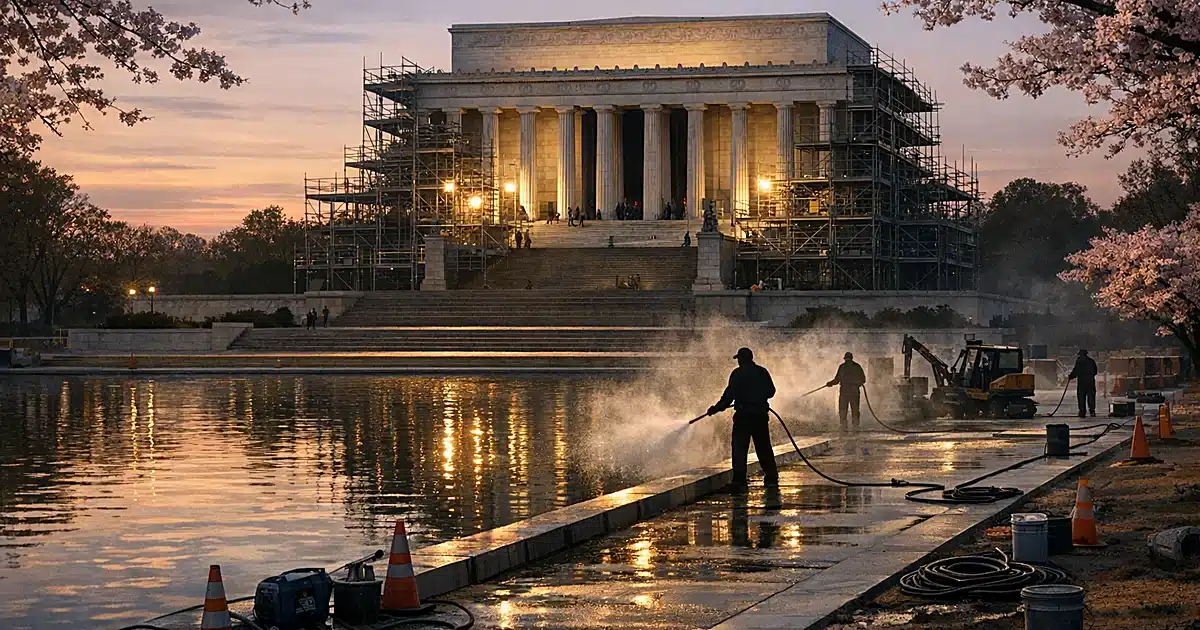
Broken fountains are running again in Washington, D.C. The Lincoln Memorial Reflecting Pool, built in 1922 and long overdue for serious work, is getting a fresh coat of paint. And some of the people applauding loudest are not Republicans.
President Donald Trump's effort to revitalize the nation's capital ahead of America's 250th birthday has drawn public praise from Democratic operatives and liberal commentators, a rare concession from figures who spend most of their time opposing the administration. Breitbart reported that several Democrats reacted favorably to the visible improvements now taking shape across the city's parks and monuments.
The praise matters not because the left has suddenly warmed to Trump. It matters because it reveals how badly Washington had been neglected, and how little the city's own political class did about it.
Carter Christensen, a communications strategist for ActBlue, the Democratic fundraising giant, posted on X about the Meridian Hill Park fountain being restored to life. His reaction was blunt.
"Cannot believe it's taken this long, but this truly makes me so incredibly happy to see."
Anthony LaMesa, identified as a Trump critic, offered similar acknowledgment after fountains in Lafayette Park near the White House were turned back on.
"Credit where credit is due. The Trump administration is finally fixing fountains around Washington, DC that have been out of order for many years."
Those are not minor admissions. LaMesa's phrasing, "finally fixing" and "many years", points directly at the failure of prior administrations and the local government to maintain basic public infrastructure in the capital of the most powerful country on earth. Christensen's disbelief that "it's taken this long" carries the same implication.
Fox News reported that the National Park Service said nine fountains are being rehabilitated and returned to service, with nine more slated for maintenance and system upgrades. Tré Easton, vice president of the Searchlight Institute, went even further on X, calling the restoration work the "best thing this administration has done and it's not even close."
When a progressive think-tank official calls a Trump project the best thing the administration has done, without qualification, it tells you something about the scale of prior neglect.
The most striking detail in the president's own account involves the Lincoln Memorial Reflecting Pool. In a video posted by the White House on Thursday, Trump said officials initially told him renovating the pool would cost $300 million and take three years.
Three hundred million dollars. For a reflecting pool.
Trump said he contacted people he knew who worked on swimming pools. Their estimate: $1 million to $2 million. He said the paint would last 40 to 50 years. Interior Secretary Doug Burgum shared an image of crews painting the pool and wrote that "The Reflecting Pool is about to look better than ever!"
The gap between $300 million and $2 million is not a rounding error. It is the kind of spread that taxpayers have learned to expect from federal contracting, and the kind that rarely gets challenged by the permanent bureaucracy. Trump's account, if accurate, suggests that a straightforward maintenance job was being priced like a moonshot. The president said he tried to save money while working on such projects, and the pool anecdote is the clearest example he offered.
The administration has shown a willingness to confront institutional inertia on multiple fronts, from shaking up federal boards to challenging bloated cost estimates on infrastructure. The D.C. beautification push fits that pattern.
The fountain and pool projects are part of a broader effort. Trump recently unveiled a rendering of a triumphal arch he plans to build in the Washington, D.C. area. The construction and landscaping work is explicitly tied to the nation's upcoming 250th birthday, a milestone that will draw visitors from around the world and put the capital's condition on full display.
White House spokeswoman Taylor Rogers framed the effort in a statement to Fox News:
"President Trump's common sense efforts to make D.C. safe and beautiful again are so popular that even Democrats are publicly praising the President for these much-needed and long-overdue renovations. Our nation's capital will look more spectacular than ever before for America's 250th birthday all thanks to President Trump!"
Rogers's statement leans into the bipartisan praise, and for good reason. When your political opponents concede you're right, the point lands harder than any press release.
The D.C. revitalization is one of several fronts where the administration has drawn reactions, both supportive and critical, from unexpected quarters. Some Democrats have found themselves conceding points to the president even as they search for new lines of attack.
Washington, D.C. is not a forgotten rural county with a shoestring budget. It is the seat of the federal government, home to some of the most visited monuments and memorials in the world, and a city that receives enormous federal attention and funding. The fact that its fountains sat broken for years, that the Reflecting Pool, a 103-year-old national landmark, needed a president to personally intervene on cost, and that basic landscaping had visibly deteriorated is an indictment of the people who were supposed to be in charge.
That includes local D.C. leadership, the National Park Service under prior administrations, and every member of Congress who walked past a broken fountain on the way to the Capitol and did nothing. The neglect was bipartisan in origin, but the fix is coming from one direction.
The president has faced no shortage of internal and external friction during his term, from personnel disputes within the Pentagon to ongoing foreign policy negotiations. But the D.C. beautification effort is a case where results are visible, concrete, and hard to argue with.
Even the triumphal arch, which Fox News noted has drawn some Democratic criticism, exists alongside the fountain and pool projects that those same critics are now praising. The administration is producing tangible improvements to the city's public spaces, improvements that residents and visitors can see and touch.
Trump's claim about the $300 million estimate for the Reflecting Pool renovation raises questions that go beyond one project. Which officials gave that estimate? What agency or contractor produced it? Was it a formal bid or an internal projection? The president's account suggests a massive disconnect between government cost estimates and market reality, but the specific details remain thin.
If the pool work is indeed being completed for somewhere between $1 million and $2 million, a fraction of the original figure, that story deserves rigorous follow-up. Federal cost overruns are not a new problem, but a 150-to-1 ratio between the initial government estimate and the final price tag would be extraordinary even by Washington standards.
The administration has been willing to challenge entrenched processes across the government, including internal debates on surveillance renewal and restructuring at federal agencies. The D.C. projects may be the most visible example of what happens when someone actually questions the first number they're given.
The Democrats praising Trump's D.C. work are not switching parties. They are not endorsing his agenda. They are doing something simpler and, in today's political climate, rarer: acknowledging that a broken fountain got fixed and that the guy who fixed it deserves credit.
That acknowledgment is worth noting precisely because it is so unusual. Washington's political culture rewards opposition for its own sake. When an ActBlue strategist and a self-described Trump critic both say the administration did something right, the underlying facts must be difficult to deny.
The monuments and parks of Washington, D.C. belong to every American. They are not partisan property. They are supposed to reflect the best of the country, its history, its ambition, its respect for the people who built it and defended it. For years, those spaces were allowed to decay under the watch of people who had every resource to maintain them and chose not to.
It took a president who thinks like a builder to notice that the fountains were off, the pool was cracking, and the price tags were absurd. The fact that even his critics can see the difference tells you everything about who was paying attention, and who wasn't.