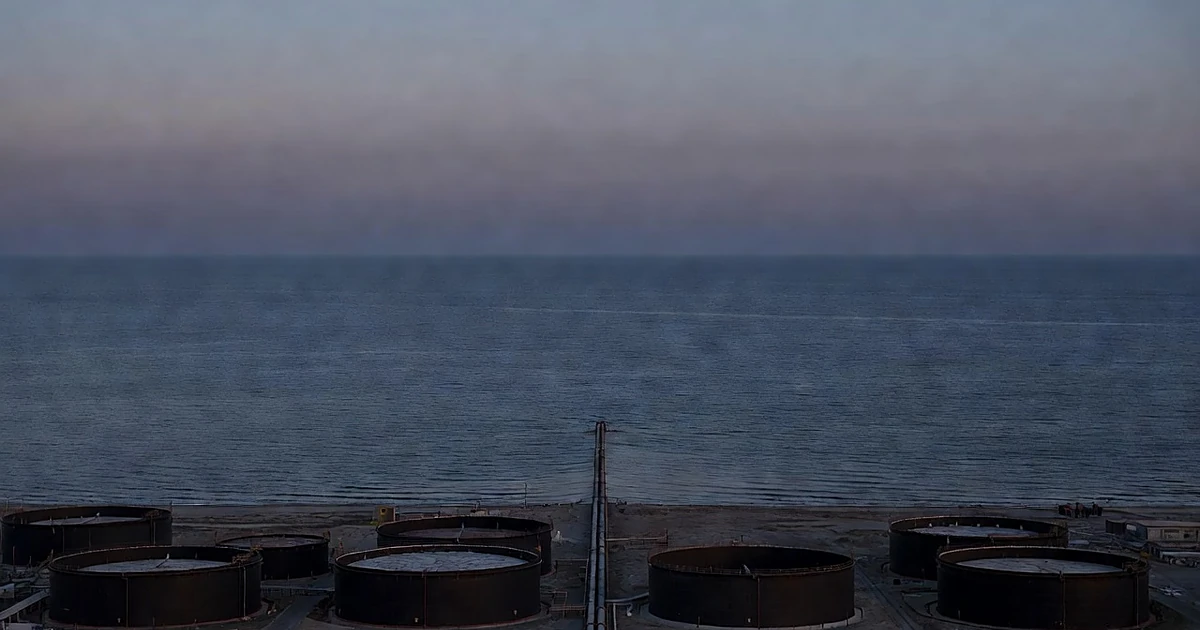





Treasury Secretary Scott Bessent says Iran will have no oil on the water and no revenue this week for the first time in history, as Tehran warns of a deepening economic crisis under U.S. pressure.
Bessent laid out the claim on the Axios Show Saturday, framing it as the payoff from a deliberate three-stage campaign that combined military strikes, a naval blockade, and sweeping economic isolation.
“For the first time in history, since they started pumping oil, they will have no oil on the water this week,” Bessent said. “They will have no revenues.”
He described the sequence in plain terms. First came kinetic strikes that he said destroyed Iran’s navy and air force, substantially depleted its drone and missile stocks, and wrecked its ability to rebuild them. Next came what President Trump calls the Iron Wall, a naval blockade that stops Iranian oil exports while letting international traffic through the Strait of Hormuz. Then came Operation Economic Outcast, the isolation drive now underway.
“Right now, the score, in terms of barrels out of the strait: U.S. about 1.1 billion, Iran zero,” Bessent added.
War Secretary Pete Hegseth reinforced the picture the same day. He said Iran has gotten nothing through the blockade and that U.S. forces are running traffic through the strait near prewar levels every night.
“Iran wants to play games with things like the Strait of Hormuz. They don’t control it. We do,” Hegseth said. “They have literally gotten nothing through. Our blockade’s been ironclad.”
Energy Secretary Chris Wright said Sunday that supplies moving through Hormuz have continued to rise in recent weeks. Goldman Sachs analysts put Persian Gulf oil exports at roughly 23.3 million barrels per day over the past week, a sign the choke point is open for everyone except Tehran.
Bessent had predicted the final cargoes would clear soon. About 15 million barrels loaded before the blockade remained aboard tankers last weekend, most headed to China. Once those deliveries finish, he said, Iran would have nothing left to trade.
Fox News reported Bessent’s earlier warning that those last shipments would leave Tehran empty-handed within roughly two weeks, locking in the zero-revenue week he now says has arrived.
On Thursday the Treasury expanded sanctions aimed at Iran’s automotive and rail industries and at foreign suppliers that feed them. The stated goal is to cut resources for the regime’s military, missile and drone programs, cyber operations, and the Islamic Revolutionary Guard Corps.
Just the News detailed the broader Operation Economic Outcast package Bessent unveiled, which targets more than 60 entities, individuals, and vessels tied to oil revenue, nuclear and missile technology, and cyber work. The effort focuses on five lifelines, digital assets, technology, gold, aviation, and shipping, under a “zero leakage” standard.
"Iran now faces a very clear choice, with only two paths before them: complete global isolation and a subsistence economy, or a path back to normalcy with an opportunity to rejoin the global economy," Bessent told reporters.
He added that the United States is enforcing a zero-leakage approach so the regime gets no breathing space to rebuild its capacity to inflict terror.
President Trump has personally pressed world leaders to cut Iran’s remaining economic support, treating the isolation campaign as a decisive step rather than a temporary squeeze.
Inside Iran the pressure is visible. The rial traded at roughly 2.69 million to the dollar on Saturday after losing more than half its value over the past year. Inflation has climbed above 70 percent. Iran’s central bank is offering up to $2 billion in U.S. currency through state banks to prop up the currency. Reuters reported ordinary Iranians exhausting savings, losing jobs, moving, and cutting spending on basic needs.
On Saturday, Iran’s top national security official Mohsen Rezaei met President Masoud Pezeshkian and senior ministers. Rezaei described the moment as among the most difficult periods the country has faced; state media did not publish his remarks verbatim. Pezeshkian acknowledged that economic conditions had worsened and said the government had adopted a “new posture” to manage “special conditions.”
Parliament Speaker Mohammad Bagher Ghalibaf insisted Sunday that the Strait of Hormuz will stay closed until seven Iranian conditions tied to the Islamabad Memorandum of Understanding are met. Foreign Minister Abbas Araghchi rejected both new sanctions and renewed military action as paths to a deal.
"There is no military solution, nor any solution based on new sanctions," Araghchi said. He warned that if Washington again chose military confrontation, "our response will be stronger than before."
The Iranian army announced Sunday it has begun increasing the range and speed of its missiles. Brig. Gen. Mohammad Akraminia said the military intends to reach adversaries at distances of up to 1,000 kilometers after concluding that U.S. forces now operate farther from Iranian shores.
Senior officials met for several hours at Camp David on Friday to discuss Iran. Vice President JD Vance chaired the previously unannounced session that included Secretary of State Marco Rubio, CIA Director John Ratcliffe, White House envoy Steve Witkoff, and Joint Chiefs Chairman Gen. Dan Caine. One U.S. official said things were decided or at least deeply discussed.
Trump told reporters the campaign is working. “Iran has been decimated. So the only question is it’ll either be the easy way or the hard way,” he said Saturday. He also noted he has a decision to make about Iran and that the country “is not doing well.”
Hegseth said the United States can maintain the blockade as long as necessary and that if Iran refuses to make the right choice, the president will have all the options he needs on the table. That posture matches earlier signals that the administration is prepared to finish the job, including reports that Trump has cited major degradation of IRGC weapons capability and has rejected claims of U.S. munitions shortfalls.
Proposals have moved through intermediaries. Trump already rejected one Iranian offer as insufficient. A U.S. response is now under Iranian review. The pattern is familiar: Tehran tries to buy time while the economic noose tightens and the military ledger runs further against it. Earlier coverage has shown Trump weighing harder steps when talks stall, including whether to annihilate remaining Iranian military capacity.
The administration has also treated sanctions as a bipartisan tool of statecraft, as when Trump signed a sweeping Russia sanctions bill that also tightened pressure on related networks. The Iran campaign follows the same logic, cut the money, cut the weapons pipeline, force a choice.
Bessent’s barrel score and revenue forecast put that choice in stark numbers. For the first time since Iran began pumping oil, a full week is set to pass with nothing leaving its ports and nothing coming into its treasury from crude. The regime can keep issuing conditions and threats. The ledger does not care.
American strength still works when it is applied without apology, and regimes that bank on oil, proxies, and delay eventually run out of all three.