



President Trump said the United States may join Saudi retaliatory attacks on Iran-backed Houthis after a Riyadh airport strike killed an American, as the group threatens more.
Speaking to reporters in Washington on Saturday, President Trump left the door open to American involvement in Saudi Arabia’s response after a deadly attack on King Khalid International Airport in Riyadh. He said the United States had only just learned of the strike and would decide quickly.
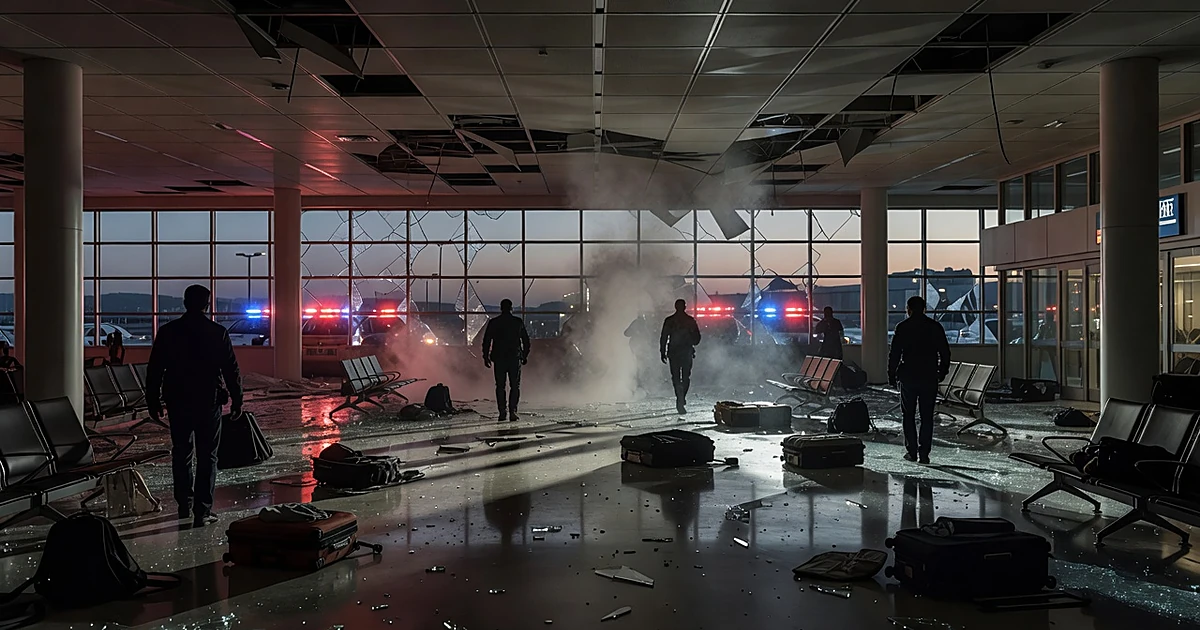
Reporting on the exchange described Saturday’s attack as killing 12 people and injuring more than 300. Among the dead were one American, a Palestinian, an Egyptian, a Jordanian, a Syrian, a Sudanese national, and two Bangladeshis.
Trump did not commit the U.S. on the spot. He made clear the attack itself was unacceptable and that options were under review.
He told reporters:
"We may. We’re going to look at it,"
And added:
"We just found out about the recent attack, so we’ll make a decision. We move very quickly,"
Secretary of State Marco Rubio issued a sharp Saturday statement branding the Houthis a terrorist force and rejecting any excuse for hitting civilians. Rubio framed the assault as an attack on innocent life and aligned Washington with the Saudi people.
Rubio said:
"The United States strongly condemns the recent attacks on the Kingdom of Saudi Arabia by the terrorist Houthis,"
He continued that the strikes showed “a blatant disregard for innocent civilian life” and must stop, while offering condolences to victims and families and declaring that America stands with the Kingdom.
That message fits a broader pattern of Iran-linked pressure and threats that has reached even the Trump family, including an Iran-linked agency’s assassination blueprint aimed at Melania and Barron Trump.
Over the weekend, a Houthi spokesperson went further, casting civilian aviation sites as fair game. The spokesman said airports have become “a theatre of operations for our forces,” urged “everyone to take our warnings seriously,” and blamed the Saudis for “responsibility for any failed interceptions.”
Those threats landed after Riyadh allegedly intercepted a drone near Mecca last month. They also followed Houthi claims that Saudi Arabia had already answered the airport attack with two airstrikes on Sanaa, the Yemeni capital the group seized in 2014.
A Houthi-run Health Ministry claimed some 91 Yemenis died and 168 were injured in Saudi-led coalition attacks over roughly the past five weeks. Those figures come from the group’s own ministry and stand as its claim, not an independent tally.
Trump had appeared reluctant to dive back in. The Houthis had committed in a May cease-fire not to attack vessels in the Red Sea, and he had shown little appetite for a messy war that predated the wider fight with Iran and its proxies. The United States had already taken military action against the Houthis between March and May of this year.
Saturday’s toll changed the temperature. Twelve dead, more than 300 hurt, and an American among the victims leave little room for shrug-it-off diplomacy. Saudi Crown Prince Mohammed bin Salman has reportedly been pushing Trump to take military action against the group.
Trump still described the Saudis as capable partners while condemning the strike in plain terms:
"The Saudis are good fighters, but I think the attack was a terrible thing. We have communication with the Houthis, and we’ll see what happens. But what they did was very bad."
He also called the attack “terrible.” Communication with the Houthis, in his telling, remains open even as a decision on force is on the table.
Voters who watched him mark hard lines on other lethal cases, including when Trump greenlit an Army firing squad for the Fort Hood shooter years after the murders, will recognize the same insistence that attacks on Americans carry consequences.
The Houthis, an Iran-backed force, took Sanaa in 2014. A year later Saudi Arabia intervened to restore the internationally recognized Yemeni government, a predominantly Sunni government the kingdom has long backed. The conflict has ground on for years across Yemen, Saudi Arabia’s southern neighbor, and spilled into shipping lanes and now a major international airport serving a country of about 35 million people.
Joining Saudi retaliatory attacks, as described in the Saturday coverage, carries the potential to widen that fight significantly. That is the strategic stake behind Trump’s short answers to reporters: speed, clarity, and no free pass for a terror group that just killed an American on Saudi soil.
Media voices have spent years questioning his fitness and even floating the 25th Amendment, as when Sunny Hostin labeled Trump deranged on The View. Saturday’s remarks were the opposite of drift, a president absorbing casualty news and saying Washington may hit back.
The human loss also lands in a week when Trump has spoken publicly about toughness and finality in American life, including after he hailed Mike Ditka as a tough winner following the NFL legend’s death at 86. Different arenas. Same refusal to treat American deaths as background noise.
Open questions still matter. The precise weapon used in the airport attack was not detailed in the initial account. Full names of the victims beyond nationality were not listed. The exact text and guarantors of the May Red Sea cease-fire were not reproduced. Official Saudi incident language beyond secondary description was thin on the page.
What is not fuzzy is the sequence: a mass-casualty strike on a capital-region airport, an American dead, Houthi threats to keep treating airports as targets, Saudi strikes claimed against Sanaa, and a U.S. president saying he may join the response after a fast review.
Iran’s backing of the Houthis is the through-line. Proxy violence that reaches Riyadh’s main airport is not a local quarrel. It is a test of whether killing Americans and flooding an airport with wounded draws a price.
Terror groups that turn airports into “theatres of operations” should not get the benefit of the doubt, and a president who says America may hit back is treating an American death overseas as a national interest, not a talking point.