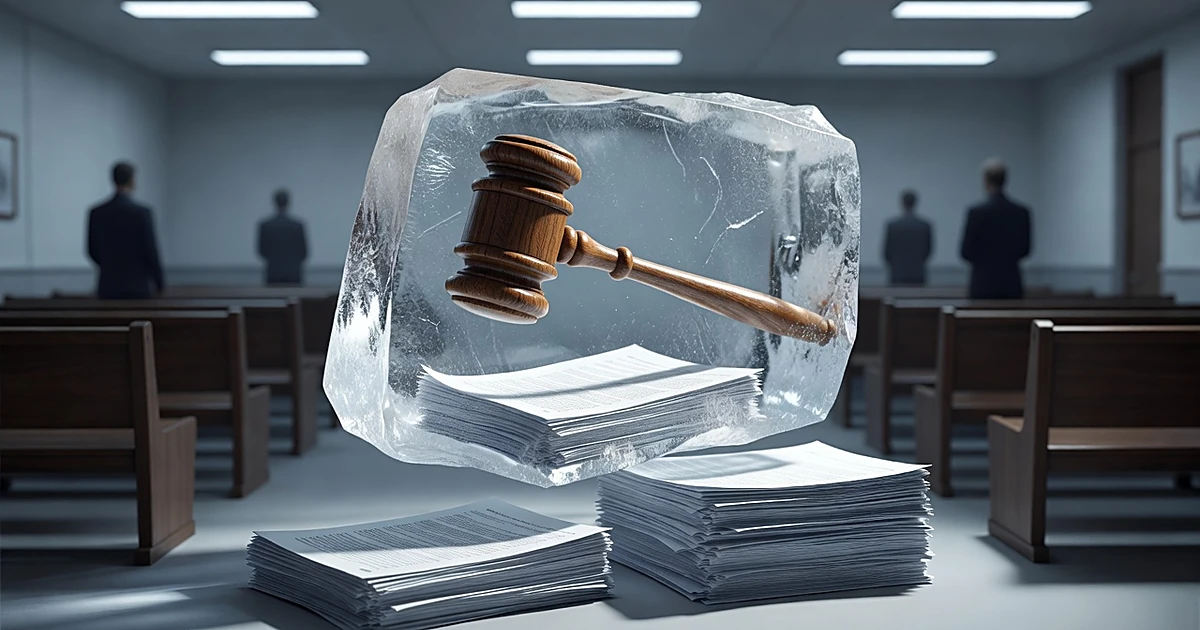


The Supreme Court rejected the Trump administration's emergency bid to enforce new USPS mail-in ballot requirements before the midterm elections, leaving a lower court's nationwide injunction in place and handing Democrats a procedural win.
The justices issued a brief order Monday finding the government was "unlikely to succeed on the merits" of its appeal and had not demonstrated that "the legal and practical considerations" warranted overturning the block. Only Justices Samuel Alito and Clarence Thomas publicly dissented. The ruling means the U.S. Postal Service cannot enforce its new standards for handling election mail while the underlying lawsuit continues, Fox News reported.
The result caps a string of losses for the administration across multiple courts. A federal judge had already converted a temporary restraining order into a nationwide preliminary injunction blocking the rules. When the administration appealed to the Supreme Court for emergency relief, the majority declined, an apparent 7-2 outcome that included Trump-nominated Justice Brett Kavanaugh siding against the government's request.
Kavanaugh's separate writing offered the administration a partial lifeline on the substance while rejecting the emergency timeline. He wrote that the USPS rule may ultimately survive legal review, as the New York Post reported:
"In my view, based on the briefing the Court has received at this interim stage, there is at least a fair prospect that the final rule falls within the Postal Service's statutory authority."
But Kavanaugh concluded that forcing states to comply before the 2026 elections would be "arbitrary and capricious" under the Administrative Procedure Act, the federal law governing how agencies create and enforce rules, because state and local election officials simply did not have enough time to implement the changes.
That distinction matters. Kavanaugh did not say the Postal Service lacks the power to set standards for election mail. He said the government waited too long to roll them out for this cycle. The rules were finalized in late August. Voting in some states was already underway or imminent.
President Trump directed the Postal Service earlier this year to develop new standards for handling election mail. The finalized requirements included several provisions aimed at standardizing how mail ballots move through the system.
Federal ballot mail would need to be sent in envelopes bearing an official election-mail logo. Those envelopes would have to be scannable by high-speed sorting equipment and carry a barcode unique to each voter. State and local election officials would be required to submit their envelope designs to the Postal Service for review and upload basic voter information to an online USPS portal. Any mailings that failed to comply would be refused and returned to election officials for correction.
Supporters of the rules argued the requirements would improve tracking and accountability for millions of mail ballots. The USPS portal, in particular, was designed to let the agency track ballot delivery at scale. But a whistleblower report warned the portal was improperly built and could result in millions of mail ballots never being sent, Breitbart reported.
More than two dozen Democrat-led states sued to block the requirements. Democratic state officials and voting rights groups argued the president has no constitutional authority to set election rules that would, in their words, "virtually eliminate mail voting on the eve of a major election." New York Attorney General Letitia James's office helped lead the challenge.
The administration's losses at every level of the federal judiciary, from the district court through the Supreme Court, mark a significant procedural defeat. The Court's recent pattern of issuing limited rulings in politically charged cases has produced mixed results for the White House, and this case followed that trend in the worst possible direction for the government's timeline.
Justice Alito, joined by Justice Thomas, pushed back sharply. Alito wrote that the government had satisfied the legal requirements for emergency relief:
"The Government has made the showings necessary for a stay, so I respectfully dissent."
Alito raised several arguments the majority did not address in its brief order. He contended that some of the plaintiffs challenging the USPS rules lacked legal standing, meaning they may not have suffered the kind of concrete injury required to bring a federal lawsuit. He argued that the remaining challengers were pursuing what the Court has previously called a "Hail Mary pass" that "rarely succeeds."
On the merits, Alito pointed to the Postal Service's broad statutory authority to regulate the collection, handling, transportation, and delivery of mail. And he warned of irreparable harm to the government: any reversal of the lower court's injunction would come too late for the midterms, effectively making the Court's inaction a final decision on the election-cycle question.
That argument carries weight. If the underlying case drags on past November, the practical question of whether the USPS can enforce these rules for the 2026 elections becomes moot. The government would have to start over for the next cycle. Election expert Jason Snead accused Democratic-led states of resisting the new standards, while attorney Gregory Teufel argued the federal court overstepped its authority in blocking implementation.
The Court has not hesitated to block state actions in other recent election-related disputes, which makes its refusal to intervene here all the more notable for the administration.
New York Attorney General Letitia James framed the ruling as a sweeping victory for voting rights. She said in a statement:
"Today, the Supreme Court protected one of our most fundamental, inalienable rights, the right to make your voice heard at the ballot box."
"This last-minute change could have thrown our elections into chaos, and I am truly relieved the Court granted this reprieve."
James added that voters "should never have to wonder whether a ballot they legally cast will be counted because the federal government suddenly changed the rules." She pledged to "keep fighting to make sure every eligible ballot is counted come November."
Senate Minority Leader Chuck Schumer went further, calling the ruling "one of the most important cases to protect voting rights before the Supreme Court." He declared that "Trump's plan to make it harder to vote was obviously unconstitutional" and that "the Supreme Court had no choice but to make the right decision." Schumer also said the president's "attempt to screw around with vote by mail was obscene" and added: "Finally, his scheme is dead."
But the Democrats' framing papers over what Kavanaugh actually wrote. He did not say the USPS lacks authority over election mail. He said the timeline was the problem. The AP noted that multiple lower courts, including one with a Trump-nominated judge, had blocked the rules, but the Supreme Court's order was narrow: it addressed the emergency request, not the underlying legal question of whether the Postal Service can impose such standards at all.
Arizona Secretary of State Adrian Fontes, a Democrat, told reporters it was "crucial for us to continue rejecting the notion that access and security are mutually exclusive when it comes to running strong elections." That framing treats standardized envelope requirements and voter-tracking barcodes as threats to access rather than tools for accountability, a position that deserves scrutiny, not applause.
The broader political context around the Court remains contentious. House Democrats recently voted down an amendment to keep the Supreme Court at nine justices, a move that raises questions about whether the left views the Court as a co-equal branch or a political obstacle to be reshaped when rulings go the wrong way.
The Supreme Court's order resolved the emergency request but left the larger legal fight unfinished. The preliminary injunction remains in place, and the underlying case will continue in the lower courts. Several critical questions remain unanswered.
Which federal judge issued the injunction, and in which district? The source reporting does not name the judge. What specific states, beyond New York, were party to the challenge? How many of the more than two dozen plaintiff states are all-mail-voting jurisdictions that would have faced the steepest compliance burdens? And what is the current status of the USPS portal that the whistleblower flagged as defective?
The administration also faces a practical clock. If the lower-court litigation stretches past November, the 2026 midterms will proceed under the old rules regardless of how the merits are eventually decided. That outcome would vindicate Alito's warning: the Court's refusal to grant a stay may function as a final ruling on the election-cycle question, even if the Postal Service's authority is ultimately upheld.
Meanwhile, other high-profile Supreme Court cases involving the Trump administration have collapsed or stalled for procedural reasons, a pattern that has frustrated the White House's ability to secure definitive legal victories on its policy agenda.
The administration wanted uniform standards, trackable ballots, and a system where the Postal Service could verify that mail was going to eligible voters. The courts said the idea might survive, just not on this schedule. Whether that distinction matters to the millions of voters casting ballots by mail this November is a question the justices left for someone else to answer.