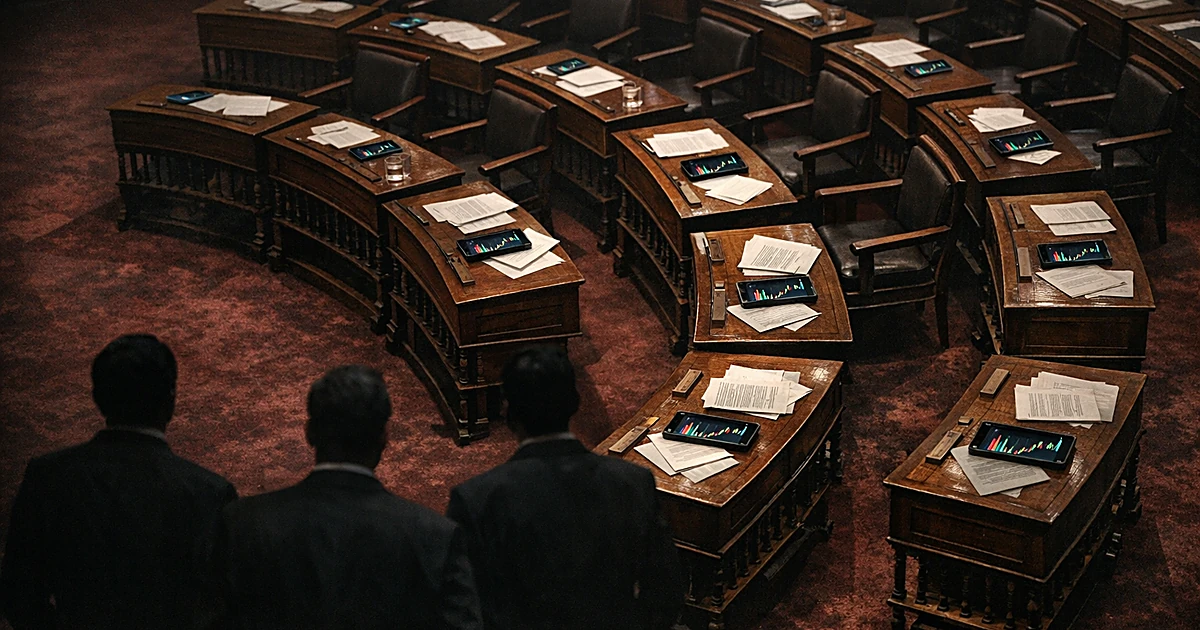


The Senate passed a resolution Thursday by unanimous voice vote banning its members from using prediction markets, a rare bipartisan move driven by insider-trading fears and a fresh criminal case involving classified intelligence used to place bets on a platform millions of Americans now use.
Sen. Bernie Moreno, the Ohio Republican who introduced the measure last week, framed the action in blunt terms. The resolution amends Senate rules to prohibit senators from entering into "an agreement, contract, or transaction that provides for any purchase, sale, payment or delivery" based on the outcome of an event. The Hill reported that the change passed without a single dissenting vote.
The ban takes effect immediately. And thanks to an amendment from Sen. Alex Padilla, it extends beyond senators themselves to cover Senate staff and officers, anyone in the chamber who might have access to nonpublic information that could move a prediction market, AP News reported.
The timing was no accident. The Department of Justice revealed last week that it had charged a U.S. Army soldier for allegedly using confidential information about the operation to capture Venezuelan President Nicolás Maduro to place bets on Polymarket. The soldier reportedly profited more than $400,000 from the wager, the Washington Examiner reported.
That case crystallized what many lawmakers had been warning about: prediction markets are growing fast, and people with access to sensitive government information sit in a uniquely dangerous position to exploit them. When a soldier with a security clearance can allegedly turn classified operational details into a six-figure payday, the question of what a sitting senator might do with similar access becomes impossible to ignore.
The broader concern runs deeper than one soldier's alleged misconduct. Senators vote on legislation, receive classified briefings, and shape policy outcomes that prediction markets track in real time, from elections to military operations to economic crises. The potential for abuse is not theoretical. It is structural.
That structural risk is why, in a chamber that can barely agree on anything, every senator present voted yes.
Moreno wrote on X after the vote:
"Proud to say my bill to ban members of Congress from insider trading on prediction markets just passed the Senate UNANIMOUSLY!"
In additional remarks reported by the Washington Times, Moreno said: "United States senators have no business engaging in speculative activities like prediction markets while collecting a taxpayer-funded paycheck, period."
He also added a line that distilled the populist argument neatly: "Serving in Congress is an honor, not a side hustle. Americans deserve to know that their leaders are here for the right reason!"
That framing, public service versus personal enrichment, is one that resonates well beyond prediction markets. Congress has faced years of criticism over stock-trading by members who sit on committees with regulatory power over the companies in their portfolios. The prediction-market ban addresses a narrower problem, but it taps the same vein of public frustration.
Senate Minority Leader Chuck Schumer, for his part, voiced support from the other side of the aisle. "We must never allow Congress to turn into a casino where members representing the public can gamble on wars or economic crises or elections," Schumer said.
When Moreno and Schumer land on the same side of a vote, it tells you something about how obvious the underlying problem is. The partisan dynamics of the current Senate make unanimous action on almost anything a notable event.
What makes this story unusual is that the prediction-market industry itself welcomed the restriction. Kalshi CEO Tarek Mansour wrote on X that he applauded the Senate's action and noted that his platform already blocks members of Congress from trading.
"Kalshi already proactively blocks members of Congress and enforces against insider trading."
Mansour called the resolution "a great step to increase trust in our markets by making it an industry standard." He then pushed the ball to the other chamber: "Now, let's pass this in the House!"
Kalshi also disclosed that it recently suspended and fined three political candidates for making trades on its regulated prediction market, Newsmax reported.
Polymarket, the other major player in the space and the platform at the center of the DOJ's case against the Army soldier, said it is "in full support of this." The company stated that its rules "already prohibit such conduct, but codifying this into law is a step forward for the industry."
The industry's enthusiasm is easy to understand. Prediction markets are fighting for mainstream legitimacy. Every scandal involving insider exploitation threatens to invite heavy-handed regulation or outright prohibition. A clean, bipartisan rule that keeps government insiders off the platforms costs the companies very little, senators are not a meaningful share of their user base, while buying significant credibility.
The resolution amends Senate rules. It is not a statute. That distinction matters. Because it operates as a chamber rule change rather than legislation, it took effect immediately upon passage and did not require a House vote or presidential signature.
But that also means it covers only the Senate side of the Capitol. The House of Representatives has taken no comparable action. Mansour's call to "pass this in the House" is more than a throwaway line, it highlights the gap. As of Thursday, House members, their staff, and their offices face no equivalent restriction on prediction-market trading.
The Senate's willingness to act on institutional integrity when the politics align is worth noting. Whether the House follows suit, or whether members there see any urgency, remains an open question.
There is also the enforcement question. Senate rules carry weight within the institution, but the mechanisms for detecting violations and imposing consequences are not spelled out in the available details of the resolution. A rule is only as strong as the willingness to enforce it. Congress has a long track record of writing ethics rules for itself and then looking the other way when members push boundaries.
Prediction markets have exploded in popularity in recent years, particularly around elections and geopolitical events. Platforms like Polymarket and Kalshi allow users to bet real money on outcomes ranging from who wins a Senate race to whether a foreign leader will be captured. The DOJ's case against the Army soldier showed that the stakes are not abstract, real people with real access to classified information are already trying to cash in.
For taxpayers and voters, the principle is straightforward. People who serve in government, whether elected officials, military personnel, or congressional staff, should not be placing bets on events they have the power to influence or the intelligence to predict before anyone else. That is not a partisan position. It is common sense.
The fact that it took a criminal case to push the Senate to act is worth remembering. Lawmakers have known about prediction markets for years. The platforms have been operating, growing, and attracting users with government connections. It should not require a soldier allegedly pocketing $400,000 on a classified military operation to prompt a rule that says senators cannot bet on the outcomes they help shape.
Still, credit where it is due. Moreno introduced the resolution, the Senate passed it unanimously, and it took effect the same day. That is faster and cleaner than most things the chamber produces. Whether members of Congress face real accountability when they cross ethical lines remains a separate and harder question.
The Senate did the easy, obvious thing. Now we find out if anyone in Washington has the appetite for the harder ones, like banning congressional stock trading or making sure the House follows suit before the next scandal lands.