
Michelle Obama turned up in cream argyle at the Obama Presidential Center in Chicago, reviving a preppy style that once triggered wardrobe blowback and political noise during her White House years.
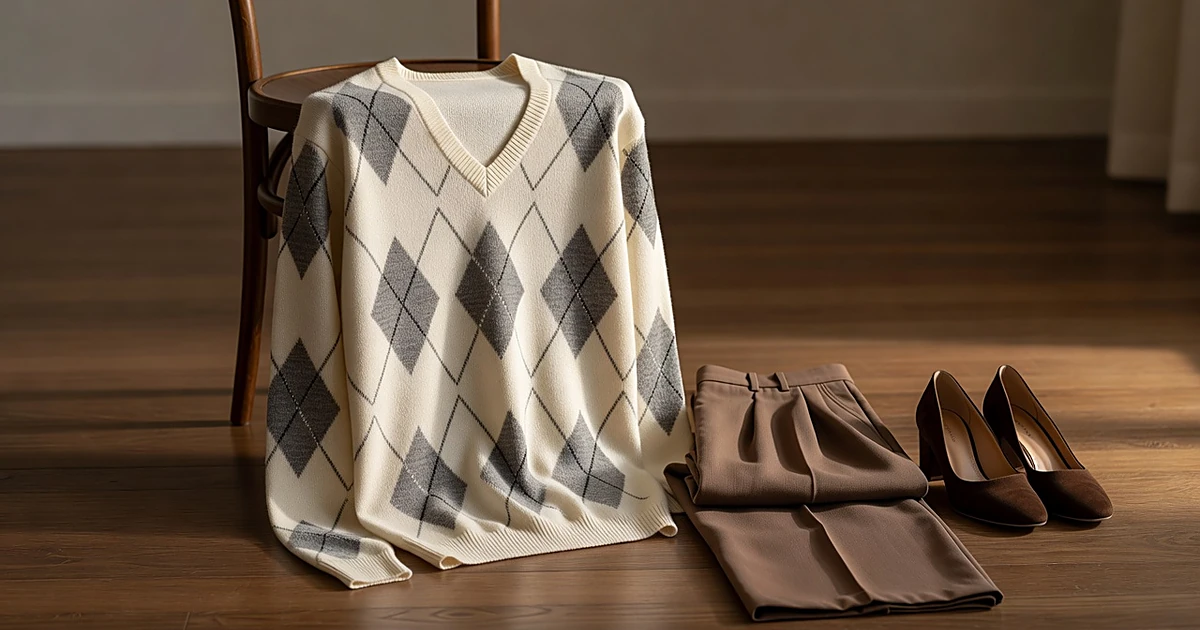
The former first lady appeared at the center in a cream V-neck sweater with a subtle gray argyle pattern, brown wide-leg trousers, and chocolate suede heels. Diamond earrings, her ring, long braids pulled into a high ponytail, and light blue nail polish finished the look as she smiled and greeted people on site.
Entertainment coverage framed the outing as a return to “preppy chic,” tying the sweater to earlier argyle moments that drew sharp fashion commentary when she was in the White House.
No absolute date was given for the Chicago visit. The reporting described it only as a recent stop. What landed was the pattern itself, and the history attached to it.
In 2009, then-first lady Michelle Obama wore a blue argyle cardigan during a visit to London’s Elizabeth Garrett Anderson School. Coverage nicknamed the episode “Argyle-gate” and turned a simple knit into a running fashion argument.
She later wore a Moschino argyle cardigan at a Library of Congress Read Across America event celebrating Dr. Seuss. The motif stuck in the public memory as part of a broader debate over how a first lady should dress.
Sleeveless dresses drew still more scrutiny, including around the 2016 State of the Union address and her first official White House portrait. Critics treated fabric choices like policy statements. Allies treated the criticism like coded politics.
Her own later comments leaned into that framing. In a 2025 People Magazine interview discussed in recent coverage, she pointed to Jacqueline Kennedy’s sleeveless dresses as first lady and cast the pile-on as something larger than hems and necklines.
"I could pull up pictures of Jackie O [Kennedy] in a second and see this fashion icon in sleeveless dresses as first lady,"
She went further on the political temperature around her image.
"So at a point you're like, 'Oh, this is politics. If you can't beat them, scare everybody. That was the motto. If it wasn't the clothes, it was 'that terrorist fist bump.' It was every word that we said,"
That is her account of the years when wardrobe talk doubled as proxy combat. The record shows the clothes kept making news anyway.
Fashion friction followed her outside formal events too. Fox News reported she once wore $540 Lanvin designer sneakers while volunteering at a Washington food bank, paired with a J.Crew cardigan in a gold argyle style that did not match the gray-and-pink shoes.
The footwear came through an upscale Chicago retailer and was already a celebrity favorite. Critics called the choice tone-deaf in a hard economy. The episode fit a longer pattern: high-end labels meeting public charity settings, then meeting public judgment.
Taxpayers and working families notice when elite symbolism and everyday strain share the same frame. A sweater can be just a sweater. A $540 sneaker at a food bank is a choice with a price tag attached.
In 2025 she released “The Look,” a book tracing her fashion arc from early public life through the White House and after, with more than 200 photographs, including previously unseen images, and input from her longtime glam and styling team.
The same year she pushed back on fashion and husband-related criticism in that People interview. Image management remained part of the brand.
She also co-hosts the podcast “IMO” with her older brother, Craig Robinson. It launched in March 2025, ran into 2026, and has featured guests including Sharon Stone, with talk ranging across relationships, family, parenting, and careers, the same media lane that produced a widely circulated Sharon Stone appearance alongside her.
Public curiosity about the Obamas’ private rhythm has not faded either. Solo social turns have repeatedly drawn notice, including coverage of her Martha’s Vineyard evenings out without Barack.
Separate remarks about family life have done the same, including the backlash after she said she does not miss her daughters at home. The through-line is constant attention to how she presents life after the White House.
The Chicago argyle look closes a loop. A motif that once fueled “Argyle-gate” is back on the former first lady in the building that carries the family name. The sweater is softer than a State of the Union sleeveless dress. The incentives around her image are not softer.
Every public outfit still reads as message discipline to fans and as elite theater to skeptics. Her book sells the evolution. Her podcast extends the voice. The presidential center supplies the backdrop. The clothes remain part of the communications plan.
None of that makes a V-neck a scandal on its own. It does keep the old question alive: when a political family treats fashion as strategy, voters are entitled to weigh the strategy, the price tags, and the gap between symbolism and the country outside the event rope line.
Style comes back around. Accountability for the message underneath it should too.