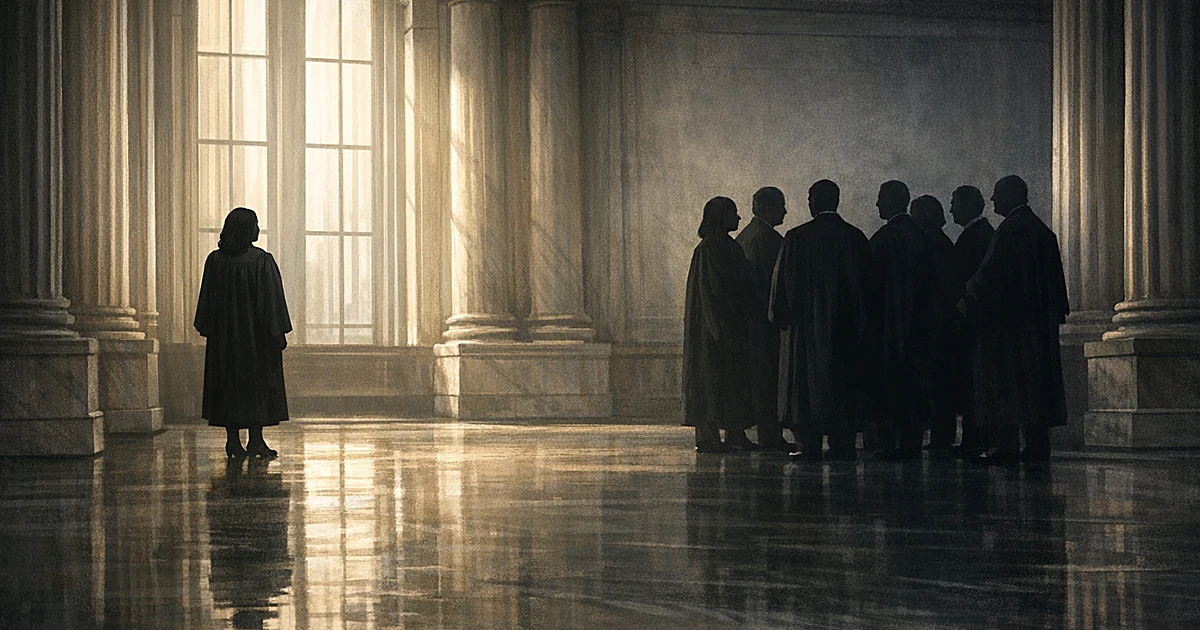

The Supreme Court reversed a Washington, D.C., appeals court on Monday in a 7-2 decision that backed a police officer's authority to stop a man in a suspicious vehicle, and Justice Ketanji Brown Jackson was the only member of the bench willing to defend the lower court's original ruling.
Jackson accused her colleagues of overstepping to "wordsmith" the D.C. court's findings in a routine Fourth Amendment case, calling the reversal an "unusual step of summary reversal" that the facts did not justify. Even Justice Sonia Sotomayor, the Court's most senior liberal and an Obama appointee, broke with the majority but declined to join Jackson's dissent, leaving the Biden appointee entirely on her own.
The case grew out of a 2023 dispatch call to Washington, D.C., police at 2 a.m. reporting a suspicious vehicle. When an officer arrived on scene, two people ran from the car. The remaining person, described as the driver or passenger, slowly began backing the vehicle out of a parking lot with a door still open. The officer stopped the vehicle.
What the officer found next told the rest of the story. Lawyers for the police said that "within moments of stopping the driver, the officer observed a smashed window and punched-out ignition, confirming that the vehicle had been stolen."
The D.C. Court of Appeals had found last year that the officer improperly stopped the man. The Supreme Court's unsigned per curiam opinion disagreed, emphasizing that officers have broad authority to rely on the "totality of the circumstances" when deciding whether reasonable suspicion exists. The majority faulted the lower court for improperly ignoring the fact that two people fled the vehicle before the third person was stopped.
Jackson did not merely dissent. She scolded the majority for intervening at all. As Fox News Digital reported, Jackson wrote that she could not understand why the Court chose to act in a case she viewed as a straightforward factual dispute best left to the lower court.
"I cannot fathom why that kind of factbound determination warranted correction by this Court."
She went further, questioning the very premise of the reversal:
"I am not sure why our Court sees fit to intervene in this case, let alone to do so summarily."
Jackson also pushed back on any suggestion that the D.C. appeals court misread the law. She wrote that "if the intervention reflects a worry that the District of Columbia Court of Appeals (DCCA) misunderstands the Fourth Amendment's totality-of-the-circumstances analysis, that worry seems unfounded." She accused the majority of "culling" facts from the record to justify the reversal.
This is not the first time Jackson has found herself isolated on the bench. Earlier this term, Justice Elena Kagan publicly rebuked Jackson in a rare footnote after an 8-1 free speech ruling, a striking moment of liberal-on-liberal disagreement that left Jackson as the sole holdout.
The D.C. attorney general's office argued on behalf of police that the "totality" of facts, the 2 a.m. dispatch call, the suspicious vehicle report, two people fleeing, and a car creeping backward with its door open, amounted to reasonable suspicion. Seven justices agreed.
Lawyers for the police framed the officer's decision in blunt terms:
"Under these circumstances, with only seconds to decide whether to intervene, the officer was entirely justified in detaining the driver."
The Fourth Amendment protects Americans' right to be "secure in their persons, houses, papers, and effects, against unreasonable searches and seizures." The question in every stop case is whether the officer's suspicion was reasonable under the circumstances. Here, the Supreme Court said yes, overwhelmingly.
Jackson has also drawn attention for her positions in other high-profile constitutional disputes, including her argument that foreign tourists who hold "local allegiance" to the United States should qualify for birthright citizenship, a stance that placed her well outside the mainstream of constitutional interpretation.
The decision fits a broader pattern at the Supreme Court this term: a willingness to correct lower courts that, in the majority's view, apply legal standards too narrowly or in ways that hamstring law enforcement and executive authority. The 7-2 margin here was not close. Only Jackson and Sotomayor broke from the pack, and even Sotomayor would not sign on to Jackson's reasoning.
That dynamic extends beyond Fourth Amendment cases. In a separate matter, the Washington Times reported that Chief Justice John Roberts temporarily stayed a 4th Circuit ruling after Solicitor General D. John Sauer argued it invited improper court interference in executive personnel matters. Sauer told the Court that it "should stay the mandate with a view to summarily reversing the decision." The underlying case involved immigration judges challenging a Justice Department policy, and the 4th Circuit had ruled that plaintiffs could bypass normal civil-service review and go directly to federal court, a pathway the administration called an open invitation for judicial overreach.
The broader tensions at the Court, including questions about potential retirements by Justices Alito and Thomas, make every ideological alignment worth watching. Jackson's willingness to stand alone, even without the support of fellow liberals, signals a judicial philosophy that prioritizes limiting police authority even when the facts strongly suggest the officer acted reasonably.
Strip away the legal jargon, and the facts of the 2023 stop are hard to argue with from a common-sense standpoint. A suspicious vehicle is reported at 2 a.m. An officer arrives. Two people bolt. The third person begins moving the car with a door hanging open. The officer stops the vehicle and immediately spots a smashed window and a punched-out ignition, telltale signs of a stolen car.
The D.C. appeals court looked at those facts and concluded the stop was improper. Seven Supreme Court justices looked at the same facts and said the lower court got it wrong by failing to weigh the totality of the circumstances, especially the flight of the two other occupants.
Jackson's objection was not that the officer acted badly. Her complaint was procedural: the Supreme Court, in her view, should not have taken the case at all. She framed the lower court's analysis as competent and the majority's intervention as unnecessary meddling in a factual dispute.
But the 7-2 margin tells a different story. When seven justices, spanning the Court's ideological range, agree that a lower court misapplied the Fourth Amendment in a case involving a fleeing suspect and a stolen car, the outlier is not the majority. The question these disputes raise is whether Jackson's instinct to shield lower-court rulings from review serves the law, or whether it serves a vision of policing that treats every stop as presumptively suspect.
Fox News host Mark Levin offered a sharper assessment of Jackson's position, calling her "out of her mind" in a segment on his show.
The Supreme Court did not break new legal ground here. It applied a well-established standard, totality of the circumstances, to a set of facts that, by any ordinary measure, gave the officer ample reason to act. The officer had seconds to decide. He decided correctly. The evidence proved it moments later.
Jackson's dissent is notable not for its legal reasoning but for what it reveals about her instincts. Even Sotomayor, who has spent years as the Court's most vocal critic of police stops, would not join her. That isolation is becoming a pattern, one that should concern anyone who believes the Court's liberal wing needs to stay grounded in the real-world consequences of the rulings it seeks.
Officers who respond to 2 a.m. calls about suspicious vehicles don't have the luxury of writing dissents. They have seconds, not paragraphs. The Supreme Court, by a commanding margin, recognized that. One justice did not.