



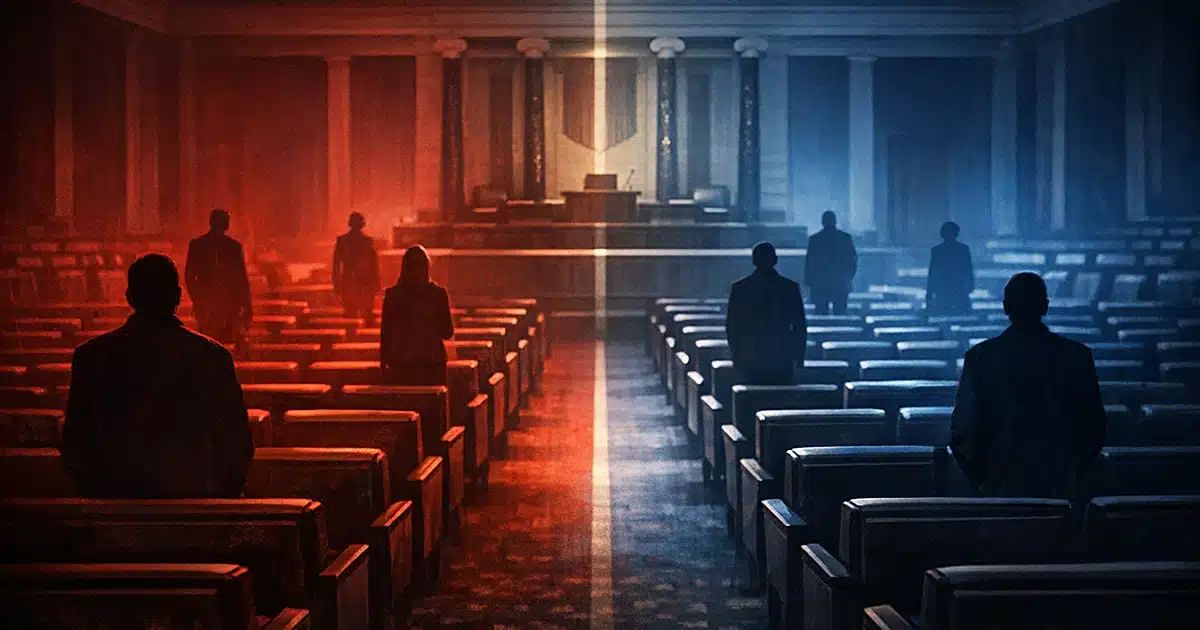


House Democrats overwhelmingly rejected a constitutional amendment that would have permanently fixed the Supreme Court at nine seats, a vote Republicans framed as proof their opponents want to pack the bench when the political winds shift.
The measure, authored by Rep. Andy Biggs of Arizona, failed 212, 206 on Wednesday, falling far short of the two-thirds supermajority a constitutional amendment requires. Every House Republican voted yes. Every Democrat but one voted no. The lone Democratic holdout was Rep. Don Davis of North Carolina. Rep. Kevin Kiley of California, a former Republican now serving as an independent, sided with Democrats against the proposal.
The vote gave Republicans exactly what they wanted: a roll call forcing Democrats to publicly oppose locking in the current nine-seat Court, a number that has held since 1869, more than half of the nation's existence. Democrats, for their part, argued Congress should never surrender its constitutional power to set the Court's size, a power it has exercised eight times since 1789.
House Speaker Mike Johnson set the terms bluntly before the vote. Johnson announced the amendment would come to the floor "on suspension," the procedural track reserved for measures expected to draw broad support. The two-thirds bar was always a long shot. The point was the public record.
Johnson framed the vote as a direct response to Democratic Socialists of America and progressive members who have pushed to expand the Court. As the New York Post reported, Johnson told colleagues before the vote: "We will have them put their money where their mouth is."
On the floor, Biggs kept his case simple. The nine-seat Court is not sacred because of the number, he said, but because a fixed number removes the temptation to rig outcomes.
Biggs told colleagues:
"It fixes the number of justices at nine permanently, not because nine is a magic number, but because a fixed court cannot be expanded by whoever happens to win the next election. It makes the rule the same regardless of who is in power."
He also pointed to the Court's most recent term to undercut claims that the current bench is a rubber stamp for conservative causes. Half of all cases were decided unanimously, Biggs noted. Only five of 57 cases, roughly 8 percent, were decided by a 6, 3 conservative-majority split.
Democrats have mounted a broader push to overhaul the Court as midterm elections approach, making the timing of this vote especially pointed.
Rep. Jamie Raskin of Maryland, the top Democrat on the Judiciary Committee, led the opposition. He cast the amendment not as a safeguard but as an effort to freeze a conservative advantage in place permanently.
Raskin told the chamber:
"MAGA's proposal is to strip Congress of all authority in the matter to freeze it and cement it permanently in the constitutional architecture for all time with the suddenly magic number nine."
Raskin reminded colleagues that Congress first set the Court at six justices in 1789 and changed the number seven more times after that, with the total ranging from five to ten before settling at nine in 1869. His argument: flexibility is the design, not the flaw.
But Raskin's framing left a question hanging. If Congress has always had the power to change the Court's size, and Democrats insist on preserving that power, the obvious follow-up is: what do they plan to do with it?
The answer is already on the record. In 2023, sixty-six House Democrats co-sponsored legislation to expand the Court from nine to thirteen justices. Raskin himself was among the co-sponsors. That bill has not been reintroduced in the current Congress, but no Democrat on the floor Wednesday disavowed the idea.
Rep. Hank Johnson of Georgia, the top Democrat on the Judiciary subcommittee overseeing federal courts, went further. He accused Republicans of hypocrisy, claiming conservative donors had already packed the judiciary through years of judicial nominations.
"Wealthy donors and corporate interests, led by the Federalist Society, spent billions of dollars to pack the judiciary with right-wing, conservative, corporate-polluting, serving judges and justices."
Johnson added: "They have already delegitimized our judiciary, yet they now stand before the American people, pretending to be guardians of judicial integrity."
Biggs responded directly to the accusation. Nominating judges through the constitutional process and winning Senate confirmation votes, he argued, bears no resemblance to adding seats to change a court's ideological balance.
"That doesn't sound like packing. That sounds like a lot of thoughtful folks on the United States Supreme Court rendering decisions they believe in and they believe comprise constitutional opinion."
The distinction matters. Appointing justices to existing vacancies is the process every president follows. Adding new seats to manufacture a majority is something else entirely, and it is the scenario this amendment was designed to prevent. Some prominent Democrats, including former Rep. Jim Clyburn, have openly called for a thirteen-member Court.
House Judiciary Chairman Jim Jordan of Ohio laid out the Republican case in starker terms. He accused Democrats of pursuing a deliberate strategy to flip the Court's ideological balance through expansion rather than elections and nominations.
"They want to take the Court from a six-three conservative majority Court to a seven-six liberal Court. It's all planned."
Rep. Ralph Norman of South Carolina pressed the slippery-slope argument. Once politicians start adding seats to chase favorable rulings, he warned, no logical limit exists.
"Once politicians start changing the size of the Court to get favorable rulings, there is no logical stopping point. Today is 13. Tomorrow could be 17. Then 21. That would turn the Supreme Court into just another political arm of Congress."
The Washington Examiner reported that NRCC spokesman Mike Marinella cast the vote in campaign terms: "Give House Democrats an ounce of power, and they'll use every bit of it to fundamentally transform America into an unrecognizable socialist hellscape."
Rep. Mary Gay Scanlon of Pennsylvania offered the Democratic counter, arguing that public demand for Court reform has only grown louder after recent rulings. "Those calls have grown louder in the wake of each decision that has lessened our individual rights and liberties," she said. She did not specify which decisions she meant.
The pattern is not new. House Democrats blocked a similar Republican measure in 2022, when 218 Democrats voted against fixing the Court at nine while 208 Republicans voted in favor. The arguments then were nearly identical. So were the results.
Republicans control 218 House seats to Democrats' 214, as Newsmax noted. Even a unified GOP could not clear the two-thirds bar alone. The amendment was never going to pass Wednesday. Republicans knew that. The vote was designed to create a record, not a ratification.
That record now shows 206 House Democrats, all but one, voted against a measure that would have done nothing more than preserve the status quo the Court has maintained for 157 years. No seats removed. No seats added. Just a constitutional guarantee that the number stays where it is.
The Washington Times reported that Raskin dismissed the effort as a "MAGA" maneuver, but the substance of the amendment contained nothing partisan. It stated a number. Democrats voted against that number, the same number every living American has known.
Recent Supreme Court decisions on issues from voting procedures to executive authority have underscored how high the stakes are when the Court's composition is in play.
Democrats can argue all day that Congress should keep its options open. But when those options include adding four seats to flip a 6, 3 conservative majority into a 7, 6 liberal one, and sixty-six of their own members already signed on to that exact plan, the refusal to lock in nine stops looking like constitutional principle and starts looking like a reservation for later.
If you will not agree that the Court should stay at nine, the only honest explanation is that you want the freedom to make it something else.