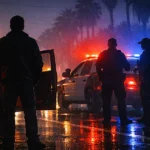
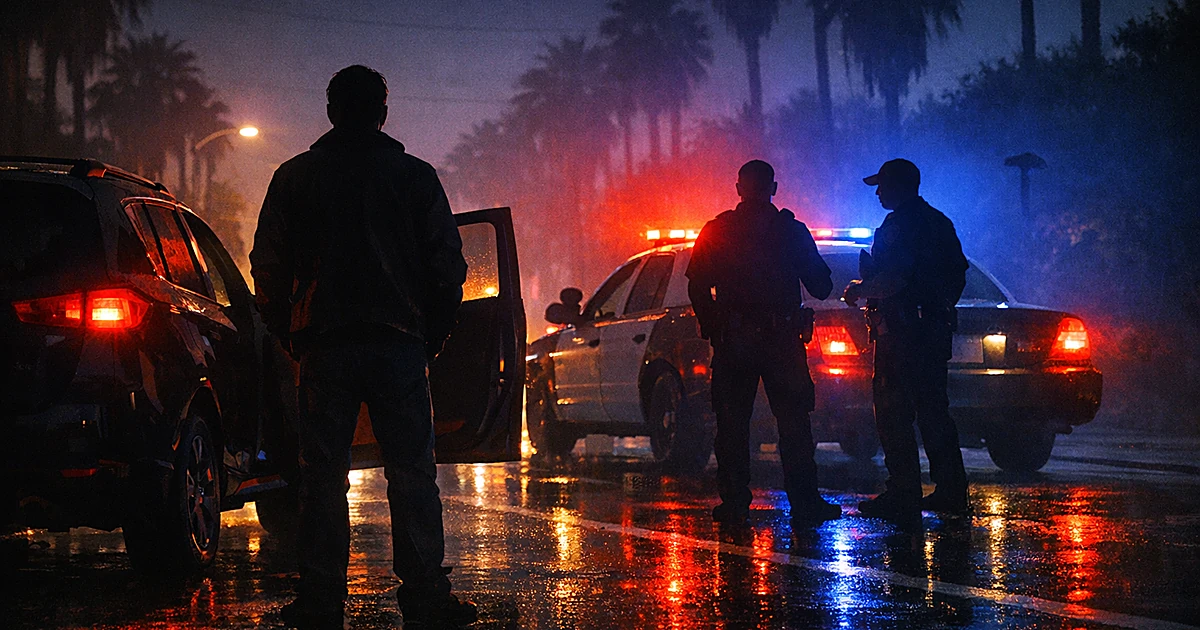



FBI agents shot and killed a 41-year-old convicted sex offender early Wednesday after he took 10 employees of the Kern County Superintendent of Schools hostage inside a downtown Bakersfield office building, warned he had strapped explosives to himself and some captives, and refused to surrender through nearly 16 hours of negotiations.
All 10 hostages were found alive and physically unharmed. Their families had spent the night not knowing whether they would see them again.
The suspect, Anthony Scott Searles-Harris, was killed around 4:20 a.m. after authorities stormed the four-story Chase Bank building where the school district office occupies the second floor, the Associated Press reported. More than 100 FBI personnel, including two SWAT teams, bomb technicians, crisis negotiation teams, and a hostage rescue team flown in from the East Coast, converged on the city of roughly 380,000 residents about 100 miles northeast of Los Angeles.
Bakersfield police responded to a bomb threat at the Chase Bank building early Tuesday afternoon. They quickly discovered the situation was far worse than a phone call: Searles-Harris had barricaded himself on the second floor with 10 school employees, claiming he had explosives.
Authorities said he tied up half the hostages during the ordeal. One captive managed to communicate with law enforcement by phone until her battery died, a lifeline that gave investigators early intelligence about conditions inside.
The police department's crisis negotiation team reached Searles-Harris by phone. He released two hostages on Tuesday, but the remaining eight stayed trapped overnight as the standoff dragged past midnight and into the early morning hours. The situation forced the evacuation of nearby buildings, including Bakersfield City Hall and police headquarters, both just a block away.
FBI Special Agent in Charge Sid Patel, who oversees the bureau's Sacramento office, said authorities were testing the devices Searles-Harris had brought into the building. They did not appear to be a genuine threat, Patel said, though that assessment came only after the suspect was dead and the hostages were free.
California Department of Justice records and court filings paint a grim picture of the man who terrorized downtown Bakersfield. Searles-Harris was on California's sex offender registry, convicted in 2014 of sexual crimes involving a child under 14 years of age. He was released from prison in 2018.
FBI officials said Searles-Harris served roughly a year in the U.S. Army before receiving a dishonorable discharge in 2007 for going AWOL. Kern County court records show he was involved in divorce proceedings that began in 2009, proceedings that noted a young child, and later appeared as an objector in a guardianship fight. He also filed a petition to prevent domestic violence at some point, though the timing is unclear.
Bakersfield Assistant Police Chief Jeremy Blakemore told reporters at a Wednesday news conference that Searles-Harris had made demands related to his prior criminal case. As incidents involving law enforcement response to violent threats continue to test public safety systems, the Bakersfield case underscores how quickly a single individual with a grievance can paralyze an entire city center.
Blakemore described the suspect's fixation on his earlier conviction:
"He had concerns related to how his previous case had been handled and what the aftermath of that was, the sentencing and those kinds of things."
Blakemore also said he was aware that Searles-Harris had apparently posted videos online criticizing the sheriff's office and claiming he was innocent of the sex crimes. The department was reviewing those videos, Blakemore said, but had no plans to investigate the innocence claims.
Arturo Revelo, the defense attorney who represented Searles-Harris in the 2014 case, described his former client as a disturbed man who believed the government was out to get him. Police asked Revelo to help on Tuesday during the hostage crisis, but he was never allowed to speak directly with Searles-Harris.
Instead, Revelo said he recorded two videos telling Searles-Harris that he was present with the case documents and would assist him in any way he could. Revelo said he was told the suspect would release the hostages in exchange for the documents, but he did not see that happen while he was on scene.
That detail raises hard questions. If negotiators had a concrete demand they could meet, documents from a prior case, why wasn't the exchange completed before the situation escalated to a lethal breach? Authorities have not explained the sequence of decisions that led to the overnight storming of the building. The broader question of security gaps and institutional preparedness in the face of determined attackers remains a recurring concern nationwide.
Blakemore confirmed all hostages were found unharmed, at least physically. The emotional toll is another matter.
"Throughout the night, their families questioned whether or not they would be seen again but we are very grateful for the outcome."
Patel acknowledged the psychological damage plainly:
"I'm sure there'll be mental scars that they're living with, and we'll have our victim specialist to help them."
Kern County Schools Superintendent John Mendiburu praised his employees' composure under extraordinary pressure. In a statement, he said what they endured was "undoubtedly a terribly frightening and unsettling experience" and called their conduct during the 16-hour ordeal "extraordinary."
These were school district office workers, people who went to work on a Tuesday expecting paperwork, not a hostage crisis. They are the kind of ordinary citizens whose safety is supposed to be guaranteed by the systems that track, supervise, and manage convicted offenders after release. In this case, those systems produced a man free to walk into a public building just a few years after a child sex crime conviction and hold an entire floor captive.
Authorities declined to discuss the motive in detail. It remains unclear why Searles-Harris targeted the Kern County Superintendent of Schools office specifically, or what connection, if any, he had to the employees he seized. The relationship between his criminal history, his custody and family court battles, and his fixation on the school district office has not been explained. Cases involving violent suspects and unresolved forensic questions often take weeks or months to fully unravel.
The nature of the explosive devices, whether they were functional or props, also remains under investigation. Patel said Wednesday's testing suggested they were not a serious concern, but he stopped short of calling them inert outright.
And then there is the broader systemic question that no press conference addressed: how a man convicted of sexual crimes against a child, dishonorably discharged from the military, and apparently consumed by grievance against the justice system was able to acquire what he claimed were explosives, enter a government-adjacent office building, and hold 10 people for the better part of a day. The growing catalog of violent incidents straining local law enforcement suggests that communities across the country are confronting threats their institutions are not structured to prevent.
Searles-Harris fits a profile that recurs with uncomfortable regularity in American violence: a man with a documented criminal history, a pattern of institutional failure and personal grievance, and a long trail of warning signs that nobody assembled into a coherent threat picture until it was too late. He posted videos. He fought in court. He served time and came out angrier. He was on a registry.
None of it stopped him from walking into a building full of school employees and holding them at gunpoint, or at least at explosive-point, for 16 hours.
The FBI deployed massively and, by the only measure that matters most, succeeded: every hostage walked out alive. That outcome deserves credit. But the fact that it took more than 100 federal agents, two SWAT teams, bomb technicians, crisis negotiators, and a hostage rescue team flown across the country to resolve a situation created by one man on a sex offender registry is not a story of strength. It is a story of a system that reacts with overwhelming force because it failed to act with basic vigilance. As recent federal prosecutions of violent attackers have shown, accountability after the fact is no substitute for prevention.
Ten families got their loved ones back. That is the headline, and it matters. But the question no one in Bakersfield has answered yet is the one that should keep officials up at night: why did it come to this at all?