
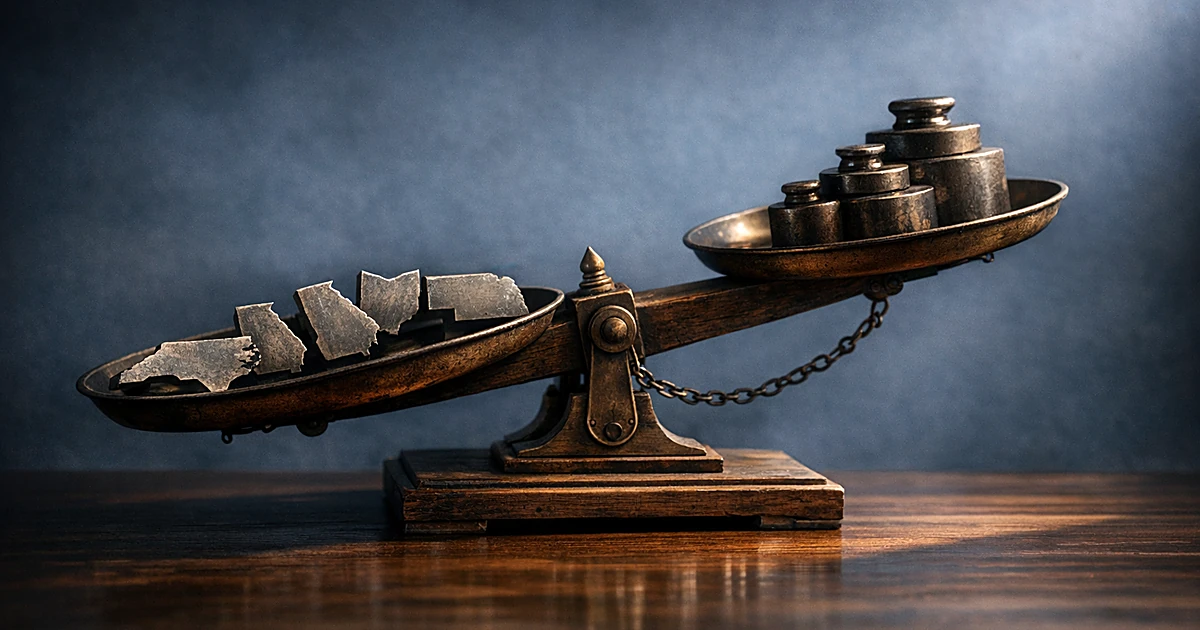

The Cook Political Report shifted its ratings on four Senate races toward Democrats on Monday, marking the clearest signal yet that Republicans face a tougher midterm map than many in the party expected heading into 2026. North Carolina, Georgia, Ohio, and Nebraska all moved in the Democrats' direction, though the nonpartisan forecaster still calls Republicans narrow favorites to hold the chamber.
The changes are worth taking seriously. They are also worth reading carefully, because the fine print tells a different story than the Democratic fundraising emails that will inevitably follow.
The Hill reported that Cook moved the North Carolina race to succeed retiring Sen. Thom Tillis (R) and Sen. Jon Ossoff's (D-Ga.) reelection contest from "Toss Up" to "Lean Democrat." Sen. Jon Husted's (R-Ohio) race dropped from "Lean Republican" to "Toss Up." And Sen. Pete Ricketts's (R-Neb.) reelection bid fell from "Solid Republican" to "Lean Republican."
Jessica Taylor, Cook's Senate and governors editor, framed the shifts in blunt terms. She wrote:
"With an increasingly sour national environment for Republicans, the Senate battlefield is shifting in Democrats' favor. But due to the difficulty of the map, winning back a majority still remains a tall order."
That second sentence matters at least as much as the first. Republicans hold a 53-47 edge. Democrats need a net gain of four seats to take the majority. Taylor herself wrote on the social platform X that the "likeliest outcome" is a Democratic pickup of one to three seats, meaning, by her own assessment, the most probable result still leaves Republicans in charge.
Start with North Carolina, where former Gov. Roy Cooper (D) will face former Republican National Committee chair Michael Whatley. Cooper is a known commodity in the state, a two-term governor with statewide name recognition. Whatley, by contrast, must introduce himself to a general electorate while navigating a political environment that Cook describes as unfavorable for the party. The seat is open because Tillis chose not to seek another term.
Georgia presents a different challenge. Ossoff won his seat in a 2021 special election and now runs for a full term against a crowded GOP primary field that includes Reps. Buddy Carter and Mike Collins, along with former football coach Derek Dooley. A messy primary can leave scars. Republicans who spend months tearing each other apart in Georgia will hand Ossoff a head start in the general election.
The broader pattern of Republican figures breaking from the party or struggling with internal divisions only compounds the problem.
Ohio is the race that should worry Republicans most. Gov. Mike DeWine (R) appointed Jon Husted to replace Vice President Vance in the Senate. Now Husted will likely face former Sen. Sherrod Brown, a veteran Democrat who lost to Sen. Bernie Moreno (R) in 2024. Brown knows the state, knows how to run statewide, and will have a chip on his shoulder. Cook dropped Ohio from "Lean Republican" all the way to "Toss Up."
Nebraska rounds out the list. Ricketts faces independent candidate Dan Osborn, who lost to GOP Sen. Deb Fischer in 2024. That a seat once rated "Solid Republican" now sits at "Lean Republican" says something about the current environment, though it also says the seat is still expected to stay red.
Taylor pointed to several factors in her analysis, and conservatives should weigh them honestly rather than dismiss them reflexively. She cited presidential approval ratings, the military engagement in Iran, rising gas prices, and voter anxiety over affordability. She also claimed that the administration's advantage on immigration has eroded, writing that the president "has even seen his advantage on immigration erode amid disapproval of ICE's controversial enforcement tactics."
The Iran situation has generated significant political friction on Capitol Hill. Senate Republicans blocked a war powers resolution related to Iran earlier this year, and the conflict remains unresolved. Taylor herself acknowledged the timing, writing:
"We concede that these ratings changes are coming as Trump is at a new polling low and still navigating a yet-to-be-resolved war in Iran."
That concession is important. Midterm ratings made during a foreign policy crisis and a temporary dip in approval numbers are snapshots, not verdicts. Taylor said as much, adding that "it's possible things could rebound for his party or that they could find a rallying cry to get his base out in November, a summer Supreme Court retirement certainly wouldn't hurt."
The Iran conflict has also drawn sharp reactions from Senate Democrats. At least one Senate Democrat has used the situation to call for the president's removal, a posture that may energize the progressive base but risks alienating voters who want steady governance, not performative outrage.
One factor Taylor noted, and that deserves more attention, is the financial landscape. The Senate Leadership Fund and MAGA Inc., the president's super PAC, have millions more in their coffers than the Democratic National Committee. Money does not guarantee wins, but it buys television time, ground operations, and the ability to define opponents before they define themselves. That cash advantage could blunt Democratic momentum in close races.
Fox News reported that even Republican leaders acknowledge the difficulty. Sen. Tim Scott told the outlet, "There's no doubt the climate has gotten more and more difficult by the day, it seems like at times." That kind of candor from a senior Republican suggests the party is clear-eyed about the challenge, which is the first step toward meeting it.
Taylor also flagged that Democrats are "still contending with messy primary fights in Maine, Michigan, Minnesota and Iowa." That detail tends to get lost in the headlines about Republican vulnerability. Democrats have their own problems. Competitive primaries drain resources and can produce weaker general election candidates. The same dynamic that threatens Republicans in Georgia could hurt Democrats elsewhere.
Just The News noted that while the ratings shifts are real, Cook still describes Republicans as "slight favorites" to retain control. The forecaster's own most likely scenario, a one-to-three-seat Democratic gain, falls short of the four-seat flip Democrats need.
The question of how Republican governors handle Senate appointments and candidate selection will continue to shape the chamber's composition heading into November.
Here is what the Cook shifts tell us plainly: Republicans have ground to make up. The national environment is not where the party wants it. Four races moved in the wrong direction. That is a fact, and pretending otherwise helps no one.
But here is what the shifts do not tell us: that Democrats are on the verge of taking the Senate. The math still favors Republicans. The money still favors Republicans. And midterm environments are fluid, particularly when a foreign conflict, gas prices, and approval ratings are all in motion at once.
Cook's own analyst said the outlook "could change in the coming months." That cuts both ways. If the Iran situation stabilizes, if gas prices ease, if the administration finds its footing on affordability, these ratings could snap back. If things worsen, more seats could slip.
The party that treats a warning as a wake-up call tends to do better than the party that treats a favorable forecast as a victory lap. Right now, Republicans have the warning. What they do with it between now and November will matter far more than any rating on a chart.