


About 2,000 police officers, elected officials, and fellow law enforcement members filled a Chicago funeral Friday to honor Officer John Bartholomew, a 10-year veteran of the Chicago Police Department and father of three who was shot and killed while guarding a suspect inside a hospital. The suspect, 26-year-old Alphanso Talley, was free on pretrial electronic monitoring at the time, despite a decade-long criminal record, multiple felony cases, and an outstanding arrest warrant.
The killing has become the latest flashpoint in a long-running fight over Illinois' SAFE-T Act, which eliminated cash bail statewide and shifted detention decisions to judges. Critics say the law left a dangerous, repeat offender on the streets when he should have been behind bars. Bartholomew's family, his fellow officers, and police union leaders are now demanding answers about how Talley ended up free, and armed, in a hospital bed.
Bartholomew, 38, spent his entire adult career with the CPD. He is survived by his wife and three children. His brother, James Bartholomew, told mourners at the funeral what the loss meant to those who knew him:
"If you worked with him. If you talked to him, if you laughed with him, if you walked with him. You are feeling what I'm feeling right now. It's as if an angel has left the earth. If you knew him. You knew his heart was full. His heart was pure."
Chicago Police Superintendent Larry Snelling addressed Bartholomew's children directly from the podium.
"To the children, your father was a hero. His legacy will live on."
Snelling also made a broader plea. "The only thing that I would like to see laid to rest alongside John is violence," he said. "Those who go out and do harm to others. Those who take and destroy lives."
Bartholomew's partner, Officer Nelson Crespo, 57, a 21-year veteran of the department, was also shot during the April 25 attack. AP News reported that Crespo remained in critical condition, with Snelling saying the wounded officer was "fighting for his life."
Prosecutors said Talley had been taken to Endeavor Health Swedish Hospital on Chicago's North Side for observation after an earlier arrest on suspicion of robbery. Around 11 a.m. on April 25, while being transported for a CT scan, Talley allegedly pulled a gun concealed beneath his blanket and opened fire on both officers.
Bartholomew was killed. Crespo was critically wounded. Talley briefly fled the hospital but was recaptured, and a weapon was recovered.
He now faces charges of murder, attempted murder, aggravated unlawful restraint, armed robbery, aggravated discharge of a firearm, possession of a firearm by a felon, aggravated battery of a peace officer, aggravated battery, escape, and unlawful use of a weapon. The charges reflect the sheer scope of what prosecutors allege happened in a matter of minutes inside a hospital hallway.
The case bears echoes of other incidents where officers confronted armed suspects under volatile conditions, but the circumstances here, a suspect already in custody, already under guard, make the failure of the system even harder to explain.
Talley's criminal record stretches back at least to 2017. Illinois Department of Corrections records show four aggravated robbery entries, each indicating he was armed with a firearm, with a prison entry date of November 1, 2017. He entered prison again on July 19, 2021, for unlawful use or possession of a firearm by a felon with a prior conviction.
On October 2, 2023, Talley entered prison on charges of possession or aiding and abetting a stolen motor vehicle and aggravated battery of a peace officer. Despite all of this, he was back out.
Court documents show Talley first received an electronic monitor on December 11, 2025, while awaiting trial in what Fox News described as a violent armed carjacking and robbery case. Prosecutors said he violated his ankle-monitor curfew, stayed out all night, let the device battery die, and later missed a court appearance. His monitor alerted two violations within three days in early March. A warrant for his arrest was issued on March 11.
That warrant was still outstanding on April 25 when Talley allegedly shot two police officers inside a hospital.
Judge John Lyke presided over Talley's criminal cases for at least three years. During a December hearing, the year was not specified in court records, Lyke offered a strikingly hopeful assessment of the repeat offender sitting before him.
"It appears [Talley's] mind is finally developing, and he may be on the path to making better decisions."
That statement, drawn from court documents, now reads as a grim monument to misplaced faith. Talley was wanted for allegedly robbing a Family Dollar store and pistol-whipping a female employee, taking her wallet and keys. He had multiple pending felony cases. And he was out on the street.
Chicago has seen no shortage of cases where the gap between official optimism and street-level reality costs lives. The city's leadership has faced similar scrutiny over its handling of violent crime and the political responses that follow.
Illinois' SAFE-T Act, which took effect in 2023, eliminated cash bail and replaced it with a system in which judges decide whether a defendant poses enough risk to warrant pretrial detention. Supporters argued it would end a two-tiered system where poor defendants sat in jail while wealthier ones walked free. Critics warned it would put dangerous people back on the streets before trial.
Talley's case has become Exhibit A for the critics.
Chicago Fraternal Order of Police President John Catanzara was blunt. "Yes, it's just a simple reality... the cashless bail let him out and gave him the ability to be out on the street terrorizing," he said. Cook County State's Attorney Eileen O'Neill Burke added her own pointed assessment: "Electronic monitoring is not an alternative to detention. It does not keep people safe."
Former NYPD investigator Paul Mauro, speaking to Fox News, placed the case in a national context. "The SAFE-T Act, let's be frank, the SAFE-T Act here is geared towards this national movement in America towards de-carceration," he said. "We're seeing it everywhere in the big blue cities and at the state level as in Illinois."
Mauro went further, describing the policy logic behind decarceration in stark terms: "The idea is just that locking bad guys up isn't a good idea, it only creates more and deeper bad guys, and so we shouldn't be doing it. And quite frankly, that calculus essentially admits that innocents are going to be hurt, but that is a price to pay."
That price, in this case, was a 38-year-old officer with a wife and three kids.
Several facts remain unclear. How did Talley obtain or retain a firearm while in custody and under hospital guard? Why was the outstanding March 11 warrant not executed in the weeks before April 25? What specific steps, if any, were taken after his electronic monitoring violations?
The broader policy questions are just as pressing. Illinois lawmakers passed the SAFE-T Act promising that judges would still have discretion to detain dangerous defendants. But the Talley case suggests the system's safeguards failed at every checkpoint: the monitoring was violated, the warrant went unserved, and a man with four prior armed robbery convictions and a battery-on-a-peace-officer record was free to commit the very kind of violence his history predicted.
The pattern of policy failures with lethal consequences is not unique to Chicago. Across the country, similar debates have erupted wherever political leaders prioritize systemic reform over public safety, and the political fallout often lands on the officials who championed those policies.
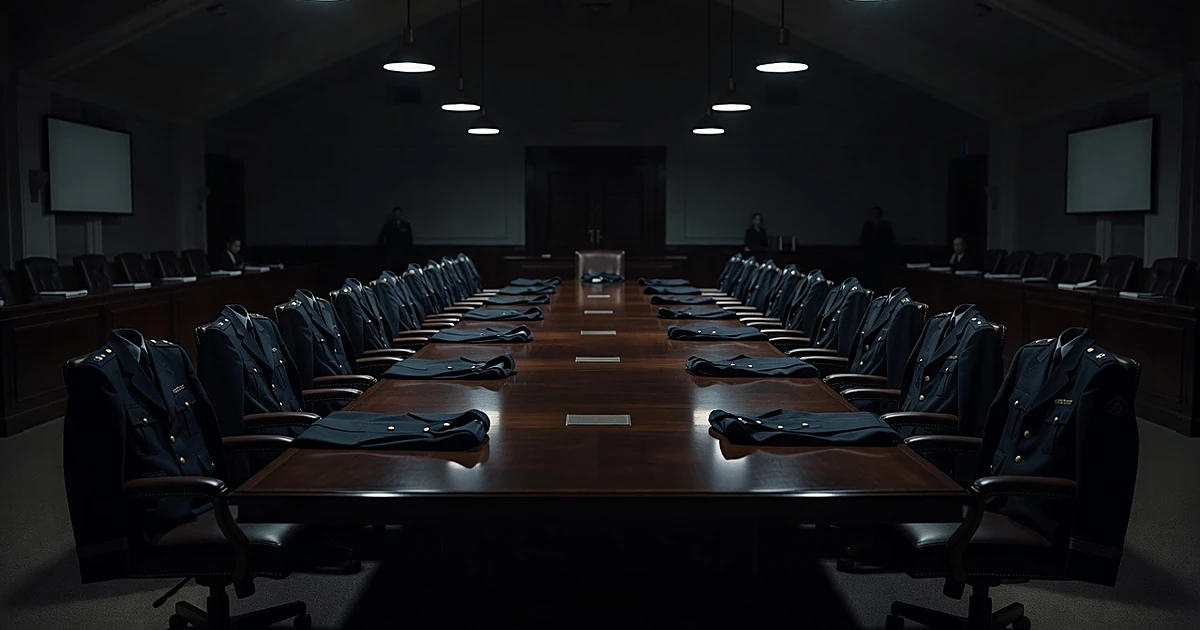
Friday's funeral drew roughly 2,000 mourners, a visible measure of how deeply Bartholomew's death has shaken the law enforcement community. The sea of blue uniforms was a tribute to a fallen colleague, and, for many in attendance, a rebuke to the policies they believe made his death possible.
Officer Bartholomew served Chicago for a decade. Alphanso Talley spent that same decade cycling through the criminal justice system, armed robberies, felon-in-possession charges, battery on a police officer, and cycling back out. The system had his record. It had his violations. It had a warrant. It had every reason to keep him locked up.
It didn't. And now a family of four is a family of three.
When the architects of decarceration admit that "innocents are going to be hurt" as "a price to pay," they should be forced to name the price. This time it was John Bartholomew. The people who wrote these laws, signed these orders, and praised a violent felon's "developing mind" owe his children more than condolences. They owe them an explanation, and a change.