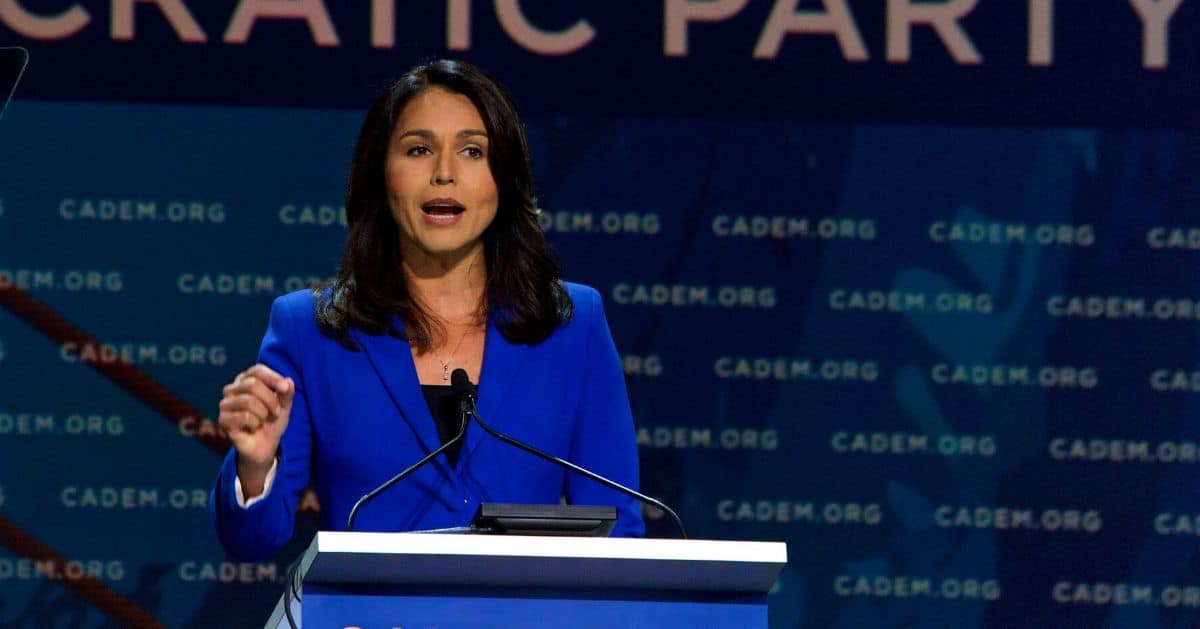
Director of National Intelligence Tulsi Gabbard finds herself at the center of a puzzling whistleblower complaint that has been stuck in bureaucratic limbo for months.
Reported first by The Wall Street Journal on Monday, the complaint against Gabbard, filed in May, involves undisclosed allegations and a separate federal agency beyond her office at the Office of the Director of National Intelligence (ODNI). Details remain unclear, and while the Office of the Intelligence Community Inspector General (ICIG) found specific claims against Gabbard not credible, other aspects could not be verified. A spokesperson for Gabbard’s office, Olivia Coleman, stated on Monday that the complaint is now with the Congressional Intelligence Committees for review.
The issue has ignited a firestorm of debate over transparency and accountability within our intelligence apparatus. While some question the legitimacy of the complaint, others see a troubling delay in its handling. Let’s unpack this mess and see where the truth might lie.
The complaint, languishing since May, has raised eyebrows over why it took so long to reach Congress. Andrew Bakaj, the whistleblower’s attorney, accused Gabbard of stalling the process, a charge her office vehemently denies, according to the New York Post.
Bakaj told the Journal, “It is confounding for [Gabbard’s office] to take weeks—let alone eight months—to transmit a disclosure to Congress.” That kind of delay smells like red tape at best, or a cover-up at worst, to those of us who value straight talk over bureaucratic games. If sensitive materials are involved, as an ICIG representative noted, fine—but let’s not hide behind “special handling” excuses.
Gabbard’s spokesperson, Olivia Coleman, fired back on X, asserting, “There was absolutely NO wrongdoing by DNI Gabbard.” Her office insists that even the prior administration’s ICIG found the allegations baseless, and Gabbard supports whistleblowers’ rights, no matter how unfounded the claims. That’s a bold stand in a town where whistleblowing often turns into political theater.
Coleman’s statement on Monday added that the complaint is now under review by Congressional Intelligence Committees. Yet, it’s murky whether either committee has seen the full document, and their spokespeople are staying tight-lipped. This opacity only fuels distrust in a system already viewed with suspicion by many Americans.
An ODNI official clarified to The Post that Gabbard wasn’t even told for months that she needed to provide security guidance on the complaint. Once informed—shortly after Christopher Fox took over as ICIG in October—she acted swiftly. That’s a reasonable explanation, though it begs the question of why the delay happened upstream.
The same ODNI source emphasized that Gabbard had no legal duty to rush the complaint along since it wasn’t deemed credible. If true, this undercuts the narrative of intentional stalling. Still, perception matters, and slow-walking anything in D.C. can look like dodging accountability to a skeptical public.
The ICIG has reportedly locked the complaint in a safe due to its “exceptionally sensitive materials,” requiring special storage. That’s a fair precaution, but it also amplifies curiosity about what’s so explosive that it needs Fort Knox-level security. Are we protecting national secrets or just avoiding hard questions?
Gabbard’s recent appearance at an FBI raid on a Fulton County, Ga., election center last week adds another layer to her public profile. Her presence there signals she’s deeply involved in probing allegations of voter fraud tied to 2020—claims Trump’s allies have championed as evidence of a stolen second term. This isn’t just about intelligence; it’s about restoring faith in our elections.
Her role in that investigation shows a leader willing to dig into controversies others might shy away from. While the left may paint this as partisan meddling, many see it as a necessary push against a system that’s too often dismissed for its failure to address valid concerns about electoral integrity. Gabbard’s actions here resonate with those fed up with establishment excuses.
The whistleblower saga, though, could distract from these bigger fights. With Bakaj—who previously advised a CIA officer in the 2019 Trump impeachment drama—representing the complainant, some might suspect a political hit job. That history doesn’t automatically discredit the complaint, but it sure raises questions about motives.
For now, all eyes are on Congress to see if they’ll push for clarity or let this fade into the D.C. fog. Gabbard’s team seems confident, and her track record suggests she won’t back down from a fight—whether it’s against baseless accusations or systemic corruption. The American people deserve answers, not endless delays.
This isn’t just about one complaint; it’s about whether our intelligence community can be trusted to self-police without playing favorites. If Gabbard is in the right, as her office claims, then let’s clear the air fast and move on to the real issues—like securing our elections and nation. If not, then no safe in Washington should shield the truth from coming out.