
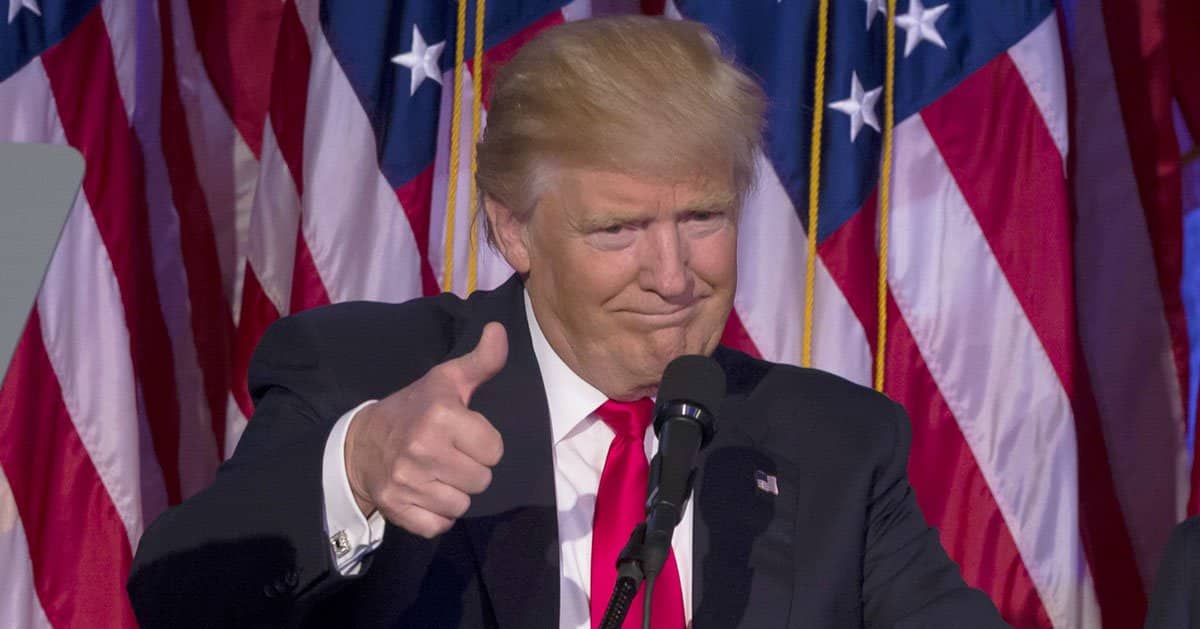
President Trump put Republican dissenters on notice Wednesday evening, warning that any GOP lawmaker who votes against his tariffs will face primary challengers and electoral punishment. The threat arrived on Truth Social hours after six House Republicans broke ranks and sided with Democrats on a resolution to repeal tariffs on Canada.
The message left nothing to interpretation:
"Any Republican, in the House or the Senate, that votes against TARIFFS will seriously suffer the consequences come Election time, and that includes Primaries!"
The six Republicans who crossed the line: Reps. Don Bacon (R-Neb.), Kevin Kiley (R-Calif.), Thomas Massie (R-Ky.), Jeff Hurd (R-Colo.), Brian Fitzpatrick (R-Pa.), and Dan Newhouse (R-Wash.). They joined Democrats in backing a resolution sponsored by Rep. Gregory Meeks (D-N.Y.), the ranking member of the House Foreign Affairs Committee. On the other side of the aisle, Rep. Jared Goldman of Maine was the sole Democrat to vote against the measure.
There's a recurring pattern in Washington: a handful of Republicans decide the politically comfortable move is to side with Democrats on a high-profile vote, collect favorable press for 48 hours, and then discover that the base has a longer memory than the news cycle.
As The Hill reported, these six chose to align with a Democratic resolution to strip away tariffs on Canada — tariffs that sit at the center of Trump's trade and national security architecture. Whatever their individual reasoning, the optics are brutal. They handed Democrats a bipartisan talking point on an issue where the president has drawn a clear line.
And that line is now electrified.
Trump's follow-up framed tariffs not merely as economic tools but as instruments of geopolitical leverage:
"In addition, TARIFFS have given us Great National Security because the mere mention of the word has Countries agreeing to our strongest wishes."
More than just rhetoric, it's a theory of negotiation that has already produced results — foreign governments recalculating their positions before tariffs even take full effect. Whether the six defectors agree with that framework or not, voting to dismantle it while negotiations are ongoing undermines the president's hand at the table.
The Democratic Governors Association wasted no time weaponizing the vote. Communications director Sam Newton issued a statement Wednesday targeting House Republican gubernatorial candidates who voted to uphold the tariffs:
"As Americans continue to bear the brunt of high costs on everything from housing to groceries, every congressional Republican running for governor voted to defend Trump's deeply unpopular, cost-raising tariffs on Canada."
Newton went further, invoking the 2025 elections in New Jersey and Virginia:
"Republican candidates got blown out of the water in New Jersey and Virginia in 2025 because Americans are tired of their disastrous economic agenda."
This is standard-issue Democratic messaging — blame every grocery bill on tariffs while pretending the last several years of inflation materialized from nowhere. The framing conveniently skips the part where years of reckless federal spending, regulatory expansion, and energy policy sabotage laid the groundwork for the cost-of-living crisis that Americans are actually experiencing.
Newton's statement also reveals the Democratic playbook for 2026: make tariffs the singular economic villain. It's a neat trick if you can pull it off — reduce a complex global trade realignment to a bumper sticker and hope voters don't remember who was in charge when prices first started climbing.
The nonpartisan Tax Foundation estimated that the tariffs resulted in an average tax increase of roughly $1,000 per U.S. household last year, with that figure potentially climbing by several hundred dollars this year if current policies remain in place.
That number deserves honest engagement. Nobody — including the president — has argued that tariffs come with zero short-term cost. The question is whether that cost purchases something of strategic value. National security leverage. Reshored manufacturing. A trading relationship with Canada that doesn't operate on autopilot while American workers absorb the downside.
Trump framed it directly:
"TARIFFS have given us Economic and National Security, and no Republican should be responsible for destroying this privilege."
This is the argument the six defectors need to answer — not to the media, which will celebrate their independence, but to Republican primary voters who sent them to Washington to back this president's agenda. The $1,000 figure is real. So is the leverage that tariffs provide at a negotiating table where Canada, Mexico, and China all have reasons to make concessions.
The resolution's overall fate in the House remains unclear from the vote alone. But the political fallout is already in motion. Trump's threat of primary consequences is not abstract. He has demonstrated — repeatedly — the willingness and the ability to recruit challengers against Republicans who break with him on signature issues. Tariffs are about as signature as it gets.
For Bacon, Kiley, Massie, Hurd, Fitzpatrick, and Newhouse, the calculus now shifts. Whatever moderate credibility they gained on Wednesday will be weighed against the reality of a Republican electorate that overwhelmingly supports using tariffs as a tool of economic nationalism. These aren't swing-district Democrats, they're courting. They're Republican incumbents who just told their base they know better than the president on his defining economic issue.
That's a bet. And Trump just told them what the house odds look like.