
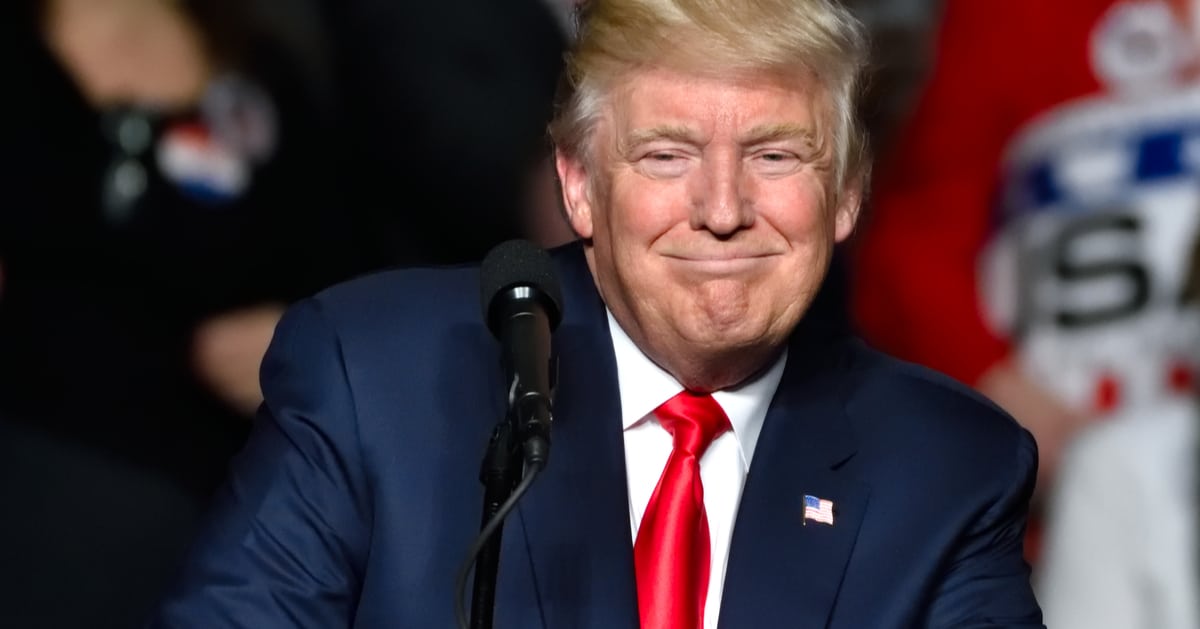

President Donald Trump shared a dramatic video on Truth Social Thursday showing one of Iran's largest bridges crumbling after a U.S. military strike, accompanied by a blunt message to Tehran: make a deal or lose everything.
The strike destroyed the B1 bridge linking Tehran with the nearby city of Karaj, a span standing more than 130 meters high. U.S. defense officials said the bridge was used to transport drone and missile components to Iranian firing units targeting allied forces in the region. One official described it as a "planned military supply route."
Trump's message left nothing to interpretation.
"The biggest bridge in Iran comes tumbling down, never to be used again — Much more to follow! IT IS TIME FOR IRAN TO MAKE A DEAL BEFORE IT IS TOO LATE, AND THERE IS NOTHING LEFT OF WHAT STILL COULD BECOME A GREAT COUNTRY!"
The bridge strike follows Trump's primetime address to the nation Wednesday night, in which he outlined the progress of Operation Epic Fury and signaled that the campaign is accelerating, not winding down.
"We are on track to complete all of America's military objectives shortly, very shortly."
According to Breitbart, Trump estimated a timeline of "two to three weeks" for the conclusion of core operations, while warning that targets would expand to include energy and power facilities if Iran refused to come to the table. He said the U.S. would hit Iran "extremely hard" and send the regime "back to the Stone Age."
That is not bluster dressed up as strategy. It is a strategy communicated as directly as possible, so no one in Tehran can claim they weren't warned. The bridge video is proof of concept. A 130-meter span of steel and concrete, reduced to rubble, posted for the world to see. The next target won't be a surprise either.
Iran responded to the strike by declaring that the U.S. was hitting "legitimate targets," a framing clearly meant to suggest indiscriminate American bombing rather than precision strikes on military logistics. Iranian Foreign Minister Abbas Araghchi pushed back on Trump's remarks in a post on X, writing that before the "Stone Age," there "was no oil or gas being pumped in the Middle East," and questioning whether the U.S. truly intended to "turn back the clock."
The retort tells you everything about where Tehran stands right now. When your foreign minister's best response to a destroyed military supply bridge is a philosophical musing about the Stone Age, you are not negotiating from strength. You are buying time and hoping the news cycle moves on.
It won't.
There is a reason Trump posted the video himself rather than letting Pentagon briefings carry the news. Every regime calculates based on what it believes the other side is willing to do. For decades, Iran operated under the assumption that American presidents would threaten consequences but flinch at the moment of commitment. Posting footage of a critical bridge collapsing in real time rewrites that calculation in a way no diplomatic communiqué ever could.
The bridge wasn't a random target. It was a logistics artery feeding Iranian drone and missile operations against allied forces. Destroying it degrades Iran's ability to project force while simultaneously delivering a message that is impossible to spin away. The rubble doesn't care about your talking points.
Trump made the escalation ladder explicit: infrastructure first, then energy, then power. Each rung is designed to impose compounding costs on a regime that has spent years funding proxy wars while its own population suffers under economic strain. The question is whether Iran's leadership values its nuclear ambitions and regional proxies more than the physical infrastructure that keeps the country functioning.
The "two to three weeks" timeline is worth watching closely. It sets a public benchmark, which means the administration is confident enough in its operational tempo to put a clock on it. That kind of specificity is not something you offer unless you intend to deliver.
Iran has a window. Trump told them exactly how wide it is. The bridge that once connected Tehran to Karaj is now a pile of debris and a viral video, which is as clear an invitation to negotiate as any regime has ever received.
The next one won't come with a warning.