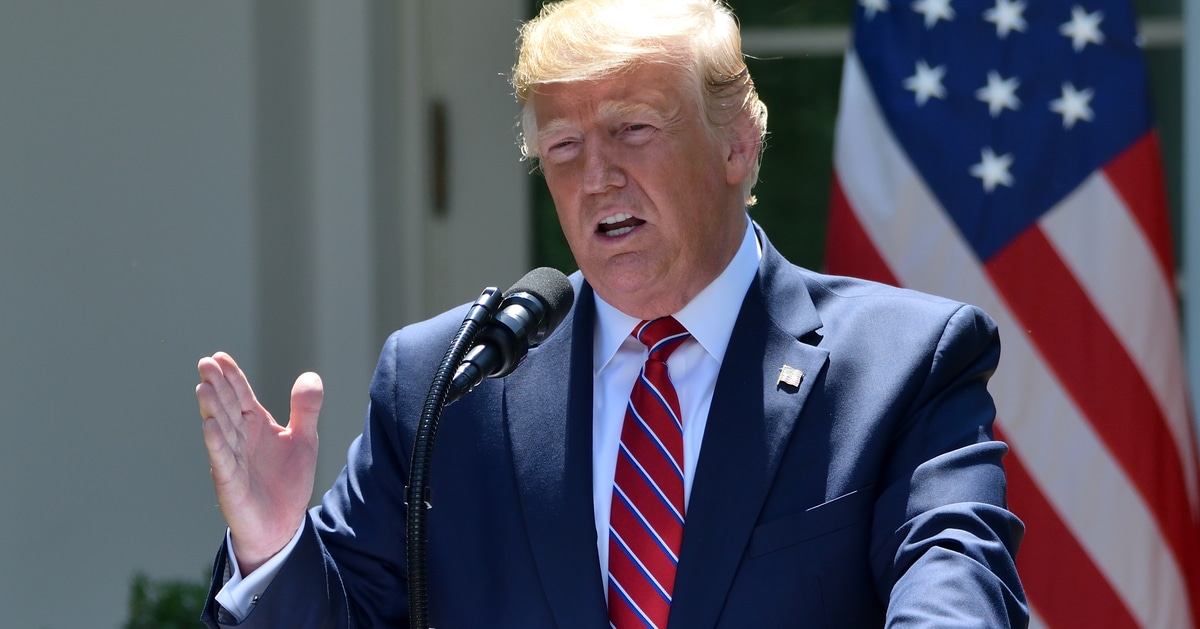


President Donald Trump announced that "Many of Iran's Military Leaders" were "terminated" in what he described as a "massive strike in Tehran," posting the claim on Truth Social alongside a video that appeared to show the strike itself.
The post carried the force of a commander-in-chief who has spent weeks drawing clear lines and watching Tehran test every one of them.
"Many of Iran's Military Leaders, who have led them poorly and unwisely, are terminated, along with much else, with this massive strike in Tehran!"
Trump paired the announcement with a renewed ultimatum over the Strait of Hormuz, the narrow chokepoint through which a massive share of the world's oil supply flows. Earlier in the day, he reminded Iran of the timeline he had already set.
"Remember when I gave Iran ten days to MAKE A DEAL or OPEN UP THE HORMUZ STRAIT."
"Time is running out – 48 hours before all Hell will reign down on them."
That 48-hour window places the next threshold before Monday's deadline.
The sequence here is worth understanding. Trump gave Iran ten days to either negotiate or reopen the Strait. Tehran chose neither. Instead, the regime continued choking off the vital waterway while its diplomats played for time. As Breitbart News's Joshua Klein reported, Trump had previously warned that if Tehran refused to reopen the Strait of Hormuz and failed to reach terms, the United States could strike major regime infrastructure, including electric generating plants, oil wells, and Kharg Island, the country's main oil export hub, as Breitbart reports.
That wasn't bluster. It was a publicly stated sequence of consequences. And now those consequences appear to have arrived in Tehran.
This is what deterrence looks like when it isn't theoretical. For years, foreign policy commentators have agonized over how to handle a regime that funds proxies across the Middle East, threatens global energy markets, and sprints toward nuclear capability. The conventional wisdom was always to manage Iran, to contain it, to negotiate endlessly while the centrifuges kept spinning. Trump's approach is blunter: state the terms, set the clock, and follow through.
Iranian Foreign Minister Abbas Araghchi offered what can only be described as the diplomatic equivalent of changing the subject. On Saturday, Araghchi claimed Tehran's position was being "misrepresented by U.S. media" and insisted the regime had "never refused to go to Islamabad."
He then framed Iran's objective as a "conclusive and lasting END to the illegal war that is imposed on us."
Note the construction. Iran is not the aggressor. Iran is the victim. The war is "imposed" on Tehran, as if the regime's decades of proxy warfare, its bankrolling of Hezbollah, its arming of the Houthis, and its ongoing threats to international shipping are all things that simply happened to it. This is the same rhetorical playbook Iran has run for forty years: provoke, escalate, then claim persecution when the response arrives.
Meanwhile, CNN reported that unnamed Iranian officials warned of "hell" if the conflict expands. The irony of a regime that has spent years expanding conflict across the region now pleading for restraint from others requires no editorial comment.
For readers wondering why a waterway thousands of miles from American shores keeps appearing in presidential ultimatums, the answer is simple: the Strait of Hormuz is the world's most important oil chokepoint. When Iran threatens to close it, they are threatening the global economy. They are threatening the price Americans pay at the pump. They are threatening the energy security of every allied nation that depends on Gulf oil.
Keeping that straight open is not optional. It is not a negotiating chip. And any regime that treats it as one is making a statement about its willingness to hold the global economy hostage for political leverage.
Trump's position is that this is unacceptable. He said so publicly. He gave a timeline. And he appears to have acted on it.
The strike in Tehran changes the calculus, but it does not end the confrontation. Trump's renewed ultimatum makes clear that additional consequences remain on the table if Iran does not comply before the Monday deadline. The list of potential targets he previously outlined, including electric infrastructure, oil wells, and Kharg Island, represents an escalation ladder that Tehran should take seriously.
The question now is whether Iran's remaining leadership grasps what has changed. The old model, where American presidents issue warnings and then settle for diplomatic half-measures, is not operative. The ten-day window was not a suggestion. The 48-hour warning is not a talking point.
Tehran has spent decades betting that American resolve is temporary. That bet just got considerably more expensive.