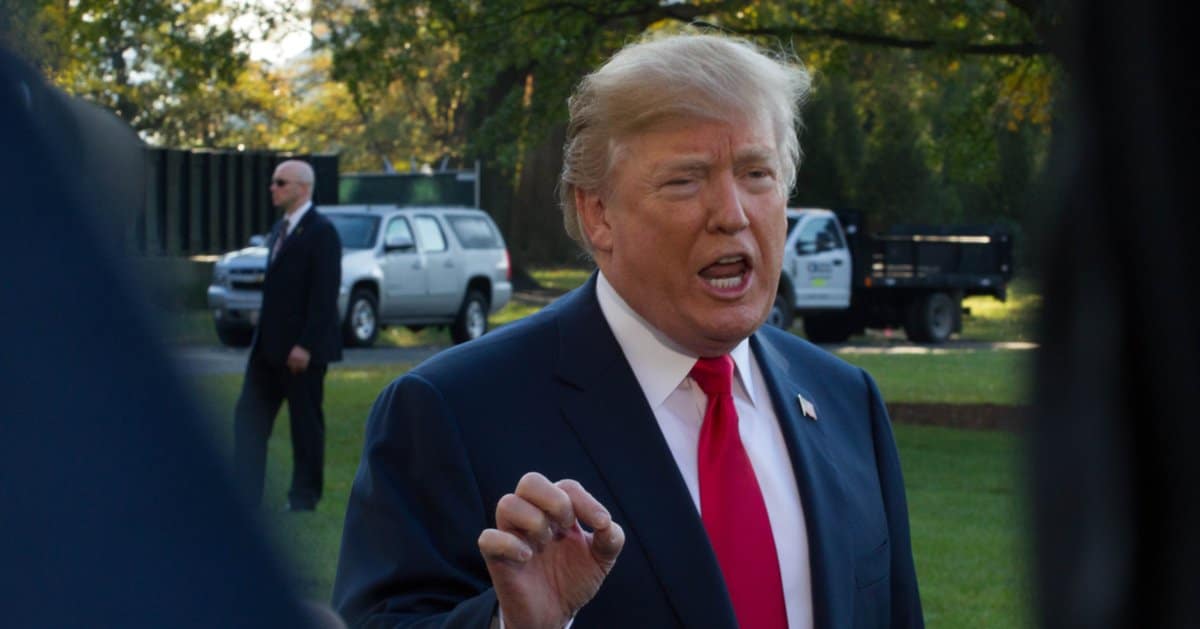

President Donald Trump didn’t hold back during a White House news conference on Tuesday afternoon, targeting Rep. Ilhan Omar (D-Minn.) with sharp criticism over her reported wealth increase.
During the briefing, Trump accused Omar of questionable financial gains as the Republican-led House Oversight Committee investigates a significant jump in her net worth, reportedly up by $30 million in a single year. The probe also scrutinizes financial disclosures related to her husband, Tim Mynett, and his business ventures. Additionally, Trump commented on broader issues in Minnesota, alleging that substantial funds are unaccounted for in the state.
The controversy has ignited discussions on Capitol Hill and beyond, with critics questioning the transparency of Omar’s financial dealings. Many argue that lawmakers must be held to the highest standards of accountability.
Trump’s Tuesday remarks pulled no punches, labeling Omar as “crooked” while questioning how her wealth could have surged so dramatically. He tied her to the far-left “Squad” and expressed frustration over her influence, Fox News reported.
“I was told that Ilhan Omar is worth $30 million,” Trump stated during the conference. “She never had a job.”
These comments, while pointed, reflect a broader concern among some about the rapid increase in Omar’s reported net worth, especially given her relatively short time in office.
The House Oversight Committee, led by Republican Chairman James Comer, has zeroed in on financial disclosures tied to both Omar and Mynett. Notably, Rose Lake Capital LLC, a firm co-founded by Mynett, was valued between $5 million and $25 million in 2024, a stark rise from a reported $1 to $1,000 the previous year.
Additionally, a winery in Santa Rosa, California, named ESTCRU LLC, appeared on Omar’s disclosures with a value between $1 million and $5 million in 2024, up from just $15,000 to $50,000 the year before. These figures have raised eyebrows among those seeking clarity on the sources of such growth.
Omar, for her part, has pushed back against the scrutiny, denying claims of vast personal wealth earlier this year and asserting via social media that she “barely” has thousands, let alone millions. Her defenders argue that this investigation is politically motivated by House Republicans.
Trump also used the briefing to highlight what he described as major financial discrepancies in Minnesota, alleging that at least $19 billion is unaccounted for in the state. He suggested a connection to the Somali community, a claim that has drawn sharp criticism for lacking specific evidence.
Without verified data or official methodology released, such statements risk fueling unnecessary tension. The administration has indicated it is aware of allegations against Omar and plans to look into them further, alongside House Republicans.
While concerns about fraud or mismanagement in state programs deserve attention, broad assertions tied to specific communities must be handled with care to avoid misinterpretation. Policy-focused solutions, rather than generalized critiques, would better serve the public interest.
The investigation into Omar’s finances touches on a critical issue: the need for transparency among elected officials. If discrepancies exist, they must be addressed through proper channels, not public speculation.
Yet, there’s also a risk of overreach, where political opponents weaponize inquiries to score points rather than seek the truth. Striking a balance between accountability and fairness is essential in a polarized climate.
As this story unfolds, the public deserves clear answers about Omar’s financial surge and any potential irregularities in Minnesota. Oversight is a cornerstone of trust in governance, but it must be wielded with precision, not as a blunt instrument for political gain.