

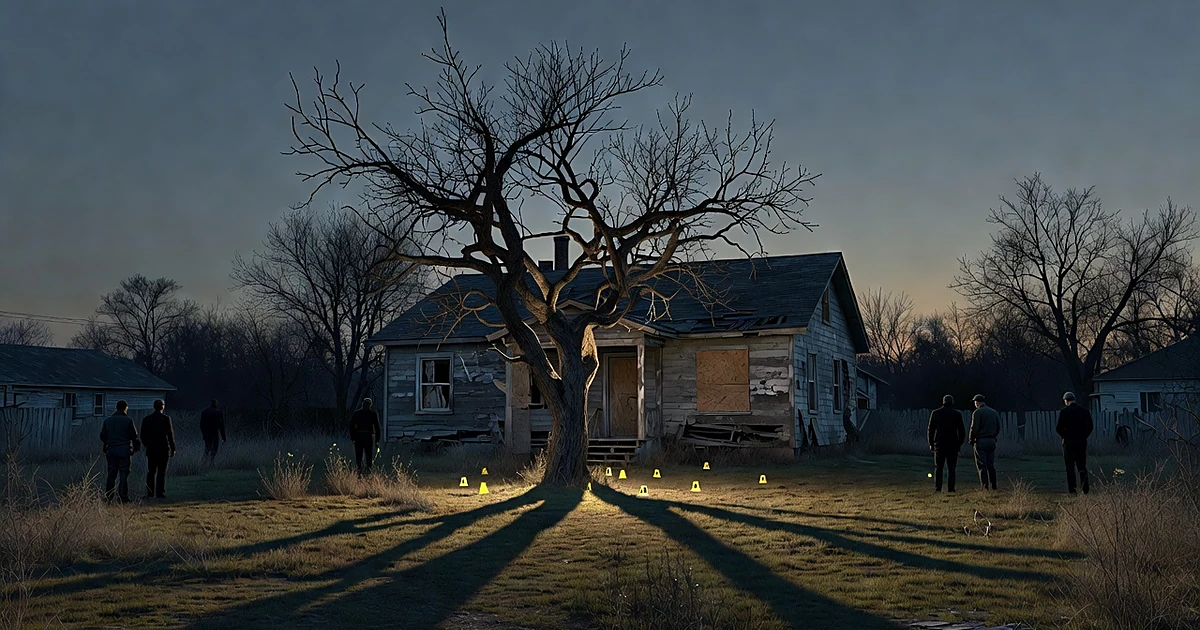



A 51-year-old San Antonio man faces a murder charge after investigators say surveillance video captured him entering and leaving an abandoned home where a 39-year-old man was beaten to death, and two separate witnesses told police the suspect later confessed to the killing.
Victor Sigala sits in Bexar County Jail on $250,000 bond. Eric Perez, the man found dead inside the abandoned home off Prairie Hill Street near Palo Alto Road on the city's Southwest Side, was pronounced dead at the scene on May 8 after suffering severe head injuries. Two other suspects shown in the footage remain unidentified.
The case, reported by News 4 San Antonio, hinges on a combination of neighborhood surveillance footage and damning alleged admissions Sigala reportedly made to people he knew, one a close friend, the other a woman who told police she had known him for roughly 30 years.
The arrest report lays out a grim sequence. Surveillance footage from a neighboring home across the street showed three masked men entering the abandoned house shortly before Perez was found dead. One carried an aluminum baseball bat. Another carried a metal rod.
When the group left, one of the suspects removed his mask. Detectives identified that man as Sigala.
The footage also showed Sigala entering and leaving the property while carrying the bat, the same weapon a witness later said Sigala admitted using on Perez.
Police interviewed Sigala at a nearby residence on the same day Perez's body was discovered. What Sigala told officers during that interview has not been made public. But what he allegedly told others paints a far more detailed picture.
A close friend of Sigala's told investigators that the suspect returned after the attack and made statements about what had happened. The witness reported that Sigala said, "I hit him with a bat," and added, "He wasn't moving."
A second witness, a woman who said she had known Sigala for about 30 years, told police that Sigala confessed while the two were talking at Palo Alto Park. She attributed far blunter words to him: "I hit him first, I knew I killed him."
That same witness also told investigators that a second man struck Perez and a third person kicked him. The arrest report does not name those additional suspects, and police have not publicly identified them.
Neither witness has been publicly named.
No motive has been disclosed. The arrest report does not describe any prior relationship between Sigala and Perez, and investigators have not said publicly what drew three armed men to an abandoned home on the Southwest Side.
It is also unclear whether the two unidentified suspects face pending charges or whether authorities consider them witnesses. Sigala's plea status and whether he has retained counsel have not been reported. The case raises the same uncomfortable question that surfaces in violent crime after violent crime across the country: how many people knew something, and how long did they sit on it before investigators came knocking?
Cases like this one, where victims are beaten and left to die, remind communities that the most basic function of government is protecting life, and that function depends on swift investigation and accountability.
The role of the neighbor's camera system in this case is worth noting. Without that footage, investigators would have relied almost entirely on witness statements, statements from people close enough to Sigala that he apparently felt comfortable admitting what he had done.
Surveillance video has become a critical tool in building criminal cases across the country. In one recent incident, video evidence played a central role in efforts to identify suspects in a violent brawl in Washington, D.C. In San Antonio, a single camera across the street from an abandoned house may have made the difference between a cold case and a murder charge.
The footage did more than place Sigala at the scene. It showed him carrying the bat. It showed the moment he pulled off his mask. And it corroborated the timeline that witnesses described, three men entering armed, one man left dead inside.
Perez's killing fits a pattern that law enforcement agencies across the country confront regularly: lethal violence carried out by multiple assailants, often in locations chosen precisely because no one is expected to be watching. Abandoned properties attract crime. They attract victims. And they attract people who believe they can act without consequence.
In this case, the consequence came, at least for one of the three suspects. Sigala's bond was set at $250,000, a figure that reflects the severity of the charge but does not guarantee he will remain behind bars through trial.
The case also echoes other recent violent crimes that have drawn national attention. A murder suspect in another case allegedly killed an acquaintance during an argument and then fled with the body, a reminder that violent crime often unfolds between people who know each other, in places where help is far away.
What separates cases that get solved from those that don't is often a single piece of evidence, a camera, a confession to the wrong person, a mask removed a few seconds too soon. Sigala, if the arrest report is accurate, managed all three.
Elsewhere, courts continue to grapple with suspects who cycle through the system. A man previously found incompetent to stand trial was recently charged with attempted murder at a Seattle train station, raising familiar questions about whether the justice system moves fast enough to keep dangerous individuals off the streets.
The most pressing open question in the Perez case is straightforward: who are the other two men on the surveillance footage?
One carried a metal rod. The third suspect was described as kicking Perez while he lay on the ground. Both wore masks. Both left the abandoned home alongside Sigala. And both remain unidentified, at least publicly.
Whether those men will face charges depends on how aggressively investigators pursue the case beyond the arrest they have already made. One suspect in custody is progress. But three men entered that house, and only one has been held to account.
For the family of Eric Perez, a 39-year-old man found dead with severe head injuries in a place no one was supposed to be living, one arrest is not justice. It is a start.
Justice means every person who walked into that abandoned home carrying a weapon walks into a courtroom to answer for it.