

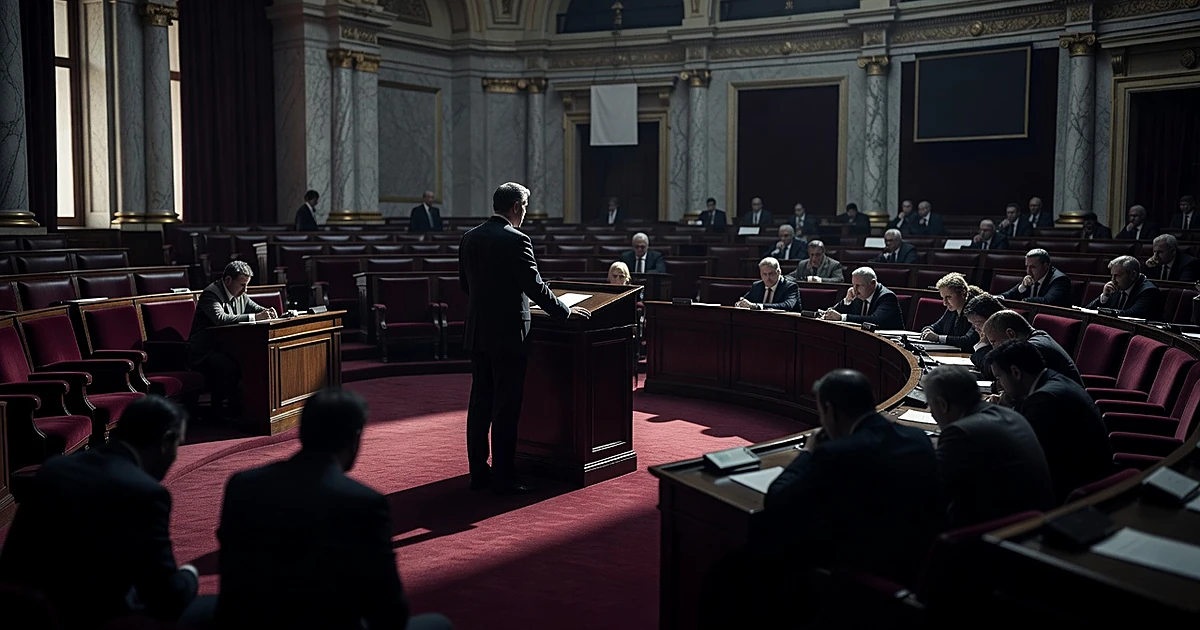


Jesse Jackson Jr. stood before a packed memorial service in Chicago on Saturday and delivered a rebuke that cut through the eulogies like a cold wind off Lake Michigan. The three former Democratic presidents who had just spent hours praising his father, he said, didn't actually know the man.
The reverend's son addressed the tributes offered by Bill Clinton, Barack Obama, and Joe Biden at the March 6 memorial for the late Rev. Jesse Jackson, the civil rights leader and two-time Democratic presidential candidate who died on February 17 in Chicago at the age of 84.
"Yesterday I listened for several hours of three United States presidents who do not know Jesse Jackson."
It was a remarkable moment. Not a whispered aside. Not a veiled allusion. A son looked at the most powerful figures in his father's own party and told them, publicly, that they had missed the point.
The rebuke didn't come without warning, Fox News noted. In February, one day after his father's death, Jackson Jr. held a press conference where he explicitly requested that politics be kept out of the memorial services. The focus, he said, should remain on his father's legacy.
"Do not bring your politics out of respect to Rev. Jesse Jackson, and the life that he lived, to these ongoing services. Come respectful, and come to say thank you. But these ongoing services are welcome to ALL—Democrat, Republican, liberal, and conservative. Right-wing, left-wing. Because his life is broad enough to cover the full spectrum of what it means to be an American."
That was the ask. Come to honor a man, not to score points. And then the former presidents showed up and did exactly what they were asked not to do.
Barack Obama reportedly aimed at President Donald Trump during his speech, telling the crowd that "every day we wake up to some new assault on our democratic institutions." Joe Biden told mourners he is "a h--- of a lot smarter than most of you," a comment made while recounting childhood struggles with his stutter. Bill Clinton called Jackson a friend and recalled a conversation with the reverend during his impeachment.
Three presidents. Three men who turned a memorial into a mirror.
There is a pattern here that conservative observers have watched repeat itself for years. Democratic leaders treat funerals and memorials as campaign stops. The eulogy becomes the vehicle, the deceased becomes the backdrop, and the audience becomes the target demographic. It happened at John Lewis's funeral. It happened at Coretta Scott King's. Now it happened at Jesse Jackson's.
Jackson Jr. understood the pattern well enough to try to preempt it. He failed, but his failure is instructive. Even the family of the honored dead cannot compel Democratic leaders to set aside their political reflexes for a few hours. The gravitational pull of the microphone and the captive audience is simply too strong.
Obama's remark about "democratic institutions" wasn't a tribute to Jesse Jackson. It was a stump speech fragment dropped into a sacred setting. Biden's self-referential comment about his own intelligence at another man's memorial speaks for itself. Clinton reminiscing about his own impeachment at someone else's funeral is a level of main-character syndrome that borders on performance art.
Jackson Jr. saw all of this and named it.
What made Jackson Jr.'s comments land wasn't just the directness. It was the substance behind them. He argued that his father's legacy couldn't be captured by men who operated within the very political system his father challenged.
"He maintained a tense relationship with the political order, not because the presidents were White or Black, but the demands of our message, the demands of speaking for the least of these — those who are disinherited, the damned, the dispossessed, the disrespected — demanded not Democratic or Republican solutions, but demanded a consistent, prophetic voice that at no point in time sold us out as a people."
Read that carefully. Jackson Jr. is saying his father wasn't a partisan tool. He's saying the Democratic establishment tried to claim a man who challenged them, who made them uncomfortable, who refused to be domesticated by party loyalty. And then at his memorial, those same leaders proved the point by making it about themselves and their political grievances.
The irony writes itself. Three presidents eulogized a man by demonstrating exactly the behavior his son said they never understood about him.
The memorial drew a roster of Democratic power that doubled as a who's who of the party's recent past:
Everyone of them came to pay respects. But Jackson Jr.'s plea that the services remain nonpartisan, open to Americans across the political spectrum, suggests the atmosphere didn't match the intent. When the most prominent attendees are all from one party, and the speeches veer into partisan commentary, the "welcome to ALL" promise rings hollow, no matter how sincerely it was offered.
Jesse Jackson Jr. has his own complicated history. But on Saturday, he articulated something that resonated far beyond the walls of that Chicago service. He understood that his father's life was being conscripted into a political narrative that diminished it. He understood that powerful men were using a dead man's platform to talk about themselves. And he said so, plainly, in front of all of them.
That took nerve. It also took clarity about what these memorial services have become in Democratic politics: not acts of remembrance but exercises in coalition maintenance, where the departed serve as props for the living's agenda.
A son asked for respect. He got speeches. So he stood up and told the truth about the difference.