FBI agents arrested a 47-year-old Ohio man on Wednesday after he allegedly spent weeks posting violent threats online targeting President Donald Trump, ICE officers, judges, police, and others. Charles Bronson Ingram of Trumbull County now sits in federal custody, charged with making illegal threats via interstate communications.
According to Breitbart News, federal officials say Ingram posted dozens of violent comments over several weeks. One message, dated January 14, laid out instructions with chilling specificity:
"Get a gun Find good location up high. Kill a random ICE agent. Anytime, anywhere, and all the time."
That wasn't a one-off. Ingram allegedly encouraged others to kill wealthy people, judges, police officers, and CEOs. His YouTube profile picture reportedly depicted President Trump being shot in the head. When officers arrived at his property, they found something else. WFMJ reported that a task force officer observed:
"an upside-down American flag hanging on a building on the property. The officer said the flag had been spray-painted with the words, 'Kill Them All.' Next to it was a sign with the message 'F–k Trump.'"
Ingram reportedly admitted to officers that he posted the messages online. He does not have a criminal record.
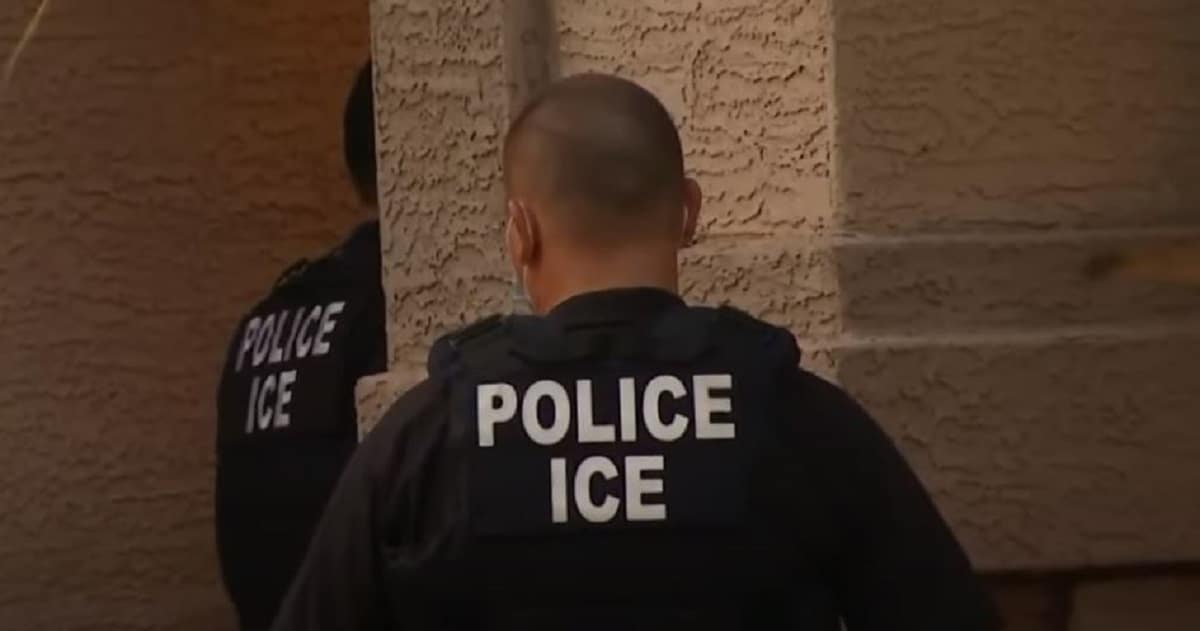
Ingram's arrest lands against a backdrop that should alarm every American who believes federal law enforcement officers deserve to go home to their families at night. Death threats against ICE officers and their families have surged by an astonishing 8,000 percent.
That number deserves a moment of consideration. Not a modest uptick. Not a troubling rise. Eight thousand percent.
This explosion in threats hasn't materialized in a vacuum. It tracks directly with the escalation of anti-enforcement rhetoric that has consumed the political left. When politicians, activists, and media figures spend years painting lawful immigration enforcement as a moral atrocity—comparing ICE agents to fascists, demanding the agency be abolished, celebrating obstruction of federal operations—the message filters down. Some people hear "ICE is evil" and take it as a call to action.
Ingram's alleged posts didn't target some abstract concept. They targeted human beings—agents with spouses, children, and lives outside the job. The instruction to find a high location and kill "a random ICE agent" reads like tactical guidance, not political commentary. The addition of "anytime, anywhere, and all the time" transforms it from a threat into a sustained campaign of incitement.
Ingram's arrest came on the same Wednesday that Ryan Wesley Routh, the 59-year-old man who attempted to assassinate President Trump at his Florida golf course, was sentenced to life plus 84 months in prison.
The Department of Justice described what happened that day in terms that read like a thriller—except it was real. Secret Service Special Agent Robert Fercano was patrolling one hole ahead of the president at Trump International Golf Club when he spotted Routh:
"According to evidence presented at trial, then-U.S. Secret Service Special Agent Robert Fercano was patrolling one hole ahead of President Trump at the Trump International Golf Club when he observed Routh pointing what appeared to be an AK 47-style rifle at him from a sniper's hide concealed in a fence line bordering the golf course. Fearing for his life and the life of President Trump, Special Agent Fercano fired at Routh, who fled the scene."
What investigators recovered at the scene confirmed this was no amateur impulse:
"Law enforcement officers later recovered a Norinco SKS rifle equipped with a scope, a loaded magazine containing 19 rounds of ammunition and one round in the chamber, steel armor plates, and a camera affixed to the fence and pointing at the sixth green of the golf course where President Trump was about to play golf."
A scope. Armor plates. A camera pointed at the green. This was a planned kill operation against the President of the United States.
FBI Director Kash Patel responded to the sentencing directly:
"Thanks to the work of the FBI and our Justice Department partners, he will pay a high price for his actions."
Routh's sentencing also brought renewed attention to the first attempt on Trump's life—the July 13 rally in Butler, Pennsylvania, where Thomas Matthew Crooks opened fire on the former president and then-candidate. A bullet pierced Trump's ear. Secret Service officers shot Crooks dead at the scene.
But Trump wasn't the only one who paid a price that day. Corey Comperatore—a husband, father, and Pennsylvania firefighter—was killed while shielding his wife and daughter from the gunfire. Two other men were wounded:
Two assassination attempts against one presidential candidate during a single campaign. A firefighter is dead. Two rallygoers were injured. A sniper's nest on a golf course. And now a man in Ohio is allegedly posting detailed instructions for killing federal agents. These are not isolated data points. They form a pattern.
There is a direct line between the normalization of political violence in rhetoric and its emergence in action. Not every person who chants "Abolish ICE" becomes Charles Bronson Ingram. But Ingram didn't radicalize himself in silence. He absorbed a political culture that treats enforcement of American immigration law as inherently illegitimate—a culture that has spent years telling its adherents that the people carrying out that enforcement are villains.
The same dynamic applies to the broader climate of threats against the president. When mainstream political discourse treats a duly elected leader as an existential threat to democracy itself—not as a political opponent, but as something that must be stopped by any means—unstable individuals receive that message differently than the average voter scrolling social media.
None of this is abstract. An 8,000 percent increase in death threats means real agents reviewing real messages describing how someone wants to murder them or hurt their families. It means children of federal officers growing up aware that their parent is hated for doing a lawful job.
The federal system moved on two fronts this week. Routh received a sentence that ensures he will never walk free again. Ingram is in custody, facing federal charges for making threats via interstate communications. Both outcomes signal that the current Justice Department intends to treat threats against the president and federal officers with the gravity they deserve.
That matters. Deterrence only works if people believe the system will act. For years, online threats occupied a gray zone where enforcement was inconsistent, and consequences were rare. The message from this week is different: post instructions for killing federal agents, and the FBI will find you.
Ingram sits in a federal holding facility tonight because he allegedly believed the internet was a consequence-free zone. Routh will spend the rest of his life in a federal prison because he believed he could position himself with a rifle, armor plates, and a camera outside the sixth green of a golf course and change the course of American history.
Corey Comperatore's family still doesn't have him at the dinner table. The agents whose names appear on those 8,000 percent worth of death threats still go to work every morning. President Trump survived two attempts on his life and governs from the office the American people elected him to hold.
The threats haven't stopped. But neither has the enforcement.