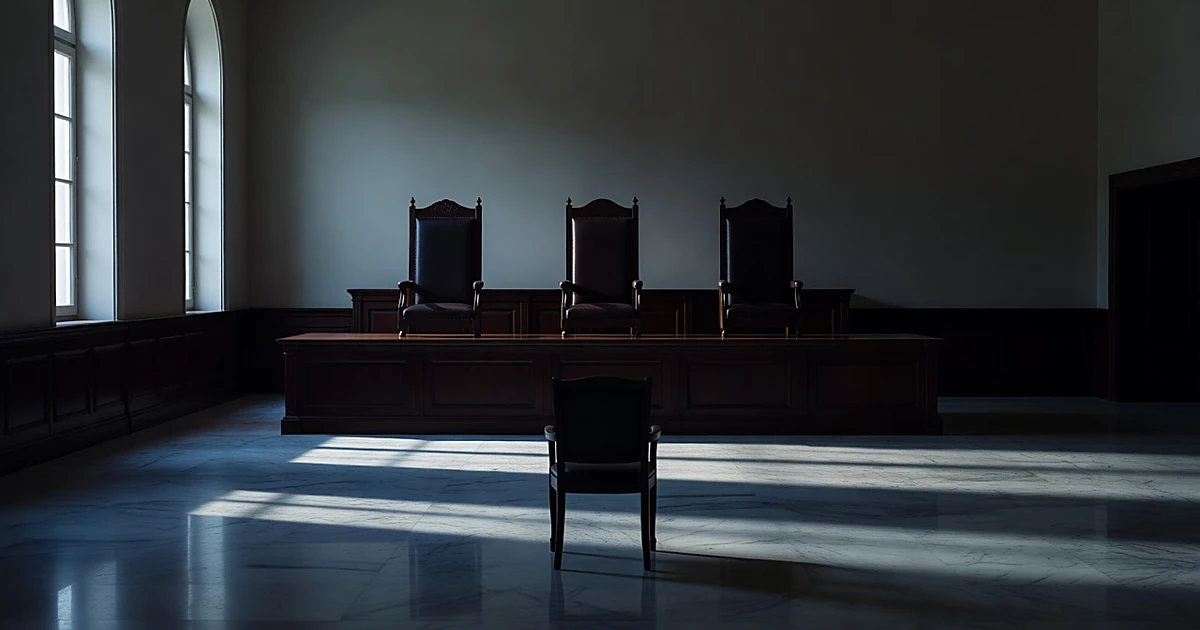


Erika Kirk, the widow of Charlie Kirk, leaned forward in a Utah courtroom Tuesday and handed a tissue to a woman she had never met, a small, quiet act that cut through the weight of a murder hearing and said more about her character than any prepared statement could.
The moment came on the second day of Tyler Robinson's preliminary hearing at the Fourth District Courthouse in Provo, Utah. Robinson, 23, stands accused of shooting and killing Charlie Kirk at a Turning Point USA event at Utah Valley University in Orem on September 10, 2025. Prosecutors are seeking the death penalty on aggravated murder charges.
The woman who received the tissue was Denae Branch, a survivor of the September shooting who had arrived at the courthouse around 2:30 a.m. Tuesday to secure one of just 14 public seats in the gallery. Branch did not know Erika Kirk personally. She came to support her, and ended up being comforted by her instead.
Branch and three friends had tried to attend Monday's opening session but arrived too late to claim seats. They came back that night, lining up at midnight and waiting through the early morning hours to make sure they got in.
All four said they were present at the Turning Point USA event where Charlie Kirk was killed. The court's decorum order barred messages of support for either side, and two women in Branch's group were asked to remove or cover their Turning Point USA T-shirts before entering.
So when Branch took her seat in the gallery Tuesday, Erika Kirk had no way of knowing who she was or why she was there.
As Fox News Digital reported, Branch later posted a teary video on Instagram describing the encounter. She said she watched Erika return to the courtroom and lean on her mother-in-law, Kathy Kirk, and the sight overwhelmed her.
"I went thinking I was going to support Erika, and at one point I turn around, and I see her just holding on to her sweet mother-in-law, and I like, kind of lose it and start crying. Next thing I know, I feel a tap on my shoulder, and I turn back, and Erika is handing me one of her tissues."
Branch said Erika had no idea she was there on her behalf.
"She didn't know that I was there for her. We weren't allowed to wear anything to tell her that we were there for her... But that's just who Erika is. She's good."
The tissue exchange did not happen in a vacuum. Minutes earlier, Erika Kirk and the Kirk family had walked out of the courtroom as testimony turned to the fatal gunshot. Defense attorney Richard Novak was cross-examining lead investigator David Hull when the family left. The court had given the Kirk family permission to come and go during painful testimony.
They returned roughly ten minutes later. Erika Kirk sat back down and leaned on Kathy Kirk, and then, seeing a stranger in tears in the row ahead, reached forward with a tissue.
She declined to be interviewed on camera.
The preliminary hearing, expected to last a full week, will determine whether sufficient probable cause exists to send Robinson to trial. Newsmax reported that the Utah Supreme Court denied Robinson's last-minute bid to block cameras from the courtroom, clearing the way for a livestreamed proceeding. Prosecutors plan to introduce ballistics reports, surveillance video, phone and social media data, and a prerecorded video interview in which a key witness says Robinson confessed.
Court filings have painted a disturbing picture of Robinson's alleged motive. National Review reported that Robinson texted his transgender partner after the shooting: "I had enough of his hatred. Some hate can't be negotiated out." A pre-shooting note attributed to Robinson read: "I have the opportunity to take out Charlie Kirk, and I'm going to take it."
DNA evidence links Robinson to a screwdriver found on a rooftop, a towel wrapped around the rifle, and the trigger of the gun, according to prosecutors.
The hearing has also surfaced legal skirmishes over the political dimensions of the case. AP News reported that defense attorney Novak sought to block prosecutors from introducing a Turning Point USA statement describing the organization's traditional Christian values, made by board member David Engelhardt. Novak argued, "I don't think that this court should be deciding, based on the record before it, where, if at all, politics and religion intersect." The judge provisionally admitted the statement as relevant evidence.
Erika Kirk has not retreated from public life since her husband's death. She holds the role of victim representative in the case and has pushed for maximum press access to the proceedings, the New York Post reported. Her presence in the Provo courtroom this week marked the first time she came face to face with the man accused of killing her husband.
That willingness to show up, and to stay engaged even through the most harrowing testimony, has not come without cost. Erika Kirk was previously forced to cancel a University of Georgia appearance after receiving what were described as very serious threats.
The broader political climate around Charlie Kirk's legacy has remained contentious. Utah Valley University drew criticism for selecting a Charlie Kirk critic as its commencement speaker, a decision many saw as tone-deaf given that Kirk was killed on that campus.
Former prosecutor Wendy Patrick, providing legal analysis of the hearing, told Just The News that the assassination "really had a worldwide reverberation" and called it "a wake-up call." She described the video footage of Kirk's killing as "explosive in nature" and "one of the most damning pieces of evidence" in the case, adding: "Unfortunately for those of us that saw it, it is absolutely triggering."
It is triggering for the witnesses, for the public, and most of all for the family. And yet Erika Kirk sat in that courtroom. She left when the testimony became unbearable, came back when she could, and still found the composure to notice someone else's pain.
The political atmosphere around cases like this one, where ideology appears to have driven lethal violence, has grown increasingly poisonous. Elected officials on the left have at times shown more sympathy for convicted political attackers than for their victims. Against that backdrop, Erika Kirk's conduct stands out not because it was dramatic, but because it was decent.
Branch, who waited through the night for a seat in a courtroom gallery, said it simply: "I hope she feels my prayers for her."
In a country that spends most of its time arguing about who deserves compassion, Erika Kirk just offered it, no speech, no camera, no calculation. A tissue and a tap on the shoulder. That is the kind of character no hearing can cross-examine.