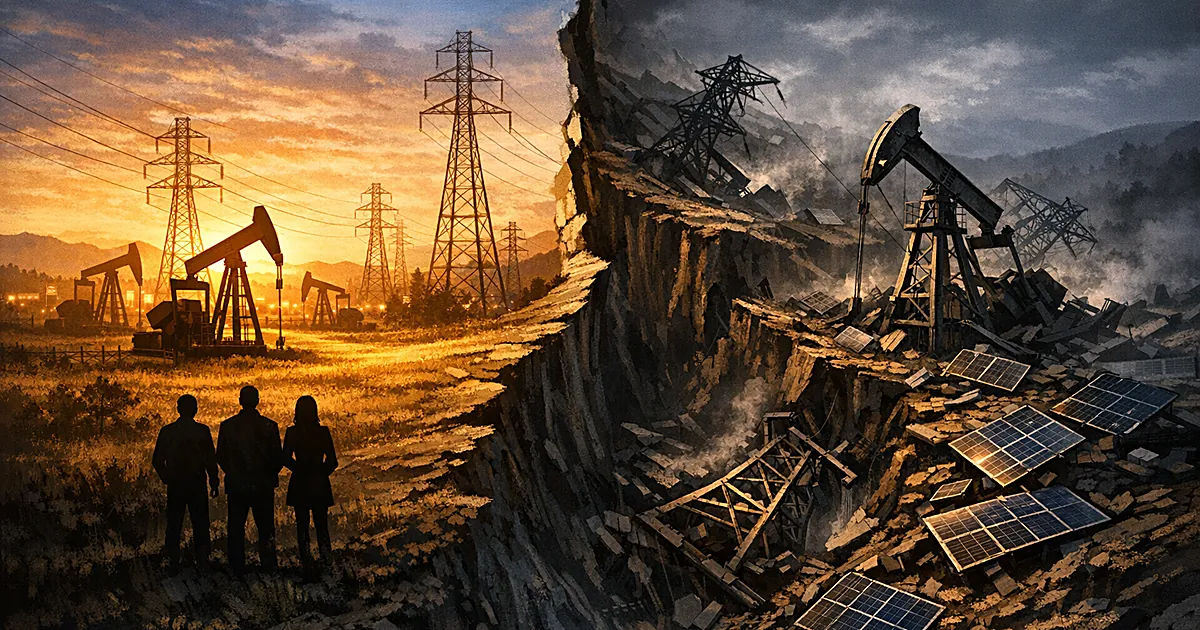


Energy Secretary Chris Wright accused the Biden administration of deliberately steering the nation's energy infrastructure toward collapse, telling a podcast audience Tuesday that the prior White House "literally wanted to drive our energy system into the ditch", and that American consumers and taxpayers are still paying the price.
Wright, appearing alongside his wife Liz on "The Katie Miller Podcast," laid out a broad indictment of Biden-era energy decisions. He pointed to massive subsidies for solar power, the politically timed drawdown of the Strategic Petroleum Reserve, and what he called a regulatory stranglehold on Alaska's oil and gas production. Taken together, Wright argued, the policies amounted to trillions of wasted dollars and a weakened energy posture that the Trump administration is now scrambling to reverse.
As the New York Post reported, Biden's office did not immediately respond to a request for comment.
Wright did not mince words about the scale of the damage he attributes to Biden-era policy. He framed the energy question in civilizational terms:
"If you get energy wrong, you destroy your society."
The secretary said the Biden administration poured massive subsidies into unreliable energy sources, solar chief among them, while neglecting the backbone of the American energy grid. He described the resulting mess bluntly:
"Just outrageous. We, fortunately, pivoted before too much deep damage. But we've wasted trillions of dollars. We need to repair the energy infrastructure in the Gulf. If the damage grows, it just means energy prices are going to be higher for longer after it."
That last line deserves attention. Wright is not simply relitigating the past. He is warning that the consequences of Biden-era energy mismanagement are still unfolding, and that ordinary Americans will feel them in their utility bills and at the pump for months or years to come.
The Trump administration has already moved to reverse some of Biden's green-energy commitments. The White House recently terminated $30 billion in green energy loans, signaling that the current team sees the prior administration's spending as a liability, not an investment.
Wright took direct aim at the solar industry's favored status under Biden, dismissing concerns that the United States is falling behind China on solar manufacturing. His argument was grounded in a simple comparison of scale.
"If you wiped all the solar panels off the planet tomorrow, no one would notice. We were losing 10% of sort of global oil production today. It is a massive crisis. If all of the solar was zeroed out tomorrow, the world would lose 1.2% of energy."
The numbers speak for themselves. A 10 percent loss of global oil production would constitute an immediate emergency. The total disappearance of every solar panel on Earth would barely register. Yet the Biden administration chose to funnel public money toward the smaller, less reliable source, a choice Wright framed as ideological, not practical.
Wright did note that he is "generally pro-solar," a caveat that undercuts any attempt to paint him as reflexively hostile to renewable energy. His objection is not to solar panels. It is to a federal government that bet trillions on a technology that currently supplies a sliver of global energy while neglecting the sources that keep the lights on.
Questions about how solar subsidies are actually spent have grown sharper in recent months. A California state audit found that $928 million from a state solar program was funneled into leftist voter activism, a finding that reinforces Wright's broader point about misallocated green-energy dollars.
Wright reserved some of his sharpest criticism for the Biden administration's decision to drain the Strategic Petroleum Reserve ahead of the 2022 midterm elections. The reserve exists to cushion the country against genuine supply emergencies, wars, natural disasters, major disruptions. Wright accused Biden of using it as a political tool to lower gas prices before voters went to the polls.
That charge is not new, but it carries extra weight coming from the sitting energy secretary. Wright is the official now responsible for rebuilding what was drawn down. And he offered a concrete benchmark for the effort:
"At the end of next year, we'll have more oil in the Strategic Petroleum Reserve than we did when President Trump took office, meaningfully more oil than when he took office."
If that timeline holds, it would represent a tangible reversal of one of the Biden administration's most criticized energy decisions. The reserve was designed to protect the country in a crisis. Using it to manage midterm election optics was a choice that left the nation more exposed, and the current administration is now spending time and money filling a hole that did not need to exist.
Wright also returned to a theme he first raised in May, when he accused the Biden administration of imposing more restrictions on Alaska's oil and gas production than the United States placed on Iran, Venezuela, and North Korea combined.
"Alaska, a state that has had more sanctions, more restrictions on production of oil and gas in Alaska than everything we did to Iran and Venezuela and North Korea if they produced any combined."
The comparison is striking. The federal government treated an American state's energy sector more harshly than it treated hostile foreign regimes. Wright called it strangling "this awesome state of immense natural resources."
The broader pattern Wright describes, subsidize unreliable alternatives, drain strategic reserves for political gain, and regulate domestic production into the ground, amounts to an energy policy that prioritized ideology over reliability. Whether you call it incompetence or intention, the result is the same: higher costs, weaker infrastructure, and a reserve that had to be rebuilt from scratch.
Transparency about the full scope of Biden-era decisions remains a live issue. The Trump administration recently ordered the National Archives to hand over Biden records, rejecting executive privilege claims that had shielded internal deliberations from public view.
Wright also offered a broader diagnosis of how energy policy went wrong. He pointed to what he called the "environmental industry" and its financial incentives to promote alarm over accuracy.
"It's so much easier to sell fear than to sell reassurance."
He expanded on the point, describing a feedback loop between activist organizations, fundraising, and public policy:
"The environmental industry really has become sort of a fear-selling industry. And boy, you can raise billions of dollars to scare people about things like nuclear power or climate change, where there's like a kernel of something there, but they're just wildly exaggerated. And unfortunately, it's been effective."
Wright said nuclear power, far from being a threat, has a "very bright future", a position that puts him at odds with the green lobby but in line with a growing bipartisan consensus that nuclear energy is essential for reliable, low-emission power. The irony is that the same environmental groups that claim to care most about carbon emissions have spent decades demonizing the one large-scale clean energy source that actually works around the clock.
That dynamic, where well-funded advocacy groups shape policy through fear rather than facts, is exactly the kind of institutional failure that demands greater scrutiny. Advocates for government transparency, including those urging a massive transparency offensive before the midterms, have argued that exposing the hidden incentives behind federal spending is essential to restoring public trust.
Meanwhile, the legal battles over Biden-era green spending continue. A federal court recently ruled against the White House on clean energy grant cuts, a reminder that unwinding four years of policy takes more than executive orders, it takes persistence.
Wright connected the Biden administration's energy record directly to its political defeat. He said the decision to drive the energy system "into the ditch" was "another reason I think President Trump won." That is a political judgment, but it rests on a factual foundation: energy prices rose, the strategic reserve was depleted for short-term political benefit, domestic production was throttled by regulation, and billions flowed to sources that supply a fraction of the nation's power.
Voters noticed. And the administration now in charge is left cleaning up a mess that did not have to be made.
When a government treats its own energy producers worse than it treats hostile foreign regimes, the problem is not a policy disagreement. It is a question of priorities, and the Biden administration's priorities were not with the people paying the bills.