
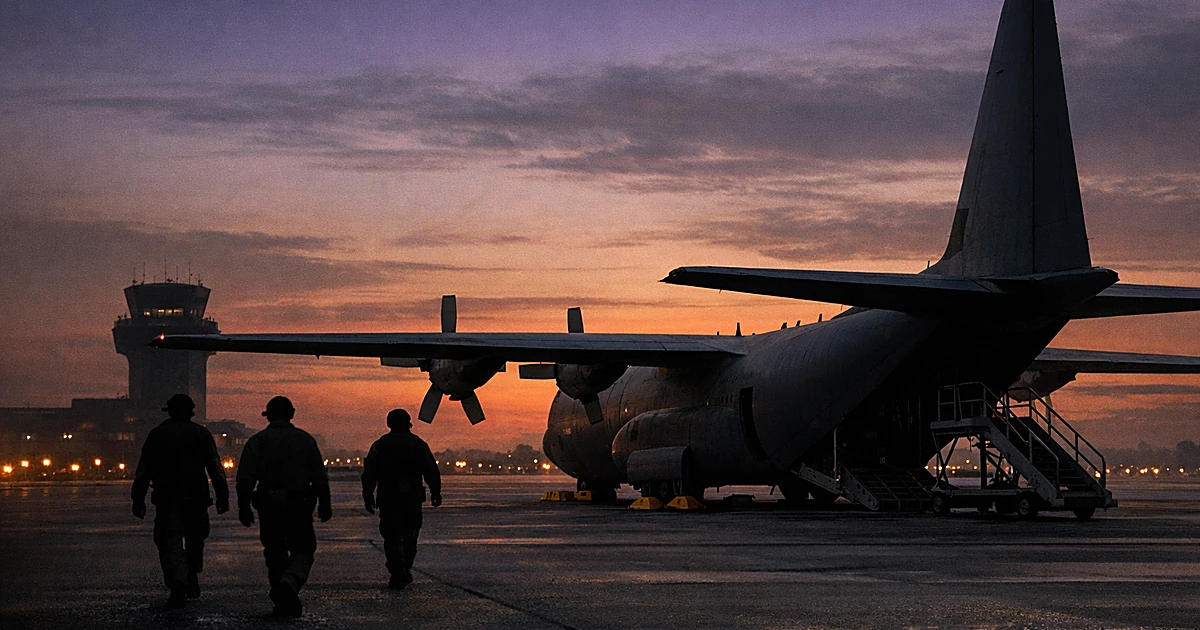
The United Kingdom is refusing to allow the Trump administration to use British military air bases for a potential strike on Iran, with U.K. officials citing concerns that such an operation could violate international law. The standoff centers on RAF Fairford in England and the strategically vital Diego Garcia base in the Indian Ocean's Chagos Archipelago.
The confrontation between Washington and London spilled into public view this week after President Trump spoke with British Prime Minister Keir Starmer on Tuesday about plans to use the RAF installations. By Wednesday, Trump had taken the matter to Truth Social.
"Should Iran decide not to make a Deal, it may be necessary for the United States to use Diego Garcia, and the Airfield located in Fairford, in order to eradicate a potential attack by a highly unstable and dangerous Regime."
Under the terms of long-standing agreements between Washington and London, British bases can only be used for military operations against third countries that have been agreed upon in advance with the British government. In other words, Britain holds a veto. And right now, Britain is using it.
According to Fox News, Trump told reporters on Thursday that Iran has a maximum of 15 days to make a deal over its nuclear program. The timeline is deliberate. The pressure is real.
A White House official framed the administration's posture to Fox News Digital with clarity:
"President Trump's first instinct is always diplomacy, and he has been clear that the Iranian regime should make a deal. Of course, the President ultimately has all options at his disposal, and he demonstrated with Operation Midnight Hammer and Operation Absolute Resolve that he means what he says."
That reference to prior operations is not accidental. It's a reminder that this administration doesn't issue idle threats. The diplomatic track remains open, but the military track runs parallel, and everyone involved knows it.
The question isn't whether Trump is serious. The question is whether America's oldest ally will act like one when the moment arrives.
The British objection reportedly rests on the claim that a strike on Iran could violate international law. This is the kind of reasoning that sounds principled in a faculty lounge and collapses under the weight of geopolitical reality.
Iran is the world's foremost state sponsor of terrorism. Its proxies have destabilized entire regions. Its nuclear ambitions threaten not just Israel and the Gulf states but Europe itself, including Britain. The regime has been weakened by internal unrest, Israeli military operations, and American pressure. And the British government's contribution to this pivotal moment is to consult its lawyers.
Sen. Lindsey Graham put a finer point on it in a post on X:
"The bottom line is the largest state sponsor of terrorism on the planet is the weakest it's been because the people of Iran have risen up by the millions to end their oppression and the United States and Israel have delivered crushing blows to the regime's military infrastructure."
Graham then addressed London directly:
"To my friends in Britain, sitting this one out puts you on the wrong side of history and is yet another example of how much our alliances throughout Europe have degraded."
He's not wrong. The "special relationship" means something only if it functions when the stakes are highest. Blocking American access to bases that exist precisely for joint security purposes doesn't just undermine a military option. It signals to Tehran that the Western alliance has fractures worth exploiting.
The timing of this dispute makes it impossible to separate the base access question from the Chagos Islands deal. Starmer has been negotiating a handover of the Chagos Archipelago to Mauritius, a deal that would allow Britain to retain control of Diego Garcia and its air base through a 100-year lease.
Trump withdrew his support for that arrangement on Wednesday, torching the diplomatic niceties in characteristically direct fashion:
"Prime Minister Starmer should not lose control, for any reason, of Diego Garcia, by entering a tenuous, at best, 100-year lease. This land should not be taken away from the UK and, if it is allowed to be, it will be a blight on our great ally."
He went further, questioning the legitimacy of the claims behind the deal itself, calling them "fictitious in nature" and warning that Starmer was "losing control of this important island by claims of entities never known of before."
The message to Starmer is layered but unmistakable. Don't give away strategic territory while simultaneously denying your closest ally the use of that territory. You cannot claim the base matters enough to lease for a century while arguing it can't be used for the very purpose it exists to serve.
There is a pattern in European foreign policy that conservatives have watched with growing frustration for decades. It goes like this:
Britain under Starmer appears determined to replay this script with Iran. The international law objection is less a legal position than a political one. Labour governments have always been more comfortable with process than with decisiveness. The instinct is to defer, convene, and deliberate until the window for action closes, then call the result "peace."
Trump's Truth Social post included a line that deserves attention beyond its surface:
"We will always be ready, willing, and able to fight for the U.K., but they have to remain strong in the face of Wokeism, and other problems put before them."
That sentence does a lot of work. It affirms the alliance while naming the rot that weakens it. The problem isn't Britain's military capability. It's the governing philosophy that treats legal paralysis as moral seriousness.
Fifteen days. That's the window Trump has given Tehran. Whether Britain cooperates or not, the administration has made its posture clear: diplomacy first, but every option on the table.
For Starmer, the calculation should be straightforward. A nuclear Iran threatens Britain. An Iran brought to the negotiating table through credible military pressure benefits Britain. And an alliance that functions only when nothing is at stake isn't an alliance at all.
Graham called this one correctly. Sitting it out doesn't make Britain neutral. It makes Britain irrelevant. And irrelevance, once earned, is not easily undone.