

Bahamian police questioned the husband of a missing American woman for more than three hours Friday about "causing harm which resulted in her death", language his own attorney says points toward a possible murder charge, even though Lynette Hooker's body has not been recovered and Brian Hooker has not been formally charged.
The 58-year-old Brian Hooker was arrested Wednesday by the Royal Bahamas Police Force in connection with the disappearance of his 55-year-old wife, who vanished during what he described as a weekend boat outing near Elbow Cay. His attorney, Terrel A. Butler, told NBC News that police interrogated Hooker at Central Police Station in Grand Bahama and that his detention was extended until 7:20 p.m. local time Monday.
Butler added that Hooker's detention cannot be extended again. Authorities must charge him by that deadline or release him.
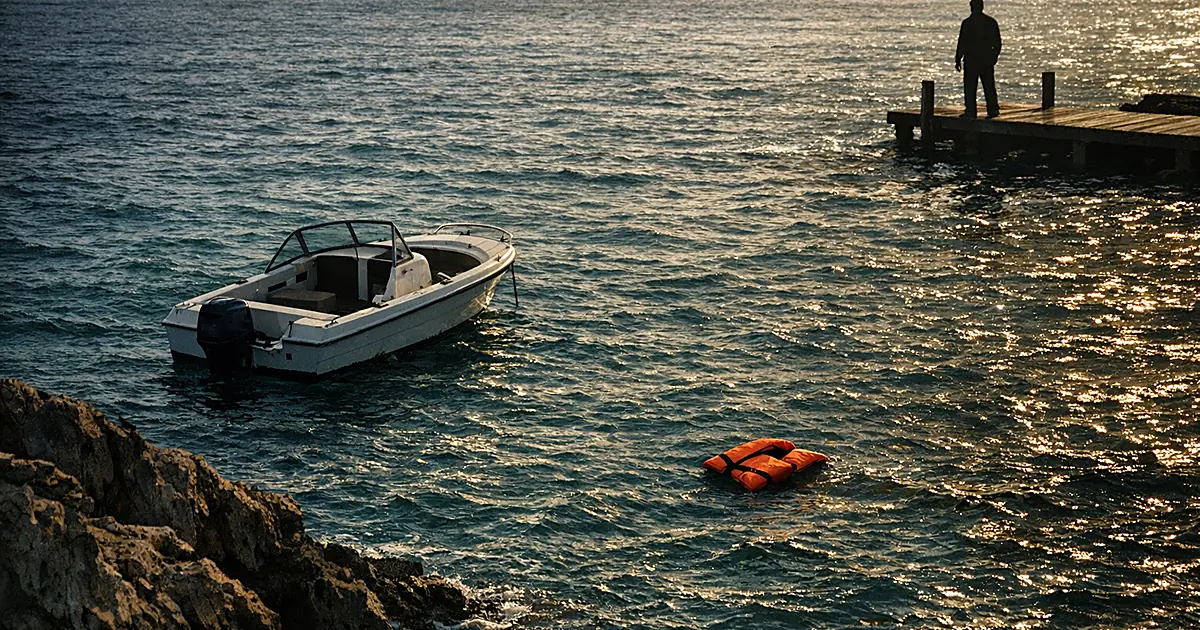
Police said Brian Hooker told them his wife fell overboard Saturday night near Elbow Cay while the couple traveled by dinghy. She fell with the boat's keys, killing the engine. In purported audio of a phone call posted to YouTube by a friend, a voice attributed to Hooker described the moments after the fall.
"We weren't wearing life jackets. It was sundown, and the sun set like basically 10 minutes after she fell over."
The voice on the recording said the wind separated them rapidly, estimating winds around 20 mph and waves at three feet. He said Lynette may have tried to swim back to the couple's sailboat, roughly 1,000 yards away. By the time he set anchor, he estimated he was a quarter to half a mile from where she went in.
Hooker described paddling for hours with a broken oar pin before landing on marshland about four miles away. He said he reached the Marsh Harbour Boat Yard early Sunday and alerted someone there, who then contacted police. He said the formal search began around 4:30 a.m., by which time, he estimated, Lynette had been in the water for eight hours.
He called the sequence a "cascade of failures and it's something I'm never going to forgive myself for."
NBC News reported it had not independently verified whether the audio was Hooker's voice or whether the recording had been edited. The friend who posted it, Blaine Stevenson, said he and his wife Marnette spoke to Hooker on Monday and that he released the audio to keep the search going while Hooker remained in custody.
Lynette Hooker's daughter, Karli Aylesworth, has publicly cast doubt on her stepfather's version of events. She told NBC News Thursday that she struggled to accept the disappearance as accidental.
"I hope this was just a freak accident, but I just have a hard time believing it at the moment. I just want to know the truth."
Aylesworth went further in a separate statement, saying she believed the incident may have been deliberate. "I feel like this was probably pre-planned, if anything, like, it doesn't seem like just some accident," she said. She described the couple as having "a history of not getting along, especially when they drink."
In comments reported by Fox News, Aylesworth cited prior domestic violence concerns involving Brian Hooker and urged a full investigation. "I've seen him choke out one of his daughters before. And we had to go to court for that," she said.
Michigan court records show a jury acquitted Brian Hooker of a child abuse charge in 2006. Separately, Lynette Hooker herself was arrested in 2015 on charges of assault and battery/simple assault after an incident in which both she and Brian accused each other of assault. A warrant was denied due to "insufficient evidence as to who started the assault," a Michigan police report stated.
The couple had been sailing together for more than a decade, Aylesworth said, eventually upgrading to a larger vessel purchased in Texas. That experience on the water is part of what makes the family skeptical. As readers following other missing-person cases know, the gap between an official account and a family's lived experience often drives the investigation forward.
Lynette's mother, Darlene Hamlett, told the Associated Press she was "glad to hear" about her son-in-law's arrest. She said she had not heard from him in nearly two days.
"I'm going to be interested in what he says, because I haven't heard from him in almost two days."
Hamlett described her daughter as someone who grew up around water. "Our family grew up on water and so Lynette her whole life has been near lakes, on boats, sailing and swimming," she said. She planned to travel to the Bahamas to help with the search and held out hope: "It would be a miracle if [she's rescued], but I'm still counting on one."
Brian Hooker's version of events has drawn scrutiny beyond his family. The New York Post reported that Hooker sent Facebook messages to family friend Daniel Danforth describing how wind separated him from Lynette after she fell overboard. Danforth said that version did not match police statements about strong currents sweeping her away.
"The stories don't really match up," Danforth said. He also flagged Hooker's behavior during the search, noting that Hooker interacted with a Facebook boating post while his wife was still missing.
On his own Facebook page, Hooker described the incident as a "boat accident in unpredictable seas and high winds" and wrote that "the search for Lynette remained his sole focus," the Washington Times noted. That public framing sits uneasily beside the police decision to arrest him as a suspect days later.
In cases where a loved one vanishes and the prime witness's story shifts, investigators face immense pressure to move quickly. Readers who followed the forensic developments in the Nancy Guthrie disappearance understand how physical evidence, or the lack of it, can define the direction of a case.
Royal Bahamas Defense Force Commander Origin Deleveaux told NBC News Friday that the search for Lynette Hooker remained active between Marsh Harbour and Elbow Cay. He said police were helping with their own vessel and that officials were deploying drone surveillance by air and underwater. He acknowledged there had been some "serious bad weather" as the search unfolded and that search resources had previously been split.
Local residents confirmed the dangerous conditions. Rapeepan Cash and Johnnie J. Cash, co-owners of the ABACO Asian Market in Marsh Harbour, spoke Thursday about the rough waters the night Lynette disappeared. Johnnie Cash said that on a calm day someone might have made it back to shore, but not under Saturday night's conditions. Rapeepan Cash said even an experienced swimmer would have struggled against the currents.
Newsmax reported that Bahamian authorities described Lynette as traveling by an 8-foot motorboat from Hope Town to Elbow Cay when she went into the water, with police stating that "strong currents subsequently carried her away, and he lost sight of her."
The U.S. Coast Guard has opened a criminal investigation in the case but is no longer assisting with the search itself. A U.S. law enforcement source said Thursday that the Royal Bahamas Police Force had officially requested American assistance. The involvement of U.S. federal investigators, similar to the FBI actions in other high-profile disappearances, signals that authorities on both sides of the water are treating this case with gravity.
Butler, Hooker's attorney, has mounted a vigorous public defense. In a statement, he said Brian Hooker "categorically and unequivocally denies any wrongdoing and in particular the allegations recently made by Karli Aylesworth." Butler described Hooker's "primary concern and source of intense frustration is his inability to continue the search for his wife of 25 years."
"He definitely denies causing her death, and he still asked about her and is hopeful that she will be recovered."
Butler also described an incident during Hooker's arrest, saying Hooker was holding a bundle of clothing in his "restricted hands" and trying to maintain balance amid "choppy and dangerous sea conditions" when he lost his footing and fell overboard himself. "He was submerged in the cold water and took in a significant amount of seawater before his life jacket brought him to the surface," Butler said, adding that police had to rescue Hooker from the water. Hooker reportedly injured his knee and received medical treatment.
Butler said Hooker was confused by the line of questioning during his Friday interrogation. "He was uncertain as to why they were questioning him about causing harm or possible murder when they had not given him any information where she is, if they had recovered her," the attorney said. Butler also noted that no evidence of Lynette Hooker's death exists because her body has not been found.
Investigations that hinge on a missing person with no recovered remains present enormous challenges for prosecutors. As seen in disputes over evidence processing in other disappearance cases, the handling of physical evidence, or the absence of a body, can make or break a prosecution.
The clock is now ticking. Butler said Hooker's detention expires at 7:20 p.m. local time Monday. Without formal charges, Bahamian authorities must release him. Fox News confirmed that Bahamian authorities placed the disappearance on the night of April 4, 2026, meaning Lynette Hooker has been missing for roughly a week with no recovery.
It remains unclear what specific evidence led police to arrest Hooker or what charges, if any, prosecutors may bring. No court date has been set. NBC News reported that the nature of the questioning, focused on "causing harm which resulted in her death", suggests authorities believe they may be dealing with something far more serious than a boating accident.
Whether they can prove it before Monday evening is another matter entirely. But Lynette Hooker's family is not waiting for a courtroom to render judgment. They want answers, and so far, the man who was last with her on that dinghy has offered a story that keeps shifting.
When a wife vanishes at sea and the only witness is the husband, the public deserves a thorough investigation, not a tidy narrative. The Bahamian authorities have days, not weeks, to decide whether they have a case or just a set of uncomfortable questions.