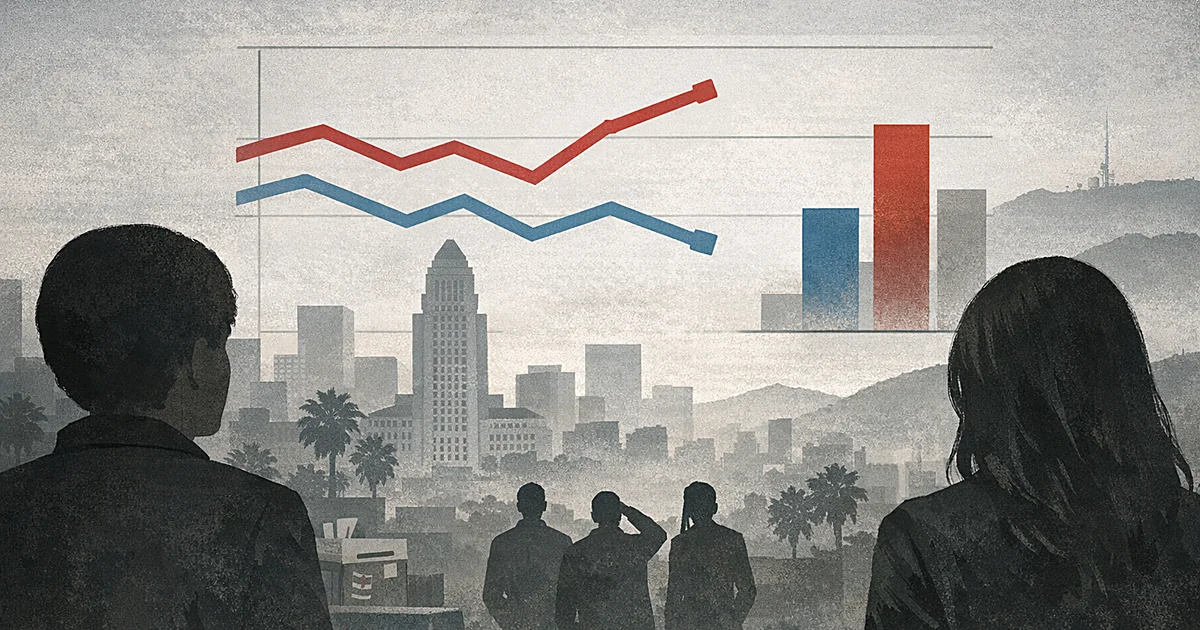



Early voting has already begun in Virginia and a handful of other states. North Carolina has sent out mail ballots. And the numbers confronting Republican strategists are grim across nearly every metric that matters. Larry Sabato's Crystal Ball at the University of Virginia now shows Democrats leading in 208 House seats to the GOP's 203, with 22 races rated as tossups. Eight House races recently moved in Democrats' direction. Democrats need 218 to take the gavel and hand the speakership to Rep. Hakeem Jeffries of New York.
The Kalshi prediction market puts the odds of Democratic House control at 90 percent. On the Senate side, where Republicans currently hold a 53-47 majority, Kalshi gives Democrats a 58 percent chance of picking up the four seats they need. Sabato's Senate rankings show Republicans clinging to a narrow 48-47 edge, a margin that leaves almost no room for error.
Elections expert Charlie Cook framed the GOP's most likely scenarios as "bad, really bad, or truly horrible." A Marquette Law School poll released this week found Democrats holding a 13-point advantage on the generic congressional ballot. The same poll pegged President Trump's approval on handling inflation at just 21 percent among registered voters.
Kansas and Iowa put the Senate map on notice
Two states that should be safe Republican ground are anything but. In Kansas, a new Emerson College poll of likely voters shows Sen. Roger Marshall trailing Democrat Adam Hamilton, a megachurch pastor, by two points, 43 to 45. The margin of error is 3.6 percent, so the race is a statistical dead heat. But the fact that it is competitive at all speaks volumes.
Spencer Kimball, the Emerson College poll director, put the finding in historical context:
"This poll finds Democrats with their best chance to win their first Senate seat in Kansas since 1932, in part driven by Democrat Hamilton's appeal to independent voters."
Since 1932. That is not a typo. Kansas has not sent a Democrat to the Senate in more than nine decades, and now an incumbent Republican trails there.
In Iowa, Republican Rep. Ashley Hinson leads Democrat Josh Turek by a single point in the RealClearPolitics polling average. Vice President JD Vance traveled to Council Bluffs, Iowa, on Friday for a campaign event and gave Hinson a public shout-out, but Hinson herself did not attend. Vance had been in Kansas the week before, a sign the White House sees both states as genuinely threatened.
Craig Gilbert, a fellow at Marquette Law School's Lubar Center for Public Policy Research, summed up the broader environment:
"These are the kind of polling numbers that are fueling discussion of a potential 'blue wave' this November."
Gilbert added a caveat, Republicans still hold an "underlying edge in the playing field", but the trajectory is running against them.
High gas prices and the Iran conflict are dragging down incumbents
The drivers behind the shift are not abstract. High gas prices and a lingering military conflict involving Iran have combined with broader voter discontent to create the kind of environment that punishes the party in power. Trump's 21 percent approval on inflation, per Marquette, is a number that would sink candidates in any cycle. Voters who feel the squeeze at the pump and the grocery store do not typically reward the incumbent president's allies on the ballot.
That dynamic has forced some Republicans into uncomfortable positions. Rep. María Elvira Salazar of Florida, described as normally a White House loyalist, released a new TV ad telling President Trump that his immigration enforcement policies have "gone too far." Trump responded to reporters on Friday, saying he disagreed with Salazar but did not disavow her.
"She got a little bit soft on the border, I understand that."
The exchange captures the bind facing Republican candidates in competitive districts. Run too close to the White House and risk voter backlash. Break publicly and risk losing the base. The razor-thin margins that have defined this House majority from the start make every individual race a potential tipping point.
GOP money advantage may not be enough
Republicans do hold one clear advantage: cash. Axios reported that the National Republican Congressional Committee leads the Democratic Congressional Campaign Committee by $13 million in fundraising, $89 million to $76 million. The pro-Trump super PAC MAGA Inc. invested $10 million in Texas earlier this month, where Republican Ken Paxton is battling state Democratic Rep. James Talarico.
But money has limits when the political environment turns hostile. House Republicans have managed to carve out expected gains through midterm redistricting, yet those structural advantages are being overwhelmed by the national mood. When a Republican incumbent trails in Kansas and leads by a single point in Iowa, no amount of redistricting geometry fixes the underlying problem.
One bright spot for Republicans: the Cook Political Report moved the New Hampshire Senate race into the toss-up column, where former Sen. John Sununu is attempting a comeback. That was one of the few recent shifts in the GOP's direction. The broader legislative calendar heading into the midterms has left several high-profile items unfinished, giving Democrats additional ammunition about Republican governance.
Republican operatives project confidence the numbers don't support
Publicly, the party is holding the line. Bernadette Breslin, national press secretary for the National Republican Senatorial Committee, issued a statement insisting the map still favors the GOP:
"Republicans are capitalizing on their newfound coordinated-spending firepower and deploying resources to battle-tested candidates across a Senate map that continues to favor the GOP. Come November, Senate Republicans will retire Democrats' socialist slate."
An unnamed Republican operative echoed that confidence: "We remain bullish in terms of holding the Republican Senate majority." But bullishness is not a strategy, and the data tells a different story. When Sabato has Democrats leading in more House seats than Republicans, when Kalshi puts House odds at 90 percent for Democrats, and when a Kansas Republican trails a megachurch pastor for the first time since the Hoover administration, confidence needs to be backed by something more than talking points.
The party's ability to push major legislation through slim margins has been one of its few governing achievements. Losing the House would end that entirely.
Republicans still have time. Polls shift. Prediction markets are not elections. But the trajectory is clear, and the causes, gas prices, a foreign conflict voters did not ask for, and an inflation record that earns 21 percent approval, are not the kind of problems a campaign ad can fix. They require results. And right now, voters are not seeing them.