
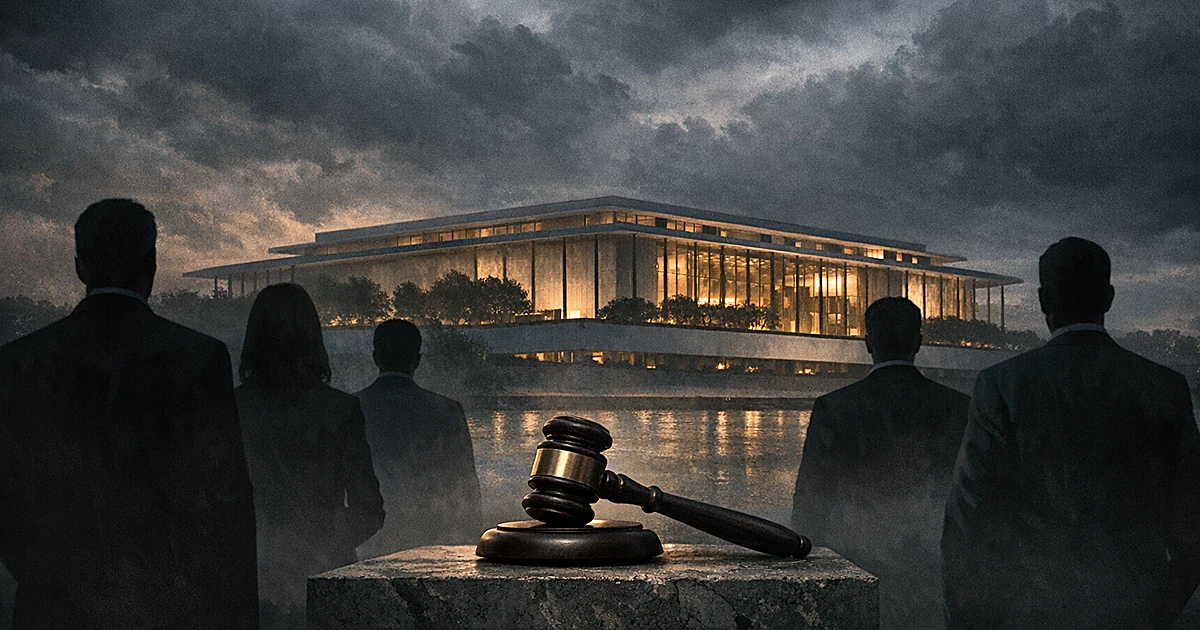


Eight architectural and preservation organizations suing the Kennedy Center escalated their fight Thursday, calling for the board to step down or submit to a court-appointed receiver, warning that the historic building faces "irrevocable loss."
The coalition, represented by attorney Greg Werkheiser of Cultural Heritage Partners, issued a public statement demanding that Kennedy Center leadership either fulfill its legal duty to protect the landmark or make way for someone who will. Werkheiser told reporters the groups are preparing to ask U.S. District Judge Christopher Cooper to appoint a receiver, a step he said could come "likely soon."
The move comes after a week of rapid developments at the performing arts center in Washington. On Tuesday, Judge Cooper again ruled that the board cannot put President Trump's name on the Kennedy Center building or grounds without congressional authorization. By Wednesday, fencing went up around the building after the board voted for a second time to shut it down for emergency repairs. Executive Director Matt Floca cited "acute risks to public safety" from structural damage in a court declaration.
The plaintiffs' statement, provided to The Hill, did not hold back about the stakes. The groups, which include the American Institute of Architects, the National Trust for Historic Preservation, the Society of Architectural Historians, Docomomo US, the DC Preservation League, the American Society of Landscape Architects, the Committee of 100 on the Federal City, and the Cultural Landscape Foundation, framed the situation as a potential emergency.
"The irrevocable loss of this iconic building, whether by intent, neglect or mismanagement, appears increasingly possible."
The statement continued:
"If the current leadership of the Kennedy Center is unwilling or unable to exercise its fiduciary duty to protect the historic building and the grounds of the John F. Kennedy Center for the Performing Arts, the court should consider appointing a receiver or replacing that leadership."
Werkheiser emphasized that the plaintiffs wanted to give the board one more public chance to act before going to court. He framed the call for resignations as a moral obligation, not a legal tactic.
"We feel an obligation, no matter how realistic we think it is, to first publicly and clearly call, one last time, on the trustees to particularly focus on their legal fiduciary duties."
The attorney noted that Judge Cooper had previously invited the coalition to raise additional requests for relief if new facts warranted judicial intervention. In the plaintiffs' view, that moment has arrived. Their statement said plainly: "We are on the verge of such a moment."
Congress has set aside $257 million for repairs to the Kennedy Center. But Werkheiser told reporters that Trump has said he will withhold those congressionally funded renovations unless the court ruling blocking the naming is overturned, and will refuse to raise additional funds. The attorney characterized this as an abuse of presidential authority.
"President Trump then said that he will [withhold the renovations] funded by Congress and the American people unless that ruling is overturned and he will refuse to raise additional funds."
Werkheiser argued that Trump has an "extraordinary responsibility" to use his power to keep the center running, "not extraordinary leverage to demand the institution honor him." The distinction matters legally. Judge Cooper's rulings have drawn a clear line: the board lacks authority to rename the building without an act of Congress. Trump does not currently have that authorization.
The situation echoes a broader pattern in Washington, where Trump administration personnel decisions and institutional power struggles have played out across multiple fronts simultaneously.
Werkheiser explained that requesting a receivership for the Kennedy Center does not require the institution to go into bankruptcy. Instead, a court-appointed receiver would take control of preserving the historic building, chosen not by the plaintiffs, not by the government, but by the court itself.
"In requiring independent protection, the court could consider measures to put someone else, not someone that we pick, not someone that the government picks, but someone that the court picks and vets, put them in charge of preserving the historic building."
A receivership is a serious legal remedy. Courts typically reserve it for situations where the party responsible for managing an asset has either failed or refused to do so. The plaintiffs' willingness to pursue it signals they believe the board has crossed that threshold.
Werkheiser quoted Judge Cooper's own language about the trustees' obligations. The judge, as characterized by Werkheiser, said the trustees "aren't mere figureheads" and are "duty-bound to fulfill their roles with due care and some modicum of independence, especially when they're managing property held in trust for the American people."
That framing, property held in trust for the American people, sits at the heart of the legal dispute. The Kennedy Center is not a private venue. It is a national cultural institution, and taxpayers are footing the bill for its upkeep. When $257 million in repairs gets tangled up in a fight over whose name goes on the building, the people who lose are the ones who paid for it.
Adding another layer to the dispute, Rep. Joyce Beatty, an Ohio Democrat who serves as an ex officio board member, submitted photos as part of a court filing in a separate lawsuit she has brought challenging the Trump administration. The photos showed Trump aboard Air Force One reading a placard that read "Kennedy Center DEMOLISHED."
Werkheiser was cautious about the photo's significance, telling reporters he wanted to wait for verification before drawing conclusions.
"My mom didn't raise the smartest person, but I know, always, that we have to wait for verification of those things before we can really express any strong opinion."
The photo's authenticity and full context have not been independently confirmed. But its submission in a court filing, not a social media post, gives it a formal legal dimension that the judge will have to weigh.
The Kennedy Center's main building remains closed for at least one week. The Department of Justice defended the closure, stating that Floca's decision aligns with Judge Cooper's prior order preventing the center from being closed for a prolonged period. That distinction, an emergency closure of defined length versus an indefinite shutdown, may determine whether the court views the board as acting within its authority or defying it.
Sudden, high-profile departures from prominent roles have become a recurring theme in recent months, from media shake-ups to administration personnel changes, and the Kennedy Center drama fits that mold, though here the plaintiffs are the ones trying to force the exits.
The Hill reached out to both the Kennedy Center and the White House for comment. Neither response was reported in the article. The board's formal position on the receivership demand remains unknown.
Several critical details also remain unclear. The specific nature and extent of the structural damage that prompted the closure has not been publicly detailed. The precise source of Werkheiser's claim about Trump threatening to withhold renovation funds, whether it came from a public statement, a private communication, or secondhand reporting, is not specified. And the full text of Judge Cooper's rulings on both the naming issue and the prolonged-closure order has not been made public in this reporting.
Meanwhile, institutional accountability battles continue across the federal government. Disputes over leadership vacuums at public health agencies and finger-pointing over policy failures reflect the same fundamental tension: who is responsible when the people in charge stop acting like stewards and start acting like participants in a political fight?
Werkheiser acknowledged that circumstances at the Kennedy Center are shifting fast. "But circumstances are changing rapidly," he said, a statement that doubles as a warning to the board and a preview of the legal filing to come.
When a building held in trust for 330 million Americans becomes a bargaining chip in a naming dispute, the people who built it, paid for it, and visit it deserve better than a locked door and a chain-link fence.