
President Trump defended his hand-picked Federal Reserve chairman after a unanimous quarter-point rate hike, blaming a "hostile board" he says raised rates "only for political reasons" weeks before the midterm election.
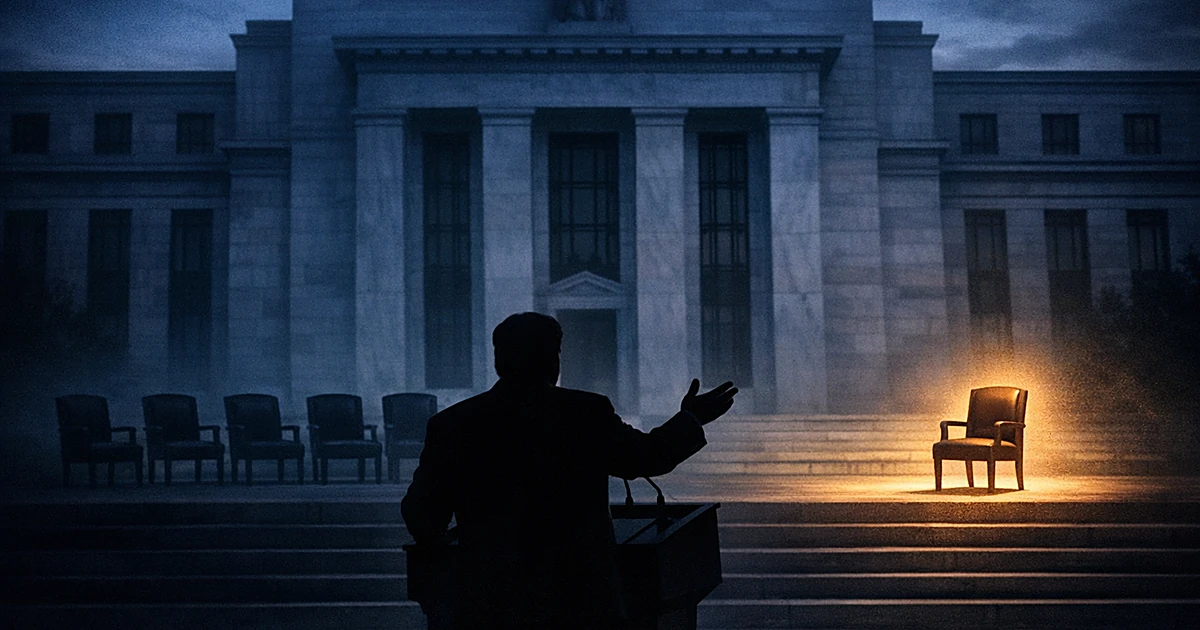
The Federal Reserve voted unanimously to push benchmark interest rates up a quarter point to the 3.75%, 4% range, the first hike in three years, and Trump wasted no time making clear whom he blames. Arriving in North Carolina for a midterm campaign rally Wednesday, the president told reporters he still has confidence in Chairman Kevin Warsh but described the rest of the board in blunt terms: hostile, political, and working against him.
It was Trump's first on-camera reaction to the decision, and he framed the rate increase as a deliberate squeeze timed to hurt him before voters head to the polls on Nov. 3.
Asked whether he still has confidence in Warsh, the 56-year-old chairman he installed in May after pushing out predecessor Jerome Powell, Trump answered yes, but immediately qualified it. The New York Post reported Trump's full exchange with reporters on the tarmac.
"I do. I mean, I'm relying on Kevin, but he's got a very tough board."
Trump went further, saying he had privately told Warsh not to bother fighting the board on the vote.
"I told Kevin, I said, 'You might as well vote with the board because it's just not going to matter.' The board is very hostile. They're very political. They're doing the wrong thing. They're a bunch of politicians."
That framing, a loyal chairman surrounded by adversaries, lets Trump hold onto his appointee while shifting blame to the broader institution. Whether Warsh personally favored or opposed the hike remains unclear; the vote was unanimous, and the president's own account suggests he advised Warsh to go along rather than dissent alone.
Trump did not hold back about what he sees as the motive behind the decision.
"They're raising that only for political reasons, and that's a raise against Trump."
The Fed cited a spike in energy prices and inflation driven by the Iran war as the basis for the move. Higher rates increase the federal government's cost to service its debt and squeeze businesses and consumers who borrow, effects that ripple through the economy at the worst possible time for an incumbent president trying to hold Congress.
Trump has clashed with the Fed before. He railed against Powell for refusing his demands to lower rates, eventually replacing him with Warsh. The new chairman's personal ties to Trump run deep: Warsh is the son-in-law of Ronald Lauder, the billionaire heir to cosmetics giant Estée Lauder and a longtime Trump friend.
Those ties made Warsh's appointment a signal that the White House wanted a more cooperative Fed. A unanimous vote to raise rates just weeks before an election suggests the board had other ideas. In a political environment where even unanimous votes in Congress are rare, unanimity at the Fed on a decision this politically charged is striking, and, from the White House's perspective, damning.
Before his on-camera remarks, Trump had already fired off on Truth Social. In what he described as his first public comments on the rate decision, the president laid out his position in characteristically direct terms.
"Interest Rates in the United States should be 1%, or less, because we are the Best Credit in the World, BY FAR. Our Country is BOOMING with new Investment!"
He followed that with a broadside on trade deficits, arguing the country is subsidizing the rest of the world.
"If we stopped Trading with every country that we have a Deficit with, which is most of them, we would make, at least, 1.5 Trillion Dollars a year. The word 'Deficit' is nothing more than a fancy word for LOSS. We are 'carrying' almost every country in the World, and that cannot go on any longer."
As of 2025, the United States ran a trade deficit with nearly 100 nations, including China, Mexico, Germany, Japan, India, South Korea, Canada, and most members of the European Union. Trump has long argued those deficits represent a transfer of American wealth abroad, a position that has driven his tariff agenda from the start.
That agenda hit a wall earlier this year when the Supreme Court struck down sweeping presidential tariff powers in a ruling Trump called "ridiculous and very costly." The president's Sept. 4 Truth Social post referenced the same decision, claiming the Court had "strongly acknowledged 'the President' has an absolute right to" halt trade with deficit nations, a characterization that conflicts with the ruling's reported outcome. The Court's actual decision, as described in reporting at the time, curtailed rather than affirmed the broad tariff authority Trump had exercised.
The collision between the White House and the Fed was not a surprise. Weeks before Wednesday's vote, Trump posted a direct threat on Truth Social tying interest rates to trade policy.
"LOWER THE RATE OR I'LL STOP TRADING WITH COUNTRIES WITH WHICH WE HAVE A DEFICIT, which the U.S. Supreme Court, in its ridiculous and very costly Tariff decision, strongly acknowledged 'the President' has an absolute right to do."
The board raised rates anyway. Every member voted yes. And the president, rather than turn on his own appointee, chose to cast Warsh as outnumbered and the institution itself as the adversary.
It is a familiar pattern. Trump replaced Powell precisely because Powell would not bend. Now Warsh sits in the same chair, facing the same institutional resistance, with a president who, for the moment, is willing to distinguish between the man he chose and the board that defied him. How long that distinction holds depends on what happens next with rates, with inflation, and with the midterms.
The broader question hanging over this fight is one that has defined Trump's relationship with every institution that checks executive power, from the courts to the Fed to Congress. The Supreme Court has already drawn its own lines on presidential authority. The Fed, with Wednesday's vote, just drew another.
Congressional dynamics add another layer. With the midterms approaching, lawmakers on both sides will face pressure to weigh in on Fed independence, a debate that echoes recent fights over institutional boundaries in Washington. Whether Republicans rally behind Trump's critique of the board or defend the Fed's independence could shape the campaign's closing weeks.
When every member of a board hand-built to cooperate votes unanimously against the president's stated wishes, the problem may not be the people, it may be the policy the institution was designed to protect. Trump can blame the board all he wants. The rates went up anyway.