

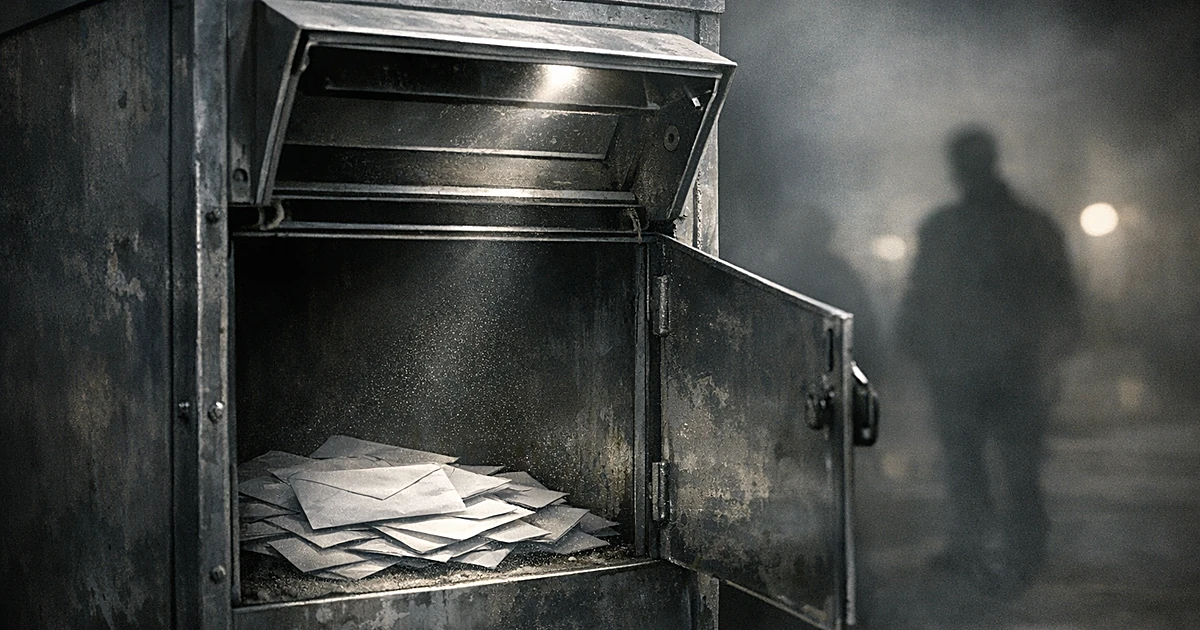

Nearly 600 sealed ballots sat forgotten at the bottom of a locked drop box in Humboldt County, California, for months after a statewide special election, never opened, never counted, and never noticed until this month. The Humboldt County Office of Elections disclosed the failure earlier this week, attributing it to a worker who did not follow procedures and a miscommunication about whether the box had been fully emptied.
The 596 ballots were cast during the November 4, 2025, special election on Proposition 50, the Gavin Newsom-backed redistricting measure that lets the state legislature draw its own congressional maps for the 2026, 2028, and 2030 elections instead of relying on an independent commission. The measure passed statewide by more than three million votes, and county officials say the uncounted ballots would not have changed that outcome.
That may be true on the math. But 596 voters in a rural county near the Oregon border cast legal ballots that were never counted, and nobody noticed for roughly six months. For anyone who takes election integrity seriously, the arithmetic is beside the point.
County Clerk-Recorder and Registrar of Voters Juan Pablo Cervantes took personal responsibility in a public statement reported by Fox News:
"While the mistake occurred after an election worker did not follow proper procedures, the responsibility for what happened ultimately sits with me. I did not have strong enough controls in place to prevent this, but we do now."
Cervantes called the outcome "unacceptable" and said it "runs counter to the core of what this office stands for." He announced that the county has implemented a new lock-out, tag-out procedure for every ballot drop box, requiring physical verification that each box is empty and secured before election results are finalized.
The ballots were discovered on May 4, 2026, as MSN reported, still sealed inside the locked box. County officials said the ballots had not been tampered with because the box remained locked and the envelopes were intact. The root cause, they said, was a miscommunication: when workers checked the drop box after the election, no one confirmed it had actually been fully emptied.
Humboldt County encompasses 4,052 square miles and has a population of roughly 136,000 residents. It is not a large jurisdiction. If a county that small cannot track whether a single drop box was cleared, the question practically asks itself: what happens in counties ten or fifty times larger?
The Humboldt County disclosure lands at a moment when California's election practices face intense scrutiny from multiple directions. President Donald Trump posted on Truth Social minutes after polls opened for the Proposition 50 vote, writing that "The Unconstitutional Redistricting Vote in California is a GIANT SCAM in that the entire process, in particular the Voting itself, is RIGGED." White House Press Secretary Karoline Leavitt followed up by describing California's voting process as "a universal mail-in voting system, which we know is ripe for fraud."
Separately, Riverside County Sheriff Chad Bianco, a Republican gubernatorial candidate, seized some 650,000 ballots in his county in March to determine whether they were fraudulently counted in the November election. The Los Angeles Times reported that California "continues to be under a microscope for allegations of voter fraud."
Democrats have pushed back against fraud allegations, and the Humboldt County incident itself appears to be administrative failure rather than deliberate manipulation. But that distinction offers cold comfort to the 596 voters whose ballots were left to gather dust. The incident also does nothing to quiet concerns about systemic weaknesses in a state that processes millions of mail-in ballots every cycle. When a miscounted-ballot controversy erupted in Michigan, officials at least caught the problem quickly. In Humboldt County, six months elapsed before anyone looked.
The uncounted ballots were tied to a high-stakes political contest. Proposition 50 was pushed by Governor Newsom as a response to redistricting efforts in Texas, allowing the California legislature to temporarily draw congressional maps instead of the state's independent redistricting commission. Political analysts described it as a Democratic power play designed to maximize the party's seat count heading into the 2026 midterms.
Yet even within Democratic ranks, enthusiasm for actually using that power appears limited. California Democratic Party Chair Rusty Hicks told the Los Angeles Times that his party has yet to capitalize on maps already drawn. "We have yet to fully win the seats in the map that was drawn in 2025," Hicks said. "It seems a step too far to say we're going to go back to the drawing board and redraw the map."
The Los Angeles Times reported Thursday that leading California Democrats have no intention of redrawing the maps before the 2026 midterms, raising the question of why voters were asked to approve the measure at all. The Supreme Court's recent ruling upholding Texas redistricting only sharpened the national debate over who gets to draw district lines, and Proposition 50 was California's answer. Whether that answer was about fair representation or raw partisan advantage is a question the measure's own backers seem reluctant to test.
Redistricting battles have become a recurring flashpoint across the country. In New York, Rep. Nicole Malliotakis took her fight to the Supreme Court after the state redrew her congressional seat. And in Virginia, former President Obama backed a redistricting referendum that could hand Democrats additional House seats. The common thread is clear: when the people drawing the maps are the same people who benefit from them, public trust erodes fast.
Election officials reflexively reach for the same line every time uncounted or miscounted ballots surface: the error would not have changed the result. Cervantes said as much. And in this case, with a three-million-vote statewide margin, the math supports him.
But that framing treats elections as if the only thing that matters is the final scoreboard. It doesn't. Every ballot represents a citizen who took the time to vote, who trusted the system to count that vote. When 596 people in Humboldt County dropped their sealed ballots into a government-provided box and walked away, they had a reasonable expectation that someone on the other end would open the envelopes. No one did.
The county's explanation, a miscommunication, a worker who skipped a step, is plausible. It is also exactly the kind of mundane, low-level failure that compounds across a state running universal mail-in elections. If one locked box in one small county can go unchecked for six months, the vulnerability is structural, not personal. Cervantes deserves credit for taking responsibility and implementing corrective procedures. But the fact that a lock-out, tag-out protocol, a basic industrial safety concept, was not already standard practice for ballot drop boxes tells you something about how casually California has treated the physical chain of custody for mail-in ballots.
Leavitt's description of California's system as "ripe for fraud" will strike some as partisan overreach. But the Humboldt County incident does not need to involve fraud to be damaging. Incompetence and negligence erode confidence just as effectively. Voters who see 596 ballots left to rot in a metal box do not parse the difference between malice and carelessness. They just stop trusting the process.
Several questions remain open. Were the 596 ballots eventually counted after their May 4 discovery, and if so, what did they show? The county's statement does not say. What specific drop box location in Humboldt County was involved? That, too, is unaddressed. And perhaps most important: has any other California county conducted a similar physical audit of its drop boxes since the November election? If Humboldt County found this only by accident, there is no reason to assume every other box in the state was properly cleared.
The broader accountability picture in California remains unsettled. Sheriff Bianco's seizure of 650,000 ballots in Riverside County is a separate matter, but it reflects the same underlying distrust. When federal officials signal that accountability for institutional failures is coming, the pressure on state and local election offices only grows.
Cervantes promised voters he is "taking this seriously." That is the minimum. The 596 people whose ballots were never counted deserved serious treatment before the envelopes were sealed, not six months after.
If California wants voters to trust universal mail-in elections, it might start by making sure someone checks the box.