
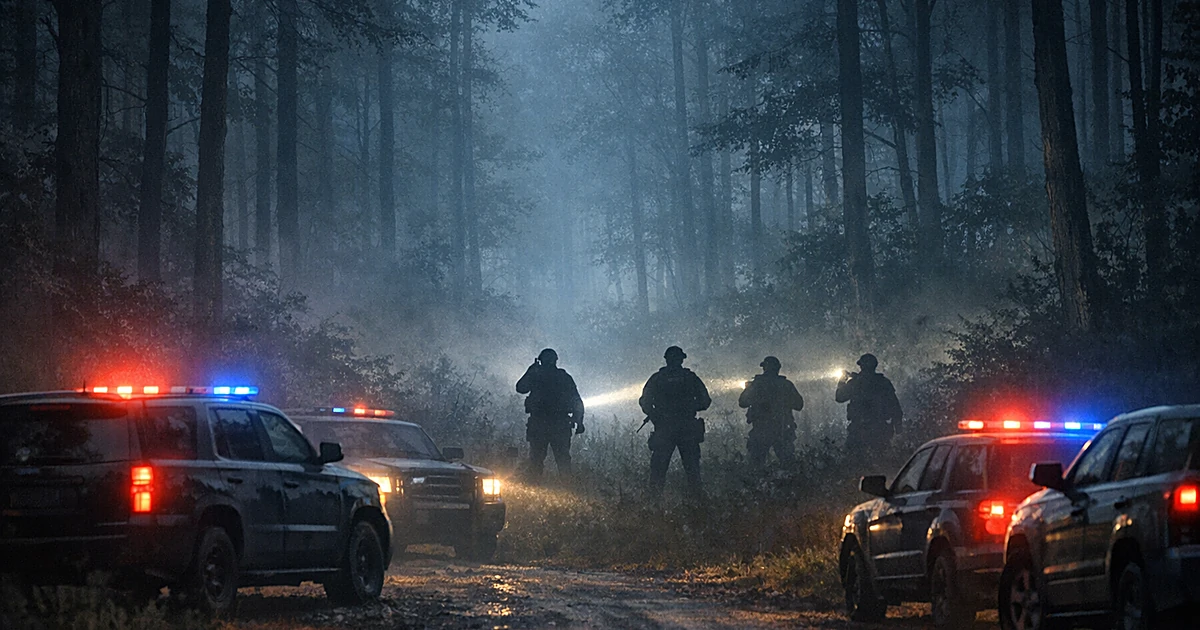



Multiple agencies are searching rural Stewart County, Tennessee, for Craig Berry, 44, after authorities accused him of shooting his wife during a domestic altercation and fleeing into nearby woods. Fox News Digital reported that deputies responded around 1:30 a.m. early Sunday morning to a home near Old Paris Highway, but Berry left before they arrived.
Officials say Berry remains at large, is believed to be armed with at least one handgun, and is wanted for second-degree attempted murder. The operation has pulled in the Stewart County Sheriff’s Office along with the Tennessee Highway Patrol, the Tennessee Bureau of Investigation, the Department of Homeland Security, and the U.S. Marshals Service.
This is the part that hits regular people first: families living near the search zone are the ones told to lock their doors, watch their property, and call 911 if they spot a man authorities warn them not to approach.
Manhunts like this are not abstract “public safety” talk. They are long, stressful days for lawful residents who did nothing wrong, and for deputies and responders who have to search tough terrain while trying to prevent a second attack.
And in this case, officials say they’re dealing with a suspect they describe as unusually capable in the outdoors.
The Stewart County Sheriff’s Office has described a "very detailed search" that spans from River Trace Road to Highway 79 and parts of Highway 232. Authorities have also pointed to Gray’s Landing and rugged terrain along the Tennessee-Kentucky border region as part of the area of concern.
Investigators said K-9 units last tracked Berry near River Trace Road. The sheriff’s office also said Berry was captured by a trail camera wearing camouflage clothing, and it urged property owners to check trail cameras for possible images.
That mix, boots on the ground, K-9 tracking, and trail-camera tips, tells you something important: in rural America, law enforcement often has to hunt in the dark and the brush with whatever tools the landscape allows.
For readers who’ve followed other cases where suspects tried to vanish into the countryside, the pattern is familiar: the public gets asked to be vigilant, while officers spread out and try to narrow the map. We’ve seen that dynamic in other multi-county searches, including a recent manhunt after an alleged crossbow shooting.
But this Tennessee search comes with a specific warning from local authorities: they do not assume the danger has passed.
Sheriff Gray, whose first name was not provided, told the public Berry knows the area well. The sheriff said: "He is very familiar with the area,"
The Stewart County Sheriff’s Office put it even more plainly about what it does not know, saying: "We have no information that he is no longer in the area,"
That is not the sort of statement that lets a community exhale. It’s also the kind of honesty the public deserves, clear limits, clear warnings, and no false assurances.
Authorities have urged residents to remain alert, lock their doors, and report anything suspicious. They have also warned residents not to approach Berry and to call 911 immediately if they see him.
In other words: the burden shifts to the public quickly. The message becomes, “You are part of the perimeter.”
Officials identified Berry as a retired Special Forces veteran with extensive survival training. They also described his physical capability in terms that matter for a search in watery, wooded country, saying "he is an excellent swimmer and diver, and is in good physical shape."
The New York Post similarly summarized the sheriff’s office view that the search could take time, citing the suspect’s survival training and warning that he may be armed with a handgun and extra ammunition.
When officials describe a suspect this way, it isn’t to build a legend. It’s to set expectations for the public and for the rank-and-file officers doing the searching: this may not end quickly, and it may not end safely.
Law enforcement has already begun shifting tactics. The sheriff’s office said authorities started scaling back some broad woodland sweeps while preparing for more targeted searches based on leads.
That shift also signals reality. You can flood the woods with manpower for only so long before you have to narrow the search, work the tips, and hope one small break turns into an arrest.
For now, key facts remain unknown. Authorities said Berry’s wife was transported to a hospital, but officials have not publicly described her condition.
It is also unclear what specific date “early Sunday morning” refers to in the official updates cited, and the sheriff’s office has not publicly provided the full name of Sheriff Gray.
Those gaps matter because they shape how the public understands risk. A community can handle hard truths, but it should not be left trying to piece together basics while the search continues.
Still, the central facts are clear enough: deputies responded around 1:30 a.m. to a home near Old Paris Highway; authorities accuse Berry of shooting his wife; and officials say he fled into nearby woods before deputies arrived.
In an era when elites love to talk about “systems,” this is what systems look like on the ground: regular families worried about a knock at night, and law enforcement trying to end a dangerous situation before it gets worse.
Every time a violent suspect stays at large, the risk doesn’t spread evenly. It falls hardest on whoever lives near the search lines, and on whoever has to answer the next 911 call.
That’s true whether the threat is a fugitive in the woods or an armed suspect in a city neighborhood, like the case we covered where Oakland officers confronted an armed man. Different settings, same basic duty: protect innocent people first.
It’s also why “don’t approach, call 911” warnings matter. Lawful gun owners, hunters, and rural residents may have the means to defend themselves, but law enforcement is still telling the public not to play deputy. That’s a serious instruction, and it reflects how unpredictable a cornered suspect can be.
The agencies involved, local, state, and federal, also show how quickly a violent domestic incident can turn into a multi-jurisdiction operation when the suspect disappears into challenging terrain.
No one should pretend these operations are cheap, easy, or optional. They are the cost of taking public safety seriously.
Authorities are asking the public for help: keep doors locked, stay alert, check trail cameras, and report anything suspicious. That’s reasonable, as far as it goes.
But the deeper expectation is simpler: when officials say a man is wanted for second-degree attempted murder and may be armed, the public expects a relentless pursuit, and straight answers as the search evolves.
We’ve also seen in other cases, including one we covered involving a suspect accused of killing someone and then fleeing, that the flight itself becomes a second crime against the public: it forces communities into fear and drains resources that should be going to ordinary policing.
The Stewart County Sheriff’s Office has told residents what to do if they see Berry. Now the public deserves the same urgency from every institution involved, no drifting, no bureaucracy, no mixed messages.
Law and order isn’t a slogan. It’s the promise that innocent people won’t be left to live on edge while government moves at a slow pace.
The first duty here is to the victim and the community, not to narratives. A free society stays free by enforcing the law, clearly, consistently, and without apology.