


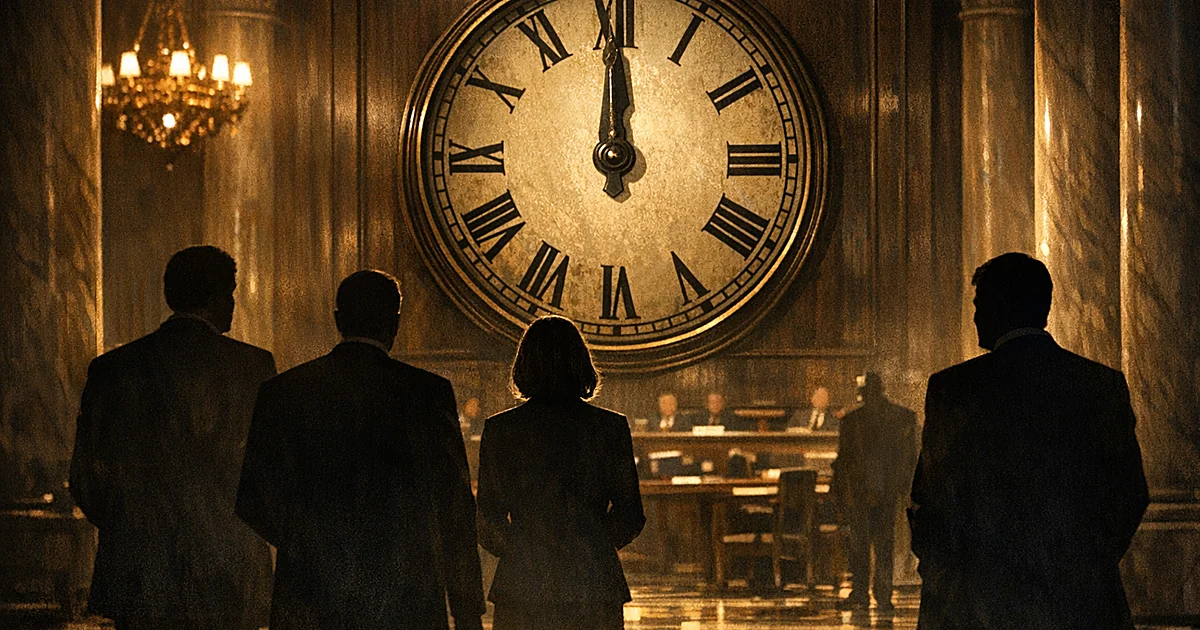
House Speaker Mike Johnson declared Thursday that the United States is "not at war" with Iran, siding firmly with the Trump administration's legal position just hours before the 60-day War Powers clock was set to expire, and as a Senate effort to force a halt to military operations went down in defeat.
Johnson told NBC News in the Capitol that he saw no reason for Congress to intervene in the middle of delicate negotiations between the administration and Tehran.
The Speaker's comments came on a day packed with action on the Iran question. Defense Secretary Pete Hegseth testified before the Senate Armed Services Committee and argued the ceasefire paused the War Powers clock entirely. The Senate then voted on a War Powers Resolution sponsored by Sen. Adam Schiff (D-Calif.) to halt military action against Iran, and the measure failed, 47 to 50. The result gave the administration the breathing room it wanted, but the underlying legal dispute is far from settled.
Johnson's framing left little ambiguity. Speaking in the Capitol on Thursday, the Louisiana Republican offered a flat declaration and a rationale in the same breath:
"I don't think we have an active, kinetic military bombing, firing or anything like that. Right now, we are trying to broker a peace."
He followed that with a blunt summary: "We are not at war."
When pressed on whether the House might act on the War Powers question, Johnson signaled deference to the executive branch at a sensitive moment. He told reporters he would be "very reluctant to get in front of the administration in the midst of these very sensitive negotiations, so we'll have to see how that plays out."
That posture, trust the commander-in-chief while talks are live, tracks with Johnson's broader pattern of aligning his public messaging with the administration's priorities on national security and foreign policy.
The legal flash point Thursday was Hegseth's testimony before the Senate Armed Services Committee. The Defense Secretary laid out the administration's position plainly:
"We are in a ceasefire right now, which our understanding means the 60-day clock pauses or stops in a ceasefire."
The timeline matters. President Trump notified Congress of military operations in Iran on March 2. Under the War Powers Resolution of 1973, the president must wind down those operations at the 60-day mark if Congress has not authorized them, unless he certifies that "unavoidable military necessity respecting the safety of United States Armed Forces" requires their continued use, which triggers a 30-day extension.
Friday marked that 60-day threshold. The administration's position is that the ceasefire, announced April 8 as a two-week pause, then extended indefinitely by Trump hours before its April 21 expiration, effectively stopped the clock from running.
Sen. Tim Kaine (D-Va.) pushed back during the hearing. "I do not believe the statute would support that," Kaine told Hegseth. He added: "I think the 60 days runs maybe tomorrow, and it's going to pose a really important legal question for the administration there."
Kaine's objection is predictable, but it raises a fair procedural question. The War Powers Resolution does not explicitly address whether a ceasefire tolls the clock. The statute was written in 1973, in the shadow of Vietnam, and its drafters were thinking about open-ended combat, not a negotiated pause in hostilities coupled with active diplomatic talks.
The administration's reading is aggressive but not without logic. If American forces are not firing and not being fired upon, the argument goes, the conditions that trigger the withdrawal requirement have changed. Whether that interpretation would survive a legal challenge is an open question, but with the Senate vote failing, no one with standing seems eager to test it in court right now.
The Schiff-sponsored resolution to discharge the War Powers measure from the Senate Foreign Relations Committee fell short, 47 to 50. The vote exposed familiar fault lines, and a few interesting ones.
Sens. Susan Collins of Maine and Rand Paul of Kentucky were the only Republicans to cross over and vote with nearly every Democrat to discharge the resolution. Both have long records of skepticism toward expansive executive war powers, so their votes were not a surprise.
More notable was the other side of the aisle. Sen. John Fetterman of Pennsylvania was the lone Democrat to vote against discharging the resolution, breaking with his party on a high-profile national security question. Three senators, Republican Jerry Moran of Kansas, Republican Tommy Tuberville of Alabama, and Democrat Patty Murray of Washington, did not vote.
The math tells the story. Even with two Republican defections, the resolution could not clear a simple majority. The Senate is not prepared to force the president's hand on Iran, not while a ceasefire holds and diplomatic talks continue.
President Trump reinforced the diplomatic angle Thursday, telling reporters that Iranian officials "want to make a deal badly." The administration and Iranian officials have been engaged in talks on a permanent peace and curbing the Islamic Republic's nuclear program, though the specific terms under discussion have not been disclosed publicly.
Johnson's willingness to back the administration publicly matters beyond the immediate legal question. The Speaker controls the House floor. If he wanted to force a War Powers vote in the lower chamber, he could. His decision not to, and to frame the situation as something short of war, effectively closes the congressional door on any near-term challenge to the president's authority on Iran.
That is a judgment call, and a defensible one. The ceasefire is holding. Talks are underway. American forces are not engaged in active combat operations, by the Speaker's account. Forcing a constitutional showdown over war powers in the middle of live negotiations would risk undermining the administration's leverage at the table, a point Johnson made explicitly.
Johnson has shown a consistent willingness to shield the administration's legislative and policy agenda from internal disruption, even when it means absorbing criticism. He has done so on tax policy, on immigration enforcement, and now on the most consequential foreign policy question of the year.
Johnson's posture on executive war authority also carries an implicit contrast with how he viewed the Biden administration's handling of Middle East conflicts. Just The News reported that Johnson sharply criticized Biden's handling of the Israel-Hezbollah war, arguing that the Biden administration had withheld weapons Israel needed and prolonged the conflict. "Israel's military success has been in spite of the White House, not because of it," Johnson said at the time.
The through-line is consistent: Johnson believes a strong executive hand, wielded decisively and backed by credible military force, produces better outcomes than half-measures and weapons holds. Whether one agrees with that framework or not, the Speaker is applying it consistently, supporting Trump's authority to negotiate from a position of strength while opposing what he viewed as Biden's tendency to undercut allies.
Several questions hang over the Iran situation that neither Thursday's vote nor Johnson's comments answered. The administration has not disclosed the specific military operations Trump notified Congress about on March 2. The legal rationale for Hegseth's claim that a ceasefire pauses the War Powers clock has not been laid out in formal legal opinion, at least not publicly. And the terms of the ongoing talks with Iran remain opaque.
Congress has also not granted any formal authorization for the military operations in question. That gap matters. The War Powers Resolution exists precisely to prevent open-ended military commitments without legislative buy-in. The ceasefire may have changed the operational picture, but it did not produce the authorization the statute contemplates.
For now, the practical reality is clear. The Senate vote failed. The Speaker is not moving in the House. The ceasefire holds. And the administration has the running room it needs to pursue a deal.
Democrats can object to the process. But the voters who sent this president and this Congress to Washington did not do so to see their leaders tie the commander-in-chief's hands while the other side says it wants to talk.