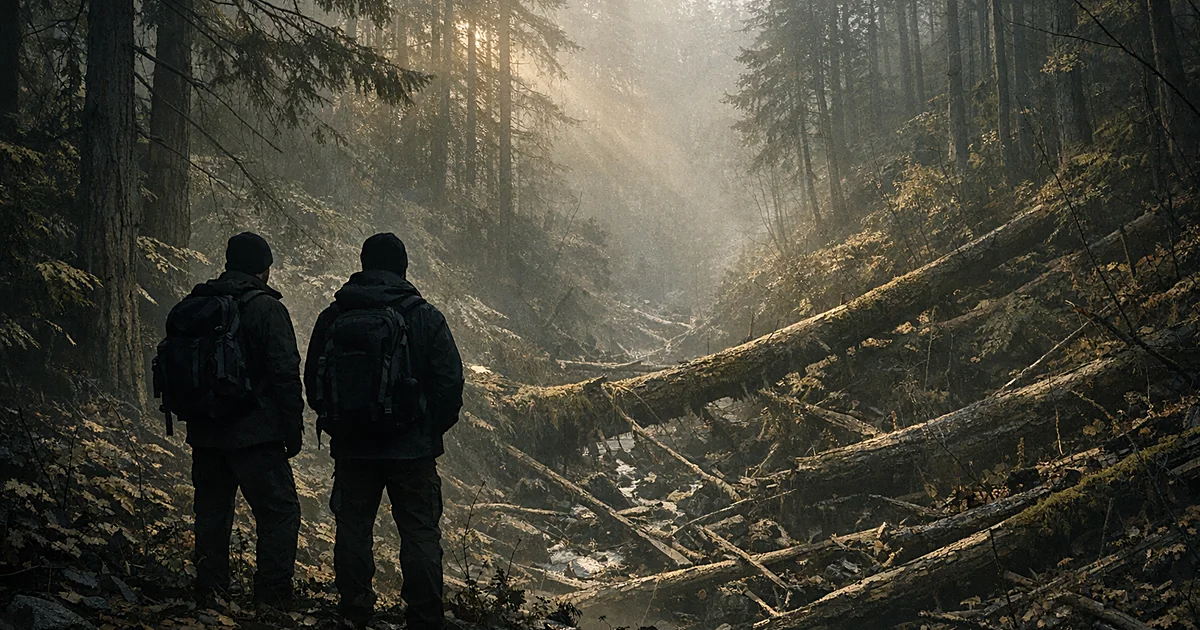

Two hikers walking through a remote wooded area near Kelso, Washington, stumbled across human bones and a piece of clothing on April 12, and the Cowlitz Sheriff's Office confirmed Wednesday that the remains belong to Hailey Athay, a 33-year-old mother of three who had not been seen by her family since just before Thanksgiving 2024.
The discovery ends a search that stretched more than sixteen months. It does not end the questions. Athay's cause and manner of death have not been released. No criminal charges have been announced. And the identity of the man she was last known to be with remains publicly unconfirmed.
For Athay's mother, Nicole Brooks, the news delivered a grim certainty she had dreaded. Brooks told KPTV:
"It's not that it was unexpected that this would be the outcome, but it certainly isn't what we wanted in our hearts."
The two hikers came upon two bones and a piece of clothing in a wooded stretch off Rose Valley Road, just north of the Oregon border. They contacted authorities, who asked them to photograph the bones. Officials sent that photo to a forensic anthropologist, who confirmed the bones were human.
The next day, one of the hikers led a search party back to the undisclosed site. Fox News reported that investigators recovered nearly complete skeletal remains along with multiple items of clothing and personal belongings. The sheriff's office said the location fell squarely within an area a detective had already identified "through investigation and interviews as an area of interest in the disappearance of Hailey E. Athay."
That detail raises an obvious question: if investigators had already flagged the area, why did previous searches turn up nothing? The Cowlitz Sheriff's Office acknowledged that earlier searches in the area of interest had produced zero discoveries.
Officials sent Athay's skull to a forensics lab, where dental records provided the final confirmation. The sheriff's office announced the identification Wednesday via a Facebook post, stating that Athay's "cause and manner of death remain under investigation" pending further forensic analysis.
The last time Nicole Brooks heard from her daughter was just before Thanksgiving 2024. Athay called from a store and told her mother she "was doing well." She said she was with a man, one Brooks did not know.
Before that call, Athay was last known to be picking mushrooms with the same unidentified man. Then silence. More than a month passed before her family reported her missing in January 2025. The gap between Athay's last contact and the missing-persons report remains unexplained in any public account.
Cases like this, where human remains surface long after someone vanishes, are more common than the public might expect. In another striking example, a severed leg found on a Sonoma County beach was identified as belonging to a banker who had vanished 27 years earlier.
Brooks described the months of waiting in blunt terms. She told reporters:
"It was a nightmare. It was just a nightmare. You don't know, and you hold out hope, and the longer it goes, the harder it is."
Now that hope is gone. Athay leaves behind three daughters who are living with family members.
The Cowlitz Sheriff's Office has disclosed remarkably little about the circumstances surrounding Athay's death. Officials have not named the man she was reportedly with before she disappeared. They have not said whether that individual has been interviewed, cleared, or considered a person of interest. They have not released the cause or manner of death.
No criminal charges have been announced. The sheriff's office says the investigation into Athay's disappearance continues. But the public record, as it stands, leaves a wide gap between the facts that are known and the conclusions that matter most to a grieving family.
The lack of public detail echoes other high-profile disappearance cases where forensic evidence has taken center stage. In the Nancy Guthrie disappearance, DNA evidence recovered from the victim's home became a focal point as investigators tried to connect physical proof to a suspect.
Whether forensic analysis of Athay's remains and belongings will yield similar leads is unknown. The sheriff's office has offered no timeline for releasing additional findings.
One detail threads through every account of Athay's final days: the unnamed man. Brooks told Fox 13 Seattle that her daughter said she was with someone the family did not recognize. Athay was reportedly picking mushrooms with this person before contact ceased entirely.
Law enforcement has not publicly addressed who this individual is or what role, if any, he may have played in the events leading to Athay's death. That silence may reflect an active investigation. It may also reflect the limits of what authorities have been able to determine from skeletal remains found in a remote forest more than a year after the fact.
Unresolved disappearance cases have a way of lingering in public attention. The Pima County investigation into Nancy Guthrie's disappearance remains active, with a key vehicle still in law enforcement custody as officials work to piece together what happened.
Kelso sits in Cowlitz County, a small community in southwestern Washington where a missing mother does not go unnoticed. The discovery site, a wooded stretch off Rose Valley Road, is the kind of terrain that can swallow evidence for months or years. That the area had already been flagged by a detective yet yielded nothing until two civilians went for a hike underscores the difficulty of searching dense, remote land.
But difficulty is not the same as an answer. Athay's three young daughters deserve one. Brooks deserves one. And the people of Cowlitz County deserve to know whether a crime occurred in their community and whether anyone will be held accountable.
In cases where death investigations do advance, the results can be dramatic. The Gilgo Beach serial killer case demonstrated that even long-cold investigations can produce accountability, but only when law enforcement has the resources, the will, and the evidence to press forward.
Brooks, for her part, is left with memories and grief. She told reporters she can still hear her daughter's voice.
"I can hear her, 'Hi, Mama', and it just breaks my heart that I won't hear that again."
A 33-year-old mother walked into the woods with a man nobody in her family knew, and she never came back. Sixteen months later, hikers found what was left. The least her daughters are owed is the truth about how she got there.