
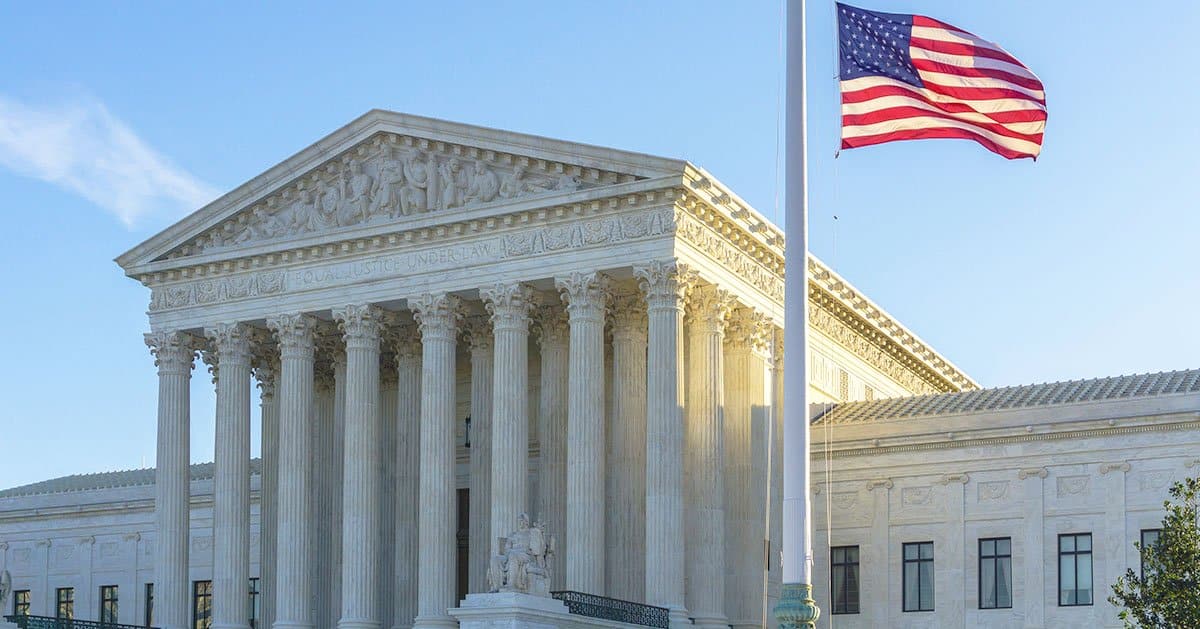

The Supreme Court handed down an 8-1 decision on Tuesday, striking down Colorado's ban on so-called "conversion therapy" for minors, finding it violated the First Amendment. The lone holdout was Justice Ketanji Brown Jackson. And in a move that startled Court watchers, it was not a conservative justice who delivered the sharpest rebuke of Jackson's dissent. It was Justice Elena Kagan.
Kagan, an Obama appointee, used a footnote in her concurring opinion to take direct aim at Jackson's reasoning. Justice Sonia Sotomayor joined that concurrence. When two of the three liberal justices not only side with the majority but go out of their way to swat down the third, something has gone sideways on the left flank of the bench.
According to Fox News, the case was brought by Kaley Chiles, a licensed Christian therapist who argued that her conversations with youth clients were a form of protected speech. Colorado had used a 2019 law that only banned therapists from counseling minors if the therapy entailed advising them on how to resist becoming transgender or gay. Therapists who affirmed a child's desire to transition faced no such restriction.
That asymmetry was the heart of the problem. The state didn't ban all counseling on gender and sexuality for minors. It banned one side of the conversation.
Justice Neil Gorsuch, writing for the majority, made the constitutional stakes plain:
"The First Amendment stands as a shield against any effort to enforce orthodoxy in thought or speech in this country. It reflects instead a judgment that every American possesses an inalienable right to think and speak freely, and a faith in the free marketplace of ideas as the best means for discovering truth. However well-intentioned, any law that suppresses speech based on viewpoint represents an 'egregious' assault on both of those commitments."
The Court directed the lower court to reexamine the Colorado law and ensure it did not interfere with Chiles' speech rights. Gorsuch noted the ruling was narrow, but the principle behind it was not.
Jackson read her fiery 35-page dissent from the bench, a move justices typically reserve for cases where they believe the majority has committed a serious error. She warned about the national implications of the decision, given that about two dozen other states have laws similar to Colorado's.
Her argument rested on a distinction between professional medical speech and ordinary public discourse. As she put it:
"Professional medical speech does not intersect with the marketplace of ideas: 'In the context of medical practice we insist upon competence, not debate.'"
She argued that Chiles was "not speaking in the ether; she is providing therapy to minors as a licensed healthcare professional." In Jackson's framework, the government's power to regulate medical practice swallows the therapist's right to speak freely with patients.
"Before now, licensed medical professionals had to adhere to standards when treating patients: They could neither do nor say whatever they want."
The dissent's closing carried the tone of an alarm bell:
"Ultimately, because the majority plays with fire in this case, I fear that the people of this country will get burned."
Strong words. But Jackson's position has a problem that even her liberal colleagues could not ignore.
Kagan's concurrence agreed with the majority that Colorado's law was unconstitutional because it targeted one viewpoint while leaving the opposite viewpoint untouched. She framed the core issue with characteristic precision:
"Because the State has suppressed one side of a debate, while aiding the other, the constitutional issue is straightforward."
Then came the footnote. Kagan observed that Jackson's dissent "rests on reimagining—and in that way collapsing—the well-settled distinction between viewpoint-based and other content-based speech restrictions." In other words, Jackson wasn't just dissenting from the outcome. She was trying to rewrite the categories the Court uses to analyze free speech cases.
Kagan went further, noting that Jackson's own dissent undermined its central claim:
"Justice Jackson's dissenting opinion claims that this is a small, or even nonexistent, category. But even her own opinion, when listing laws supposedly put at risk today, offers quite a few examples."
That is not a collegial nudge. That is a senior colleague pointing out that the dissent contradicts itself on its own terms.
Ilya Shapiro of the Manhattan Institute captured the tone on X:
"That should be a separate descriptor of an opinion: concurring, dissenting, expressing exasperation with Justice Jackson."
Jackson's dissent reveals something deeper than a disagreement about therapy licensing. It reveals a theory of the First Amendment in which the government can silence speech it deems professionally inappropriate, so long as it labels the restriction a regulation of "conduct" rather than "speech." That theory has no obvious limiting principle. If a state can ban a therapist from expressing one view to a patient, it can ban a doctor from discussing treatment options the state disfavors. It can ban a teacher from presenting material that contradicts an approved curriculum. The label changes. The mechanism does not.
Kagan clearly saw this. Her concurrence acknowledged that a content-based but viewpoint-neutral law might present a harder question. Colorado's law was not that. It permitted therapists to counsel minors toward one conclusion about their identity while criminalizing counseling toward the other. That is viewpoint discrimination in its purest form, wearing a lab coat.
The fact that eight justices recognized this, including both of Jackson's liberal colleagues, underscores how far outside the mainstream her position sits. Jackson did not merely dissent from the holding. She dissented from the framework that produced it, the framework Kagan and Sotomayor still accept.
The decision sends the case back to the lower court, but the signal to those two dozen states with similar laws is unmistakable. If your statute bans one side of a counseling conversation while blessing the other, it will not survive First Amendment scrutiny. States that want to regulate therapeutic practice will need to do so in a way that does not pick ideological winners and losers.
For Jackson, the episode is becoming a pattern: bold dissents that land not as persuasive minority opinions but as isolated statements increasingly distant from even her natural allies on the bench. When Kagan and Sotomayor join an 8-1 majority and then use their concurrence to dismantle your reasoning, you are not building a future coalition. You are writing for an audience outside the building.
Eight justices held that the government cannot silence one side of a debate and call it healthcare regulation. One justice disagreed. And her own allies told her why she was wrong.