
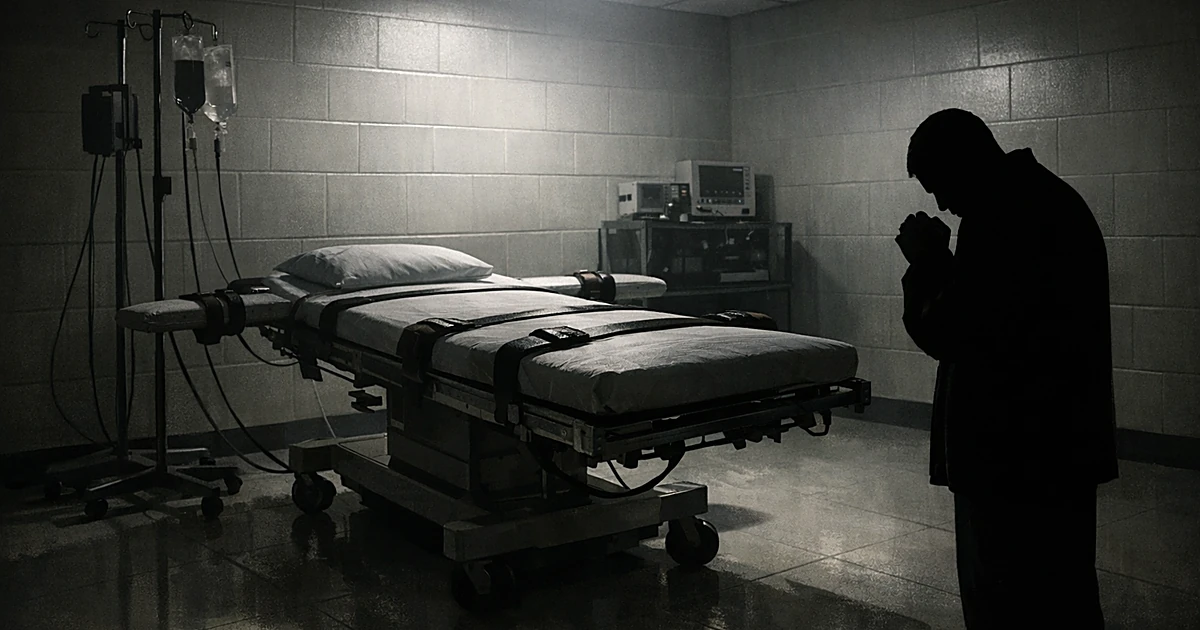


Five European governments declared Saturday that Russian opposition leader Alexei Navalny was poisoned by epibatidine — a toxin found in poison dart frogs native to South America — while imprisoned in a Russian Arctic penal colony. The United Kingdom, Sweden, France, Germany, and the Netherlands issued a joint statement saying they "are confident" in the finding, based on analyses of samples from Navalny.
Navalny died in February 2024. Moscow maintained that he became ill after a scheduled walk and died of heart problems. That explanation never convinced many in the West, and now five allied governments have formally rejected it.
The announcement landed at the Munich Security Conference, the same venue where Navalny's widow, Yulia Navalnaya, learned of her husband's death two years ago and called for Vladimir Putin "to be punished." She was back in Munich this weekend when the news broke — a grim kind of symmetry.
Navalnaya posted her response to X, striking a tone that was equal parts vindication and grief:
"Now there is proof: Putin killed Alexei with chemical weapon. I am grateful to the European states for the meticulous work they carried out over two years and for uncovering the truth. Vladimir Putin is a murderer. He must be held accountable for all his crimes."
She noted she had been "certain from the first day that my husband had been poisoned." Last fall, she disclosed that two separate lab analyses had reached the same conclusion. Saturday's five-nation announcement formalized what she had long asserted publicly, as Washington Examiner reports.
On the sidelines of the conference, Navalnaya met with U.K. Foreign Secretary Yvette Cooper, who offered the most pointed government language of the day:
"Only the Russian government had the means, motive and opportunity to deploy this lethal toxin against Alexei Navalny during his imprisonment in Russia."
Cooper went further in a second statement:
"Today, beside his widow, the U.K. is shining a light on the Kremlin's barbaric plot to silence his voice. Russia saw Navalny as a threat. By using this form of poison the Russian state demonstrated the despicable tools it has at its disposal and the overwhelming fear it has of political opposition."
French Foreign Minister Jean-Noël Barrot echoed the accusation, saying Putin is "prepared to use chemical weapons against his own people to remain in power." He posted to X that "France pays tribute to this opposition figure, killed for his fight in favour of a free and democratic Russia."
The joint statement is a diplomatic act, not a legal one. No criminal charges were announced. No new sanctions were disclosed. No international legal proceedings appear to have been initiated. Five nations put their names on a conclusion, stood beside a widow at a conference, and returned to their hotels.
That pattern should be familiar by now. Western governments have become remarkably skilled at identifying Russian malfeasance and remarkably reluctant to impose consequences that alter Russian behavior. Navalny was barred from challenging Putin in the 2018 presidential election. He was subsequently imprisoned. He died under state custody. And the response from Europe's leading democracies is a forensic attribution released at a security conference — two years after the man was buried.
None of this diminishes the significance of formally establishing what happened. Epibatidine is not something a prisoner stumbles into. It is an exotic neurotoxin sourced from a narrow ecosystem on the other side of the planet. Its presence in Navalny's samples tells a story that "heart problems after a walk" simply cannot.
But attribution without action is just an obituary with better sourcing.
Europe's willingness to name Russia's crimes has never been the problem. The problem is the gap between naming and doing. The Kremlin has watched Western democracies condemn, sanction, condemn again, and then quietly recalibrate when energy prices spike or diplomatic convenience beckons. Moral clarity that costs nothing eventually communicates nothing.
Cooper's framework — means, motive, and opportunity — is borrowed from criminal prosecution. In an actual prosecution, establishing all three leads to a courtroom. In international relations, it leads to a press conference. The distinction matters.
Navalny was one of Putin's fiercest critics. He was silenced incrementally — banned from elections, imprisoned, and ultimately killed with a chemical weapon inside a Russian prison. Each step was an escalation. Each step was met with condemnation and little else.
For conservatives watching this unfold, the lesson is straightforward: deterrence is built on consequences, not statements. Moral authority means nothing if it isn't backed by strategic seriousness. The five nations that signed Saturday's announcement are the same nations that have spent years discovering that sternly worded communiqués do not constrain authoritarian regimes.
The sheer logistics involved in poisoning a prisoner with a South American frog toxin inside an Arctic penal colony deserve a moment of plain consideration. This was not an impulsive act. Someone sourced the substance. Someone transported it. Someone administered it to a man already locked in one of the most remote facilities in Russia's prison system. The operational sophistication points in exactly one direction — and it isn't toward a random inmate or a rogue guard.
Significant questions remain unanswered. The five governments did not disclose how or when samples were obtained from Navalny, what type of samples were analyzed, or which laboratories performed the work. Russia has offered no public response to Saturday's announcement. The joint statement's full text was not released — only fragments reached the public through news coverage.
These gaps matter. If the goal is accountability — the word Navalnaya keeps returning to — then the evidentiary chain needs to be airtight, not just diplomatically sufficient.
Yulia Navalnaya has carried this cause with remarkable discipline. Two years ago, she stood at this same conference and absorbed the news that her husband was dead. She demanded punishment then. She is demanding it still. The European governments that stood beside her on Saturday gave her something — confirmation, solidarity, forensic backing. What they haven't given her, and likely cannot, is the accountability she's asking for.
Putin remains in the Kremlin. Navalny remains in his grave. And the West remains very good at knowing exactly what happened — after it's too late to stop it.